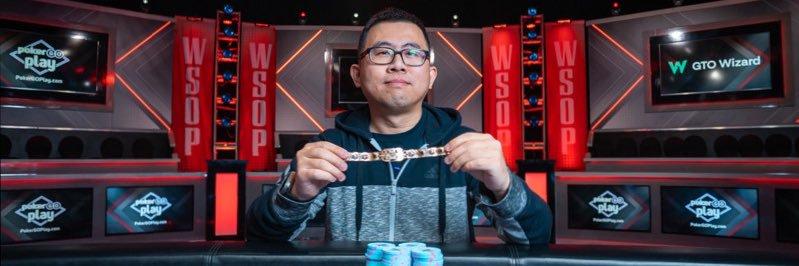
@cavincasino@cavincasino 👋 could you please let me know if I am eligible for WSOP TOC 2025? I won TOC 2024 yet my name is not on https://t.co/3tcLhm1cvq
This is just in: Google Cloud A4X VMs are in preview, and general availability is coming soon!
A4X VMs, powered by @nvidia GB200 GPUs, have achieved 860,000 tokens/sec of inference performance on a full NVL72 running Llama 2 70b. Learn more → https://t.co/fGIILFYM7k
"Introducing Multimodal Llama 3.2": As promised two weeks ago, here's the short course on Meta's latest open model!
This short course is created with @Meta and taught by @asangani7, Director of AI Partner Engineering at Meta.
Meta’s Llama family of models is leading the way in open models, allowing anyone to download, customize, fine-tune, or build new applications on top of them.
Learn about the vision capabilities of the Llama 3.2, and use it for image classification, prompting, tokenization, tool-calling. You'll also learn about the open-source Llama stack, which gives building blocks for many different stages of the LLM application life cycle.
In detail, you’ll:
- Learn what are the features of Meta's four newest models, and when to use which Llama model.
- Learn best practices for multimodal prompting, with applications to advanced image reasoning, illustrated by many examples: Understanding errors on a car dashboard, adding up the total of photographed restaurant receipts, grading written math homework.
- Use different roles—system, user, assistant, ipython—in the Llama 3.1 and 3.2 models and the prompt format that identifies those roles.
- Understand how Llama uses the tiktoken tokenizer, and how it has expanded to a 128k vocabulary size that improves encoding efficiency and multilingual support.
- Learn how to prompt Llama to call built-in and custom tools (functions) with examples for web search and solving math equations.
- Learn about Llama Stack, a standardized interface for common toolchain components like fine-tuning or synthetic data generation, useful for building agentic applications.
By the end of this course, you’ll be equipped to build out new applications with the new Llama 3.2.
Thank you to @Ahmad_Al_Dahle, Amit Sangani, and the whole AI at Meta team @AIatMeta for all the hard work on Llama 3.2 — we’re excited to make these open models even more accessible to more developers with this new course!
Please sign up here! https://t.co/Flp5Ae9apy
After a recent price reduction by OpenAI, GPT-4o tokens now cost $4 per million tokens (using a blended rate that assumes 80% input and 20% output tokens). GPT-4 cost $36 per million tokens at its initial release in March 2023. This price reduction over 17 months corresponds to about a 79% drop in price per year. (4/36 = (1 - p)^{17/12})
As you can see, token prices are falling rapidly! One force that’s driving prices down is the release of open weights models such as Llama 3.1. If API providers, including startups Anyscale, Fireworks, Together AI, and some large cloud companies, do not have to worry about recouping the cost of developing a model, they can compete directly on price and a few other factors such as speed.
Further, hardware innovations by companies such as Groq (a leading player in fast token generation), Samba Nova (which serves Llama 3.1 405B tokens at an impressive 114 tokens per second), and wafer-scale computation startup Cerebras (which just announced a new offering this week), as well as the semiconductor giants NVIDIA, AMD, Intel, and Qualcomm, will drive further price cuts.
When building applications, I find it useful to design to where the technology is going rather than only where it has been. Based on the technology roadmaps of multiple software and hardware companies — which include improved semiconductors, smaller models, and algorithmic innovation in inference architectures — I’m confident that token prices will continue to fall rapidly.
This means that even if you build an agentic workload that isn’t entirely economical, falling token prices might make it economical at some point. As I wrote previously, being able to process many tokens is particularly important for agentic workloads, which must call a model many times before generating a result. Further, even agentic workloads are already quite affordable for many applications. Let's say you build an application to assist a human worker, and it uses 100 tokens per second continuously: At $4/million tokens, you'd be spending only $1.44/hour – which is significantly lower than the minimum wage in the U.S. and many other countries.
So how can AI companies prepare?
- First, I continue to hear from teams that are surprised to find out how cheap LLM usage is when they actually work through cost calculations. For many applications, it isn’t worth too much effort to optimize the cost. So first and foremost, I advise teams to focus on building a useful application rather than on optimizing LLM costs.
- Second, even if an application is marginally too expensive to run today, it may be worth deploying in anticipation of lower prices.
- Finally, as new models get released, it might be worthwhile to periodically examine an application to decide whether to switch to a new model either from the same provider (such as switching from GPT-4 to the latest GPT-4o-2024-08-06) or a different provider, to take advantage of falling prices and/or increased capabilities.
Because multiple providers now host Llama 3.1 and other open-weight models, if you use one of these models, it might be possible to switch between providers without too much testing (though implementation details — specifically quantization, does mean that different offerings of the model do differ in performance). When switching between models, unfortunately, a major barrier is still the difficulty of implementing evals, so carrying out regression testing to make sure your application will still perform after you swap in a new model can be challenging. However, as the science of carrying out evals improves, I’m optimistic that this will become easier.
[Original text (with links): https://t.co/txk7q32EXn ]