In conversation with Vuk Ćosić (@supperman) for SLEEK
The Internet After Failed Utopias
AM What are your thoughts when you hear a new generation of artists saying, »We’re going to democratize the art world. We don’t need gatekeepers. We don’t need institutions«?
VC It’s a little sad because I literally recognize sentences from our manifestos or posts written in the middle of the night, and I see them again today, as if we were speaking about the same utopian possibilities. I don’t buy it.
That rhetoric was abused by network speculation, especially by NFT people. The rhetoric of liberation, zero gatekeepers, or disintermediation was captured by the crypto crowd because they have a use for an active, participating audience of creators. NFT artists are slightly trapped by that rhetoric. It’s not their text. It’s the text of the Bitcoin people, or blockchain people in general.
But if there are kids out there who believe in it, and they generate work while believing in it and trying to make it happen, then it may be good. Maybe it’s like a useful psychosis.
Last call for DWeb Camp CFP 🌱
Submissions close in a few hours, and this year’s “Root Systems” theme explores resilient infrastructure, community networks, local-first systems, & more.
Open to builders, artists, organizers, researchers, and dreamers alike.
Read on for info👇
Submit your proposal for @GETDWeb Camp in July! 🏕️ Bring your ideas to a forest full of conversations on sustainability, decentralized design, privacy, local-first systems, censorship resistance, resilience & more! See you at camp?
Submissions close in a few hours! Hurry up! 🚀
didn’t we get into nfts in the first place so we wouldn’t have to worry about art fairs and now all we do is worry about art fairs and make sure not to mention nfts?
@LeemoXD@DiegoTristain Would hyperbridge share its revenue with Polkadot/Treasury in case of success ? I think everyone knows the answer.
"Socializing losses, privatizing profits". Are we again in 2008?
Crypto and bridges are risking products, asses your risk appetite when investing.
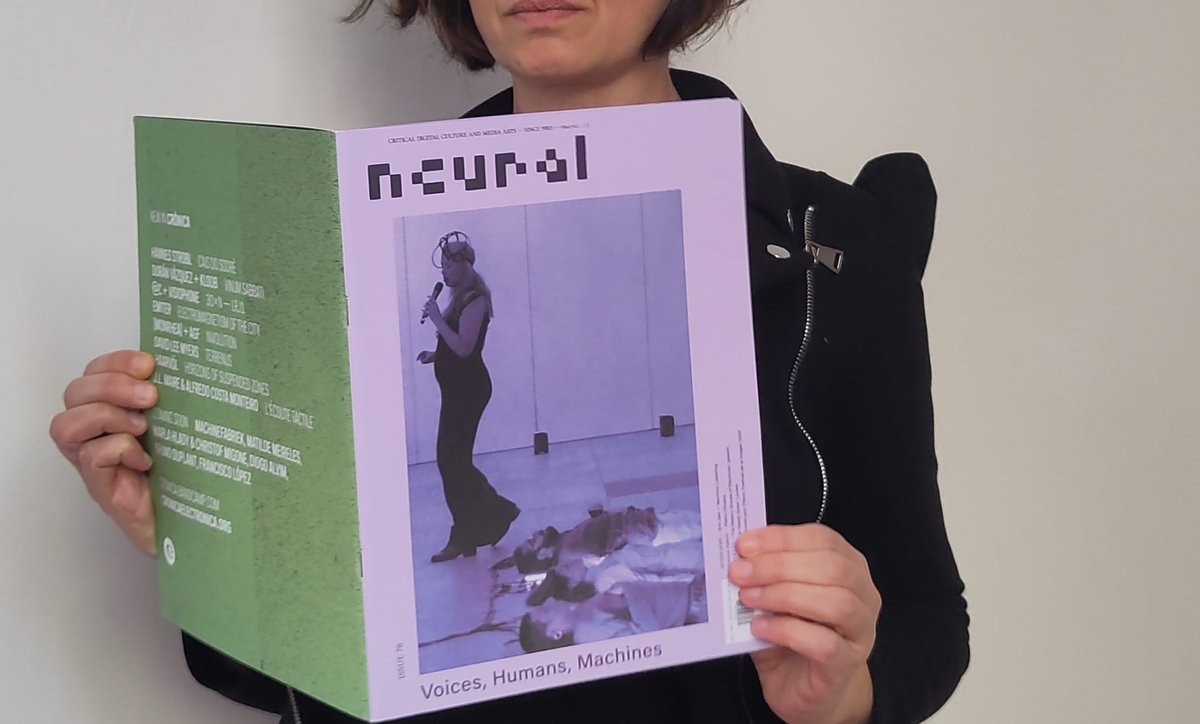
New Neural issue #78 Voices, Humans, Machines is hot from the press + extra: the artist’s poster “VOICE_ERASE.PY” by @robinrimbaud – Scanner, and the catalogue of the Sussurra Luce sound art festival
> https://t.co/rolUmkGjqN
#neuralmagazine#digitalcultures
@redbeardnft@kdean Five years ago, the NFT space set out to build a new art world, one without gatekeepers and separate from the established art world.
The goal was to create an alternative system, as the NFT space viewed the traditional art world as broken.
What happened to that revolution? 😅
In a world of total surveillance, Steyerl explores the political potential of being invisible or becoming a 'poor image'.
In our work, we constantly seek to disappear, moving the subject's individuality away from the center point.
🟩🟩🟩🟩🟩🟩🟩🟩🟩🟩🟩
@byteboro i have developed an app of a very niche business model in 6 weeks, when before I stimated one year of work. I only go down to the code when i need to save tokens, the rest is in the bot
For people who know what they want is great tool, for compulsive ticket closers is hard times
@jlhortelano Eso es porque a la gente que le gusta programar le interesa resolver problemas de maquinas. A mi me interesa una aplicacion que funcione y listo. Yo se muy bien lo que quiero, asi que herramientas tipo Claude son perfectas.
La unica pega que tienen, es saber cuando parar.
when people say artists need to work with emerging technology more in order to be relevant, it's not a controversial new take. it's an old take, literally an ancient take
for most of human history painting was the state of the art of image-making technology
Over the past year, many people I talk to have expressed worry about two topics:
* Various aspects of the way the world is going: government control and surveillance, wars, corporate power and surveillance, tech enshittification / corposlop, social media becoming a memetic warzone, AI and how it interplays with all of the above...
* The brute reality that Ethereum seems to be absent from meaningfully improving the lives of people subject to these things, even on the dimensions we deeply care about (eg. freedom, privacy, security of digital life, community self-organization)
It is easy to bond over the first, to commiserate over the fact that beauty and good in the world seems to be receding and darkness advancing, and uncaring powerful people in high places are making this happen. But ultimately, it is easy to acknowledge problems, the hard thing is actually shining a light forward, coming up with a concrete plan that makes the situation better.
The second has been weighing heavily on my mind, and on the minds of many of our brightest and most idealistic Ethereans. I personally never felt any upset or fear when political memecoins went on Solana, or various zero-sum gambling applications go on whatever 250 millisecond block chain strikes their fancy. But it *does* weigh on me that, through all of the various low-grade online memetic wars, international overreaches of corporate and government power, and other issues of the last few years, Ethereum has been playing a very limited role in making people's lives better. What *are* the liberating technologies? Starlink is the most obvious one. Locally-running open-weights LLMs are another. Signal is a third. Community Notes is a fourth, tackling the problem from a different angle.
One response is to say "stop dreaming big, we need to hunker down and accept that finance is our lane and laser-focus on that". But this is ultimately hollow. Financial freedom and security is critical. But it seems obvious that, while adding a perfectly free and open and sovereign and debasement-proof financial system would fix some things, but it would leave the bulk of our deep worries about the world unaddressed. It's okay for individuals to laser-focus on finance, but we need to be part of some greater whole that has things to say about the other problems too.
At the same time, Ethereum cannot fix the world. Ethereum is the "wrong-shaped tool" for that: beyond a certain point, "fixing the world" implies a form of power projection that is more like a centralized political entity than like a decentralized technology community.
So what can we do? I think that we in Ethereum should conceptualize ourselves as being part of an ecosystem building "sanctuary technologies": free open-source technologies that let people live, work, talk to each other, manage risk and build wealth, and collaborate on shared goals, in a way that optimizes for robustness to outside pressures.
The goal is not to remake the world in Ethereum's image, where all finance is disintermediated, all governance happens through DAOs, and everyone gets a blockchain-based UBI delivered straight to their social-recovery wallet. The goal is the opposite: it's de-totalization. It's to reduce the stakes of the war in heaven by preventing the winner from having total victory (ie. total control over other human beings), and preventing the loser from suffering total defeat. To create digital islands of stability in a chaotic era. To enable interdependence that cannot be weaponized.
Ethereum's role is to create "digital space" where different entities can cooperate and interact. Communications channels enable interaction, but communication channels are not "space": they do not let you create single unique objects that canonically represent some social arrangement that changes over time. Money is one important example. Multisigs that can change their members, showing persistence exceeding that of any one person or one public key, are another. Various market and governance structures are a third. There are more.
I think now is the time to double down, with greater clarity. Do not try to be Apple or Google, seeing crypto as a tech sector that enables efficiency or shininess. Instead, build our part of the sanctuary tech ecosystem - the "shared digital space with no owner" that enables both open finance and much more. More actively build toward a full-stack ecosystem: both upward to the wallet and application layer (incl AI as interface) and downward to the OS, hardware, even physical/bio security levels.
Ultimately, tech is worthless without users. But look for users, both individual and institutional, for whom sanctuary tech is exactly the thing they need. Optimize payments, defi, decentralized social, and other applications precisely for those users, and those goals, which centralized tech will not serve. We have many allies, including many outside of "crypto". It's time we work together with an open mind and move forward.
Join @Merzmensch and me tomorrow when we perform human poems about machines and machine's poems about humanity-
diving deep into the history of cryptopoetry!