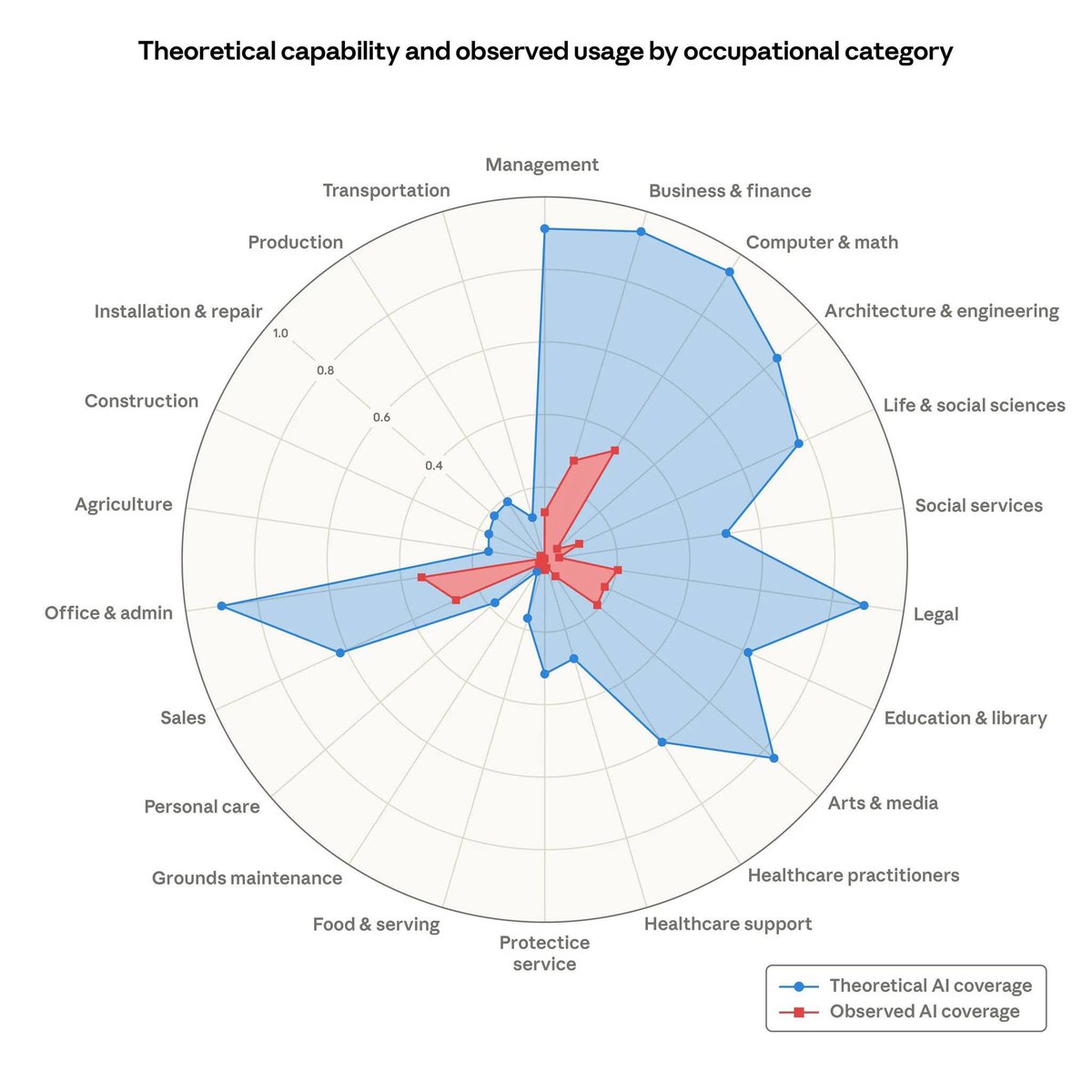
Es curioso porque los mismos que dicen que los partidos los ganan los delanteros están muy preocupados porque si no juegan los defensas les meten diez goles y pierden.
Los partidos los ganan los defensas. Los delanteros se llevan la gloria.
Anthropic, la empresa que creó Claude, acaba de comprar una biotech que tenía un solo empleado.
Se llama Mithril Medicine y la fundó hace 18 meses Cody Tranbarger, que empezó como analista en Goldman Sachs y estudió biotecnología y MBA en Harvard. Su objetivo es un anticuerpo para la distrofia muscular congénita LAMA2, una enfermedad rara que aparece en bebés y niños. No tenía laboratorio propio. Tenía ocho consultores a tiempo parcial, 11 laboratorios externos y a Claude coordinando contratos, logística y experimentos. En menos de año y medio pasó de una idea a resultados prometedores en ratones, y Anthropic espera que pueda llegar a ensayos en humanos a finales de 2028.
¿Por qué importa tanto? Porque hasta ahora desarrollar un fármaco exigía equipos enormes y muchísimo capital, y una enfermedad con pocos pacientes casi nunca justificaba ese gasto. Por eso hay miles de enfermedades raras huérfanas, sin nadie que investigue para ellas. Si una persona con IA puede llevar adelante un programa entero, eso cambia.
Cuando fundé Viatel y Jazztel, para llegar a cualquier cosa necesitabas mucho dinero y mucha gente. Hoy trabajo cada día con agentes de IA, y en Certuma vemos cómo un equipo pequeño hace lo que antes pedía una empresa entera. Mérito de Cody por animarse a probarlo primero, y con niños enfermos como objetivo.
La próxima gran biotech quizás tenga un solo empleado.
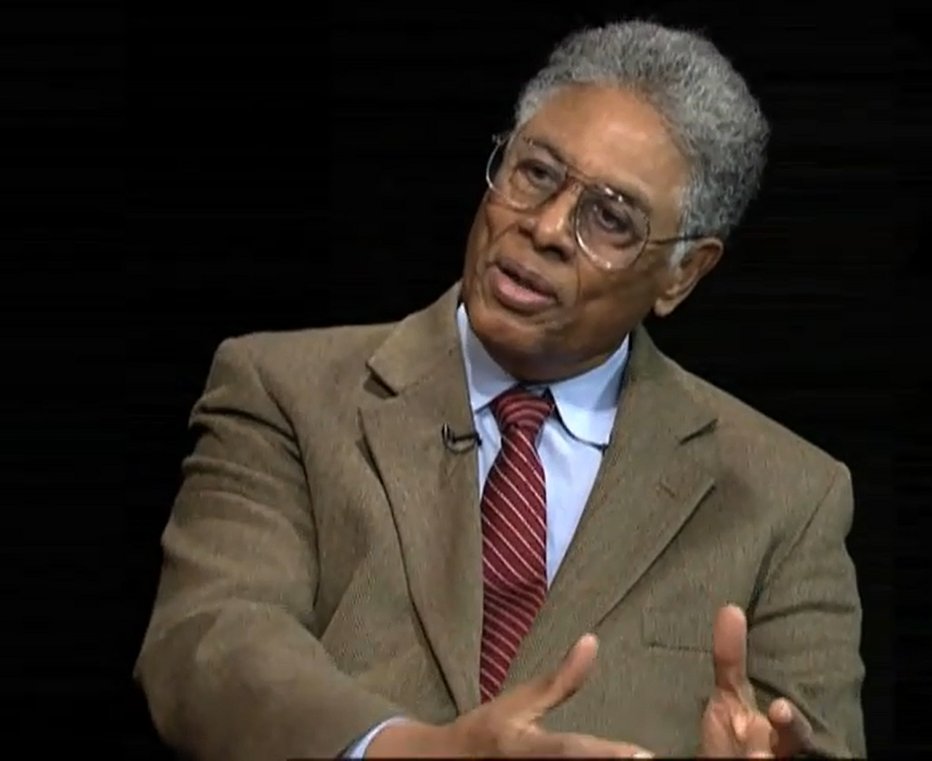
"Hay que entender que los políticos no están tratando de resolver nuestros problemas. Están tratando de resolver sus propios problemas, de los cuales ser elegido y reelegido son el problema número 1 y 2. Lo que sea el número 3 está muy atrás"
T. Sowell
Hace 30 años, España destinaba del presupuesto un 7,5% a infraestructura y mantenimiento, hoy destina un 3,9%, se ha reducido su peso en casi un 50%.
En el mismo tiempo la partida de pensiones ha aumentado un 33%
this is so embarrassing. here, spain's ruling party (the socialist party, PSOE) is boasting that the social security reserve fund ("la hucha de las pensiones") has grown from €5bn in 2018 to €20bn in 2026. that would be good news if it wasn't for the fact that the pension system has been running a deficit since 2010, so every euro that goes into the fund is a euro the state has to cover with taxes or debt!
the fund was established in the late 1990s with the idea of storing the system's surpluses in good years to then draw on them when contributions fall short in bad years. it peaked at around €67bn in 2011 (about €85bn in today's euros, or 6.2% of gdp). then the crisis hit, the system went into deficit, and between 2012 and 2019 governments used the fund to pay pensions, which is (surprise) precisely what it was designed for. so this is what the picture is telling you: on the left, the popular party (PP), which left office in 2018 having drawn down a large part of the fund. on the right, the PSOE, taking credit for having refilled it. the problem is that today the size of the fund tells you nothing about the health of the system, and selling its recent growth as an achievement only works if you assume people are stupid
spain has a contributory, fully pay-as-you-go pension system: the social contributions of today's workers pay for the pensions of today's retirees, and what you pay in is not saved for you anywhere. since 2010 the system has run a contributory deficit, meaning the contributions being paid into the system are not enough to pay the pensions of current retirees. the exact size of this deficit depends on how you measure it (what counts as contributory revenue and spending is a bit of a technical discussion), but roughly speaking, contributions cover about three quarters of contributory spending (which is mostly pensions). the remaining quarter is the deficit: more than €60bn a year, around 3.8% of gdp, covered mostly with transfers and loans from the state, that is, with general taxes and debt. social security already owes the state more than €135bn
so where the hell does the recovery of the reserve fund come from? since 2023 workers have been paying an extra social contribution, the so-called intergenerational equity mechanism (MEI, after its spanish initials). it is an earmarked contribution that generates no pension rights (that is, paying it does not add a single euro to your future old-age pension). by law, its revenue can only go straight into the reserve fund, which cannot use it to pay pensions before 2033
now, we've already established that the system runs a contributory deficit, so every year it needs transfers and loans from the state just to pay pensions. do you see how stupid this is? if the system is running a deficit, putting the MEI money into the reserve fund is like having credit card debt and, when some extra money comes in, putting it in a savings account instead of paying down the card. meanwhile, you keep putting your bills on the card, the debt keeps growing, and you go around showing everyone your savings balance. that is pretty much what is happening: since the end of 2022 the fund has grown by about €12bn, while social security's debt to the state has grown by about €30bn. and it gets more absurd, because the fund invests almost all of its money in spanish government bonds (in other words, the state is lending money to itself)
anyone who can do basic maths can see this isn't saving under any reasonable definition of the term. the system can't pay the pension bill without the state bailing it out every year, and the governing party's big idea is to celebrate that it has taxed workers to lend money to itself. it is honestly sad that this is the level of spanish politics
The problem isn’t salaries, it’s the business climate.
🇨🇭 Economic freedom: 2nd in the world
🇪🇸 Economic freedom: 53rd
🇨🇭 Corporate tax: 14%
🇪🇸 Corporate tax: 25%
🇨🇭 VAT: 8.1%
🇪🇸 VAT: 21%
🇨🇭 Social contributions: ~13%
🇪🇸 Social contributions: ~36%
Wages don’t fall from the sky.
They come from companies that can start, grow and compete without taxes and paperwork killing them.
And by growing high-margin, sophisticated industries instead of relying on tourism.
How has the Spanish economy performed over the very long run?
To answer, I use Leandro Prados de la Escosura’s (@LdelaEscosura) data on real GDP per capita from 1277 to 2024. I express Spain’s figure as a ratio to Britain’s, since Britain was the first economy to achieve modern economic growth, from around 1660, and has been the leader, or close to it, ever since.
Spain, within its present borders, was prosperous in the Late Middle Ages, well ahead of Britain, then a peripheral corner of Europe. The Black Death and its aftermath hit Spain harder, and by 1360, the two economies had converged.
That parity held until 1600, when Spain began a long decline, in absolute terms (on the eve of the French Revolution, it was barely above its 1600 level, after a deep slump in between) and in relative terms (Britain pulled steadily away). The standard explanations, the Habsburg wars, and the serial bankruptcies run into one problem. They can account for the poor performance between 1550 and 1650, but not for the stagnation between 1650 and 1789. 140 years of stagnation is far more than wars and debt under the Habsburgs can explain.
The series also shows that Spain did not benefit from its empire. That is a problem for every theory tying colonies to modern growth. At most, one can argue that colonies were a necessary condition for takeoff (I do not believe even that, but leave it for another day). One cannot argue that they were sufficient.
The period from 1789 to 1936 was no kinder. The economy grew a little, and Spain built a modern but unfinished liberal state. Yet it never closed the distance to Britain. It is hard not to read the period from 1789 to 1936 as a national failure and the Civil War as its final consequence.
The recent efforts of some historians to paint those years in brighter colors strike me as unfounded. Spain did not fail at modernization as badly as China, but it did not succeed. A deeply corrupt dynasty, closed and incompetent elites in Madrid, Barcelona, and Bilbao, and an economic policy built on intervention and protection (by 1920, Spain was the most protectionist economy in the Western world, so much for the friends of protection) together made the country a basket case.
A cruel civil war left Spain at its historical low, with just 31% of the British GDP per capita. The foreign visitors who arrived in the early 1950s found a poor, backward country.
Policy in the first twenty years of the dictatorship was awful. Autarky was not so much imposed by the Allies as chosen. Spain’s rulers, using their quasi-fascist Weltanschauung, believed growth would come from state intervention, closed markets, and unorthodox fiscal and monetary policy.
Then, in 1959, policy changed. Spain adopted a more orthodox fiscal and monetary policy and opened to foreign investment and trade. The results were spectacular. For forty years, Spain grew briskly and became the modern country it is today. By 2001, it had reached 77% of British GDP per head.
But the internal contradictions of two things eventually became binding: the growth model launched in 1959, and the political regime created by the 1978 constitution. By 2024, Spain had slipped back to 74% of British GDP per head. This is worse than it looks. Britain itself has done poorly over the past twenty years, and losing ground to a weak performer is a bad sign.
Spain stands at a crossroads, economic and political. The country’s foundations no longer work, but its political and business elites have failed to understand this fundamental reality. A good grasp of its economic history helps make sense of its present predicament.
Es vergonzoso ser español cuando uno comprueba lo que ya sospecha desde hace tiempo: un antiguo presidente del gobierno involucrado en casos de corrupción sistemática junto a dictaduras crueles. Que más adelante un juez pueda determinar que la evidencia está probada más allá de toda duda razonable (un criterio muy estricto) es muy diferente de la clara acumulación de evidencia que ya tenemos sobre la mesa.
Pero si esto fuera un caso aislado de corrupción, la vergüenza podría sobrellevarse. Lo preocupante es que forma parte de un patrón sistemático. Zapatero fue presidente del gobierno bajo Juan Carlos I, quien tuvo que abdicar por casos de corrupción intolerables (corrupción que, por otra parte, ha sido constante e invariable en la dinastía Borbón en España desde la regencia de María Cristina de Borbón).
Y a Zapatero le sucedió Rajoy, sí, el Rajoy de “Luis, sé fuerte”. IU y su espacio (como se llame esa semana) tampoco se han librado de estos problemas cuando han tenido pequeños resortes de poder. Moral Santín es el caso más claro.
Y en Cataluña vimos que la antigua CiU y la familia Pujol eran una mafia. El único sitio donde el sistema no ha generado escándalos vergonzosos es el País Vasco, aunque uno sospecha que es más bien consecuencia de la ausencia práctica de libertad de expresión que de su ausencia real.
En otras palabras: los españoles hemos visto cómo la Monarquía, el PSOE, el PP, IU y los grandes partidos nacionalistas han vulnerado de manera sistemática todo tipo de normas éticas y penales.
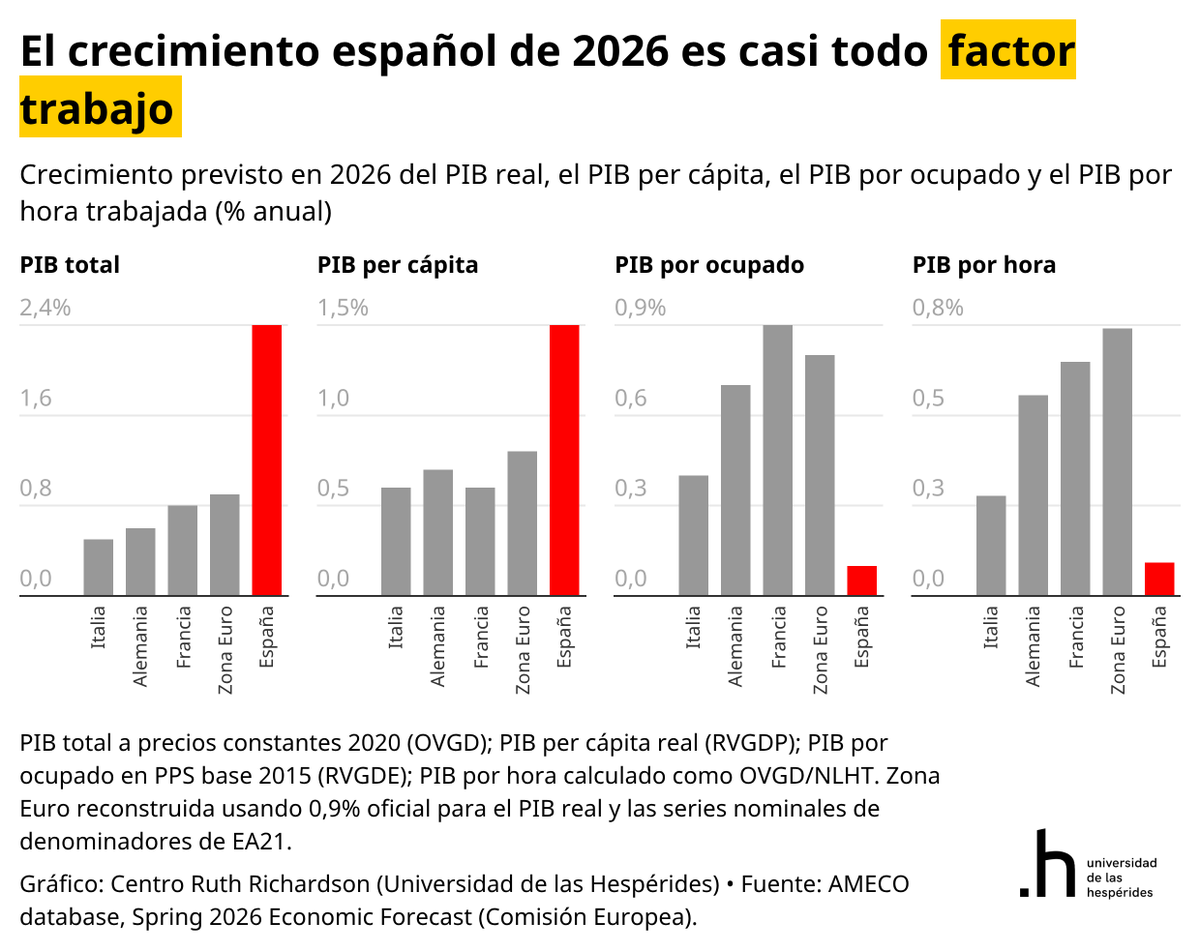
Mientras tanto, los salarios están estancados, la vivienda está por las nubes, la seguridad social está en una situación límite y la prosperidad actual es un espejismo empujado por una inmigración no sostenible que solo traerá problemas profundos a largo plazo (la figura de @SantiCalvo_Eco lo dice todo).
Quizás sea el momento de aceptar que esto no se arregla cambiando a quien gobierna, sino cambiando las reglas que hacen que casi dé igual quién lo haga.
Hacienda acaba de publicar los datos salariales de 2024.
Acompáñenme a ver la España REAL y la historia que nos cuenta, la historia de un país de TRABAJADORES POBRES.
Hilo va 🧵
Este estudio evidencia que al transferir microbiota intestinal de personas con depresión a ratas, estas desarrollan conductas depresivas. Estamos frente a una evidencia del eje intestino-cerebro y de cómo la biología, la inflamación y el metabolismo influyen en la salud mental.
Spanish PLD Space has secured an additional €180m investment to scale its industrial and launch capabilities. 🇪🇺
Their rocket, MIURA 5 is on track for the first test flight in 2026. With launch cadence expected to reach 30 annually by 2030.
German Chancellor Merz:
We are simply no longer productive enough. Each individual may say, “I already do quite a lot.” And that may be true.
But when you return from China, ladies and gentlemen, you see things more clearly.
With work-life balance and a four-day week, long-term prosperity in our country cannot be maintained. We will simply have to do a bit more.
Contrariamente a lo que se afirma insensatamente con frecuencia, un sistema público de pensiones contributivas de reparto no es una estafa piramidal.
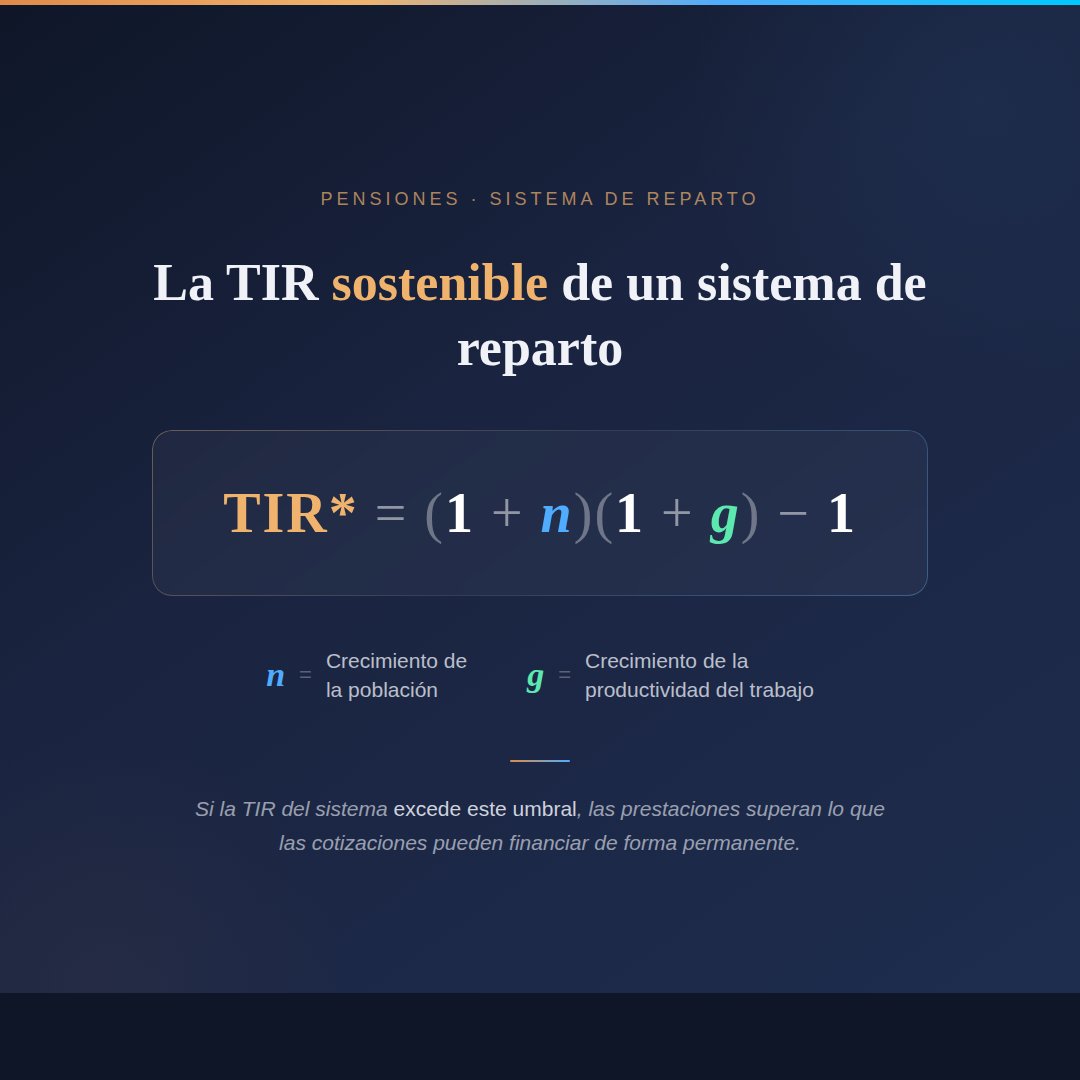
Todo sistema de reparto se caracteriza por una tasa interna de retorno (TIR), que es la tasa de descuento que iguala, en valor presente, las cotizaciones de los trabajadores con las prestaciones que reciben (todas las cifras de este post están en términos reales, es decir, ya descontada la inflación). Esta TIR puede ser la media del sistema (para todos los trabajadores) o individual (en la que se emplea el valor actuarial esperado, que considera las posibilidades de supervivencia).
Aunque un sistema de reparto no capitaliza las cotizaciones, esta TIR es un valor contable fundamental para determinar la sostenibilidad del sistema. Un sistema es sostenible si la TIR es igual al crecimiento de los ingresos del sistema, que, a largo plazo, es aproximadamente igual al crecimiento del PIB (factores como un cambio en la participación de los salarios en la renta nacional no cambian la TIR sostenible a largo plazo; solo generan transiciones temporales).
El problema del sistema público de pensiones en España es, por tanto, que su TIR es excesivamente alta: es de aproximadamente 5,7% anual, frente a un crecimiento medio del PIB desde 1990 del 2,1%. Esta diferencia de 3,6% es la que hace que la pensión media en España tenga hoy un valor entre un 45% y un 60% por encima de lo que las cotizaciones de la persona que la recibe justificarían. Cuando los pensionistas dicen que “solo estoy recibiendo lo que pagué con mis cotizaciones”, se equivocan: están recibiendo entre un 45% y un 60% más.
Por supuesto, se puede argumentar que un sistema de pensiones no tiene por qué ser contributivo y que la TIR del sistema puede estar por encima de la TIR sostenible. Pero eso implica querer distribuir por edad, no por renta, riqueza o necesidad familiar y, personalmente, no creo que tenga sentido alguno en un Estado del bienestar.
Pero lo importante para nosotros es que, siempre que la TIR del sistema sea coherente con el crecimiento conjunto de la población y de las cotizaciones, el sistema puede ser sostenible de manera indefinida, algo que, por definición, no ocurre en los esquemas de Ponzi o en estafas piramidales, que terminan quebrando.
El argumento según el cual el sistema solo se sostiene gracias a la llegada de nuevas generaciones y que, por tanto, sería un esquema de Ponzi, es esencialmente vacío. Un sistema de capitalización también requiere que las inversiones de sus partícipes generen rendimientos positivos a lo largo del tiempo. Pero esos rendimientos solo son posibles si la economía incorpora nuevos trabajadores que mantienen la actividad productiva y hacen viables los beneficios empresariales y los retornos del capital.
En un escenario extremo de desaparición total de las nuevas generaciones, ni un sistema de reparto ni un sistema de capitalización podrían funcionar, sencillamente porque no habría trabajadores que produjesen bienes y servicios (esto no quiere decir, claro, que no fuera buena idea contar con un pilar de capitalización en el sistema). Sería lo mismo que afirmar que las facultades de educación son una estafa piramidal porque necesitan de nuevos niños a quienes sus graduados enseñen como profesores
El debate sobre la sostenibilidad de las pensiones en España es crucial para nuestro futuro, y tan irresponsables y frívolos son los que argumentan que no hay problema alguno y que las pensiones son sostenibles, como los que califican el sistema de reparto de pensiones de estafa piramidal.
En ambos casos tenemos la combinación nefasta de ignorancia y demagogia: decir lo que sea para alcanzar los objetivos políticos personales de cada uno. La historia juzgará con dureza a todos estos personajes que se escudan detrás de la bandera del progresismo o de España para mentir a los españoles y poner en peligro a las generaciones futuras, a cambio de asegurarse un plato de lentejas que su pésima carrera profesional no les permite.
Y no, mentir o exagerar nunca es una buena idea “para llegar al gran público”. De la mentira y la demagogia, nunca ha surgido nada bueno.