@Novastro_xyz@DabbaNetwork This kind of partnership feels real infrastructure on the ground finally syncing with value onchain.
CCkpLYNWRTs4wyJVMXHUUVfGyAZZhcignSebiWxfhS3g
We’re partnering with @DabbaNetwork to bring real-world connectivity and on-chain yield closer together, expanding the Novastro ecosystem while accelerating DePIN adoption across new user segments.
@DabbaNetwork is building one of the most active DePIN networks today, with 85,000+ hotspots deployed in India with more than 250k+ active wifi users powering real broadband infrastructure on the ground.
Ahead of the $DBT token launch via the LIVE BONK launchpad, Dabba is running a lossless Loot Box campaign with rewards from top DePIN, NFT, AI, and memecoin partners, including Novastro.
How to Join
✅ Follow @Novastro_xyz and @DabbaNetwork
✅ Like + RT this post
✅ Comment your Solana address
✅ Visit Dabba Loot: https://t.co/FoVG8NNCuZ
Note
1 ticket pass = 1 USD guaranteed DBT + other surprises
More boxes = more chances to win
Runs for 6 days starting 12 Jan
Snapshot on 17 Jan, 1PM UTC
Rewards: 50 winners to split 1,000 Dabba Loot Passes ($1,000 worth) — each winner receives 20 Loot Passes.
Friendly reminder that the world exists 🌍
Go outside, snap a photo, and you could win $100 in BNB. (10 winners.)
To join:
🔸 Follow @binance + RT this post
🔸 Comment below with your outdoor photo
🔸 Submit your entry 👉 https://t.co/mzHIw75PqF
Activity period: now until Feb 1, 23:59 UTC
Alipay’s Layer 2 Is the Most Bullish Signal for Ethereum Yet
Alipay, the world’s largest fintech app with over a billion users, has launched Jovay, a Layer 2 blockchain built on Ethereum.
This isn’t another startup experiment. It’s a signal that the next phase of global finance is being built on Ethereum rails.
Alipay is the payments arm of Ant Group, the fintech giant born from Alibaba.
They process trillions of dollars in payments each year, serve over a billion users, and operate one of the world’s most advanced digital finance ecosystems.
In China, Alipay isn’t an app; it’s an infrastructure layer for daily life, payments, loans, insurance, identity, mobility, and more.
And now, Ant Group is taking that infrastructure onchain.
@JovayNetwork is an Ethereum Layer 2 developed by Ant Digital Technologies, the enterprise blockchain arm of Ant Group.
According to its description, Jovay focuses on tokenizing real-world assets (RWAs), enabling instant, low-cost transactions, and integrating cross-chain value flows with institutional-grade security.
In simpler terms: Jovay is the infrastructure layer where regulated assets meet open blockchains.
Ant Group could have built on anything.
They could have gone private chain, built their own stack, or used a permissioned network.
Instead, they chose Ethereum, the most decentralized, secure, and composable settlement layer in the world.
That decision isn’t technical; it’s ideological. It means the largest fintech in the world now trusts Ethereum’s architecture to host real financial assets.
This is the first time we’re seeing a trillion-dollar fintech building directly on Ethereum infrastructure.
It means:
✦ Mainstream onboarding: Alipay users could soon interact with Ethereum-native assets without realizing it.
✦ RWA liquidity: Billions in tokenized invoices, supply chain assets, and digital bonds could flow into DeFi liquidity pools.
✦ Regulatory bridge: Jovay could serve as a compliant, high-trust interface between global capital markets and onchain ecosystems.
✦ Enterprise confidence: Ethereum has become the default trust layer for global institutions.
For years, critics said no major institutions would ever touch Ethereum.
And yet here we are, the world’s largest payment company is building its future on an Ethereum Layer 2.
This is what winning looks like, slowly and then all at once.
Billions of users won’t “enter crypto” through speculation.
They’ll enter because their money, identity, and assets will simply exist on secure rails.
Jovay is the quiet start of that transition, where traditional finance stops competing with crypto and starts merging with it.
The next billion users won’t even know they’re on Ethereum.
But we will.
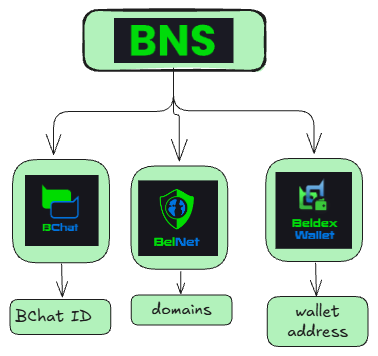
Beldex Name Service is more than a naming service, it is the human readable alternative for various addresses on the Beldex Blockchain.
BNS is a decentralized domain name system. at @BeldexCoin core it is integrated with all ecosystem tools
BNS is used as
- a stand-in for the BChat ID, such that users only need BNS name to connect with others and use the messaging service.
- a domain name system on BelNet. BNS domains are used as BelNet addresses.
- a stand-in for the beldex wallet address, such that the BNS name can be used to access wallet transactions.
Every new platform seems to ask for the same thing, another KYC
@idos_network fixes this.
One verification becomes reusable everywhere.
KYC once and access any stablecoin app on any chain while keeping your privacy preserved.
when I first got into crypto, I thought privacy was just about hiding transactions.
but over time I realized it’s so much bigger, it’s about conversations, the way we connect, even how we move across the internet.
that’s why @BeldexCoin stood out.
-chatting without eavesdroppers on BChat,
-browsing without trails on beldex browser,
-connections that aren’t owned by anyone with BelNet.
For me, that’s not tech hype. That’s peace of mind.