I'm pleased to invite @Wemby to our second Commission on Government Efficiency hearing on Wednesday June 10th 5-8pm, where we'll be asking the public for their thoughts on how government can run better. Would love to have you there for the whole time!
The Long Goodbye (1973) - 1:42:04
Dir. Robert Altman
Runtime 112 minutes
🚬 x 39, or one cigarette every 2.87 minutes
⚠️ REAL SMOKER MOVIE ⚠️
https://t.co/3oqF8g4Jbt
According to this graphic, MLB can measure distance down to 1.2 ten-billionths of an inch.
This is approximately 2.54 picometers
As 1 inch = 25.4 mm and 1 mm = 10^9 nm
1/12,000,000,000 inch ≈ 2.54 × 10^-12 meters = 2.54 pm
For some perspective, the diameter of an oxygen molecule is 292 pm, or 114.96 times larger than what MLB can supposedly measure with statcast.
A single oxygen atom, though, is only 59.84 times large than this supposed measurement.
Now, because I am a loser, and I hate being lied to, I have done some research...
To measure something that small, between 1–10 picometers, one would require either Atomic Force Microscopy or X-ray Crystallography, which, to the best of my knowledge, are used to study differences between cancer cells and healthy cells, create designer drugs, or improve materials for technology by revealing details about atoms and molecules.
More precisely, they would need something like Scanning Tunneling Microscopy, which can detect how much atoms wiggle. Again, using oxygen as our example, this is between 2-3 picometers—look at that! MLB's 2.54 pm accuracy falls right in there!
BUT here's the problem...
Statcast is fundamentally incapable of achieving measurements at the picometer scale, such as the implied 2.54 picometer example provided by MLB below.
Statcast relies on a combination of X-band Doppler radar (operating at 8-12 GHz with a wavelength of 25-37.5 mm) and high-speed stereoscopic cameras to track baseballs and players in real-time across the stadium. These systems are designed for macroscopic measurements, with a practical accuracy of about one inch (25.4 mm) for batted ball distances, though it is accurate down to about 0.1 inches (2.54 mm) on balls at the plate.
Regardless, the picometer scale (those decimals furthest to the right in the graphic) is roughly 10^10 times smaller than even Statcast’s best resolution.
In fact, measuring anything so small is pretty much impossible without the aforementioned technology and a stable, vacuum sealed lab with no air, absolute zero temperature (-452°F), and zero vibration.
...now, Atlanta isn't THAT bad... or was it, @Brent_Rooker25?
All of this, after all that wasted time and banked new, useless knowledge, just to say...
Oh, and my lawyer still says this stuff is my opinion.
The journey it took for you to get to where you was at and you really accomplished your goals of making it to the NFL, you really looked out for me. A true brother and all you wanted to do was see me succeed and vice versa always love slim❤️
The James Webb Space Telescope has started capturing images of galaxies so far away that they are causally disconnected from the Earth — nothing done here or there could ever interact. 🧵
1/
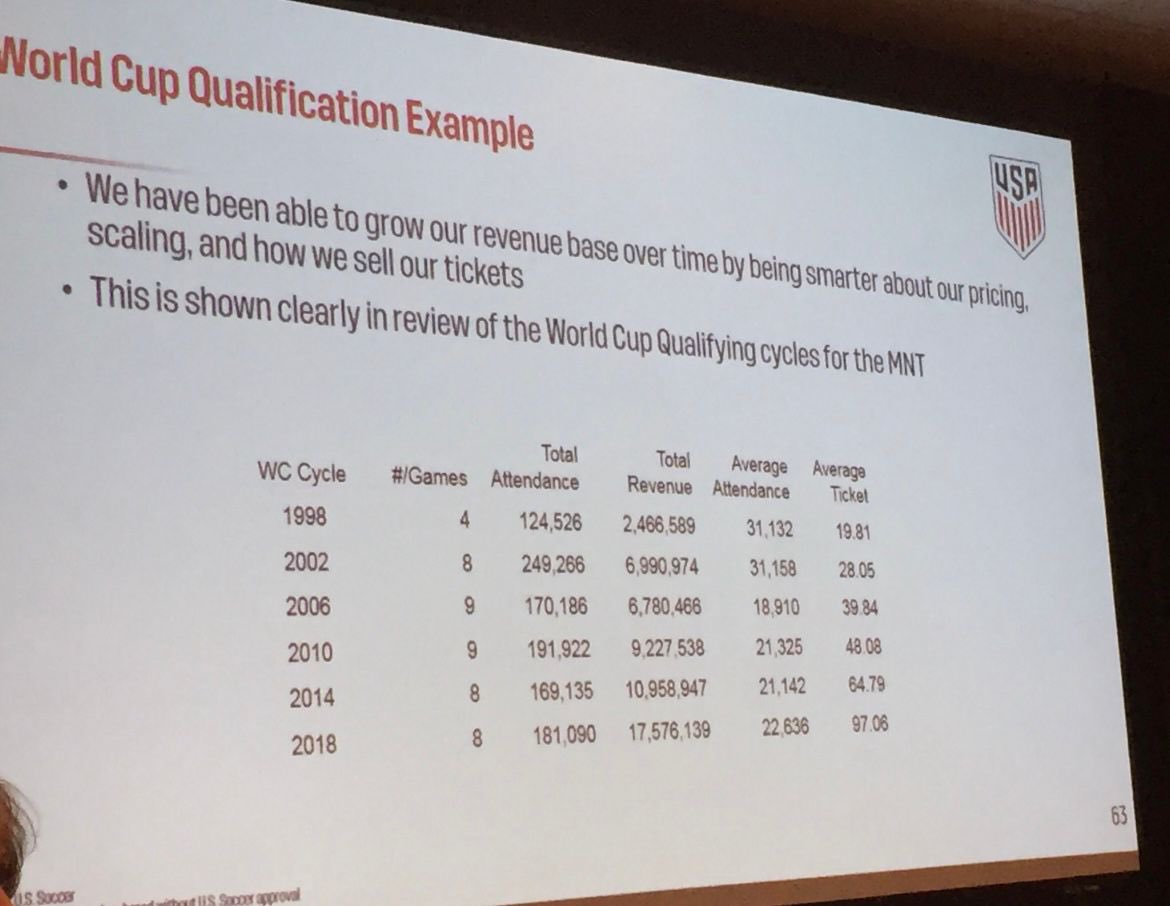
This is a presentation from the US Soccer Federation flexing their profit by multiplying ticket prizes by 5 within 20 years, giving 0 fucks that less people come to the stadiums now.
This federation sees ⚽️ purely as a money machine. Now you‘ll ask why not? They do this in Europe too and it works?
Well, in Europe the game grew for decades organically without big money. As a sport for everyone. That’s what created our huge fanbases. After that, big investors capitalized.
But in the US, they focus on profit before growing the game. ⚽️ will never be as big as they wish over there if that‘s their strategy.