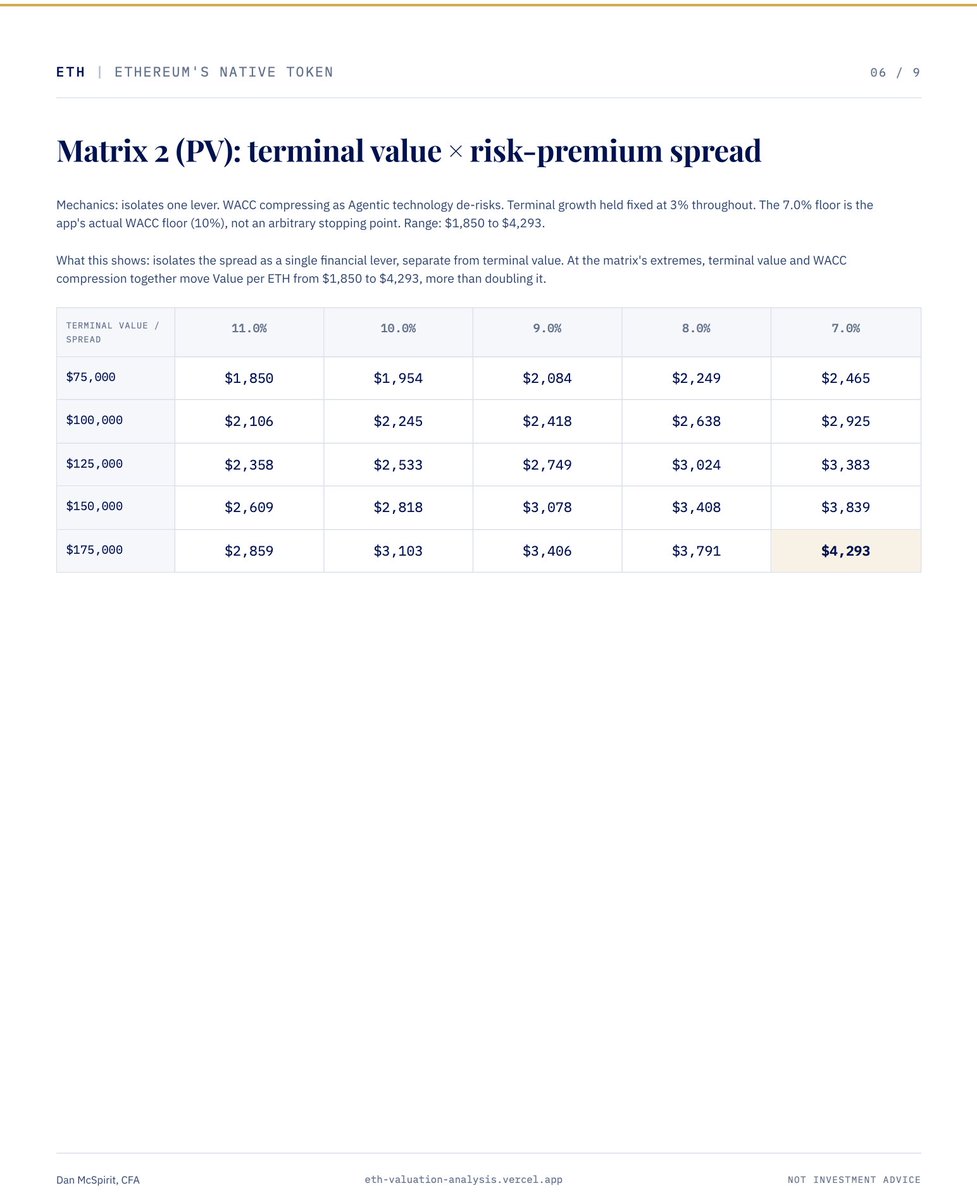
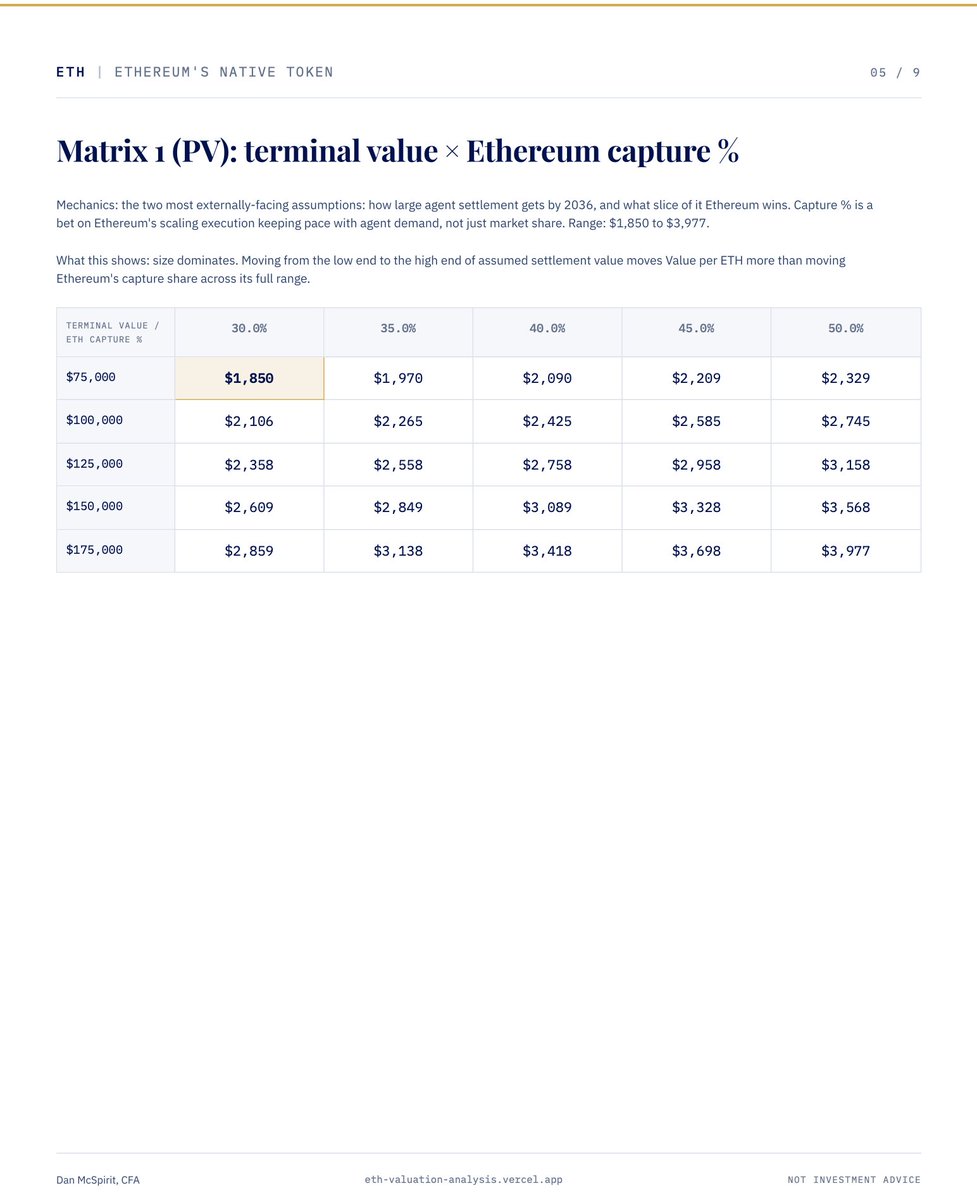
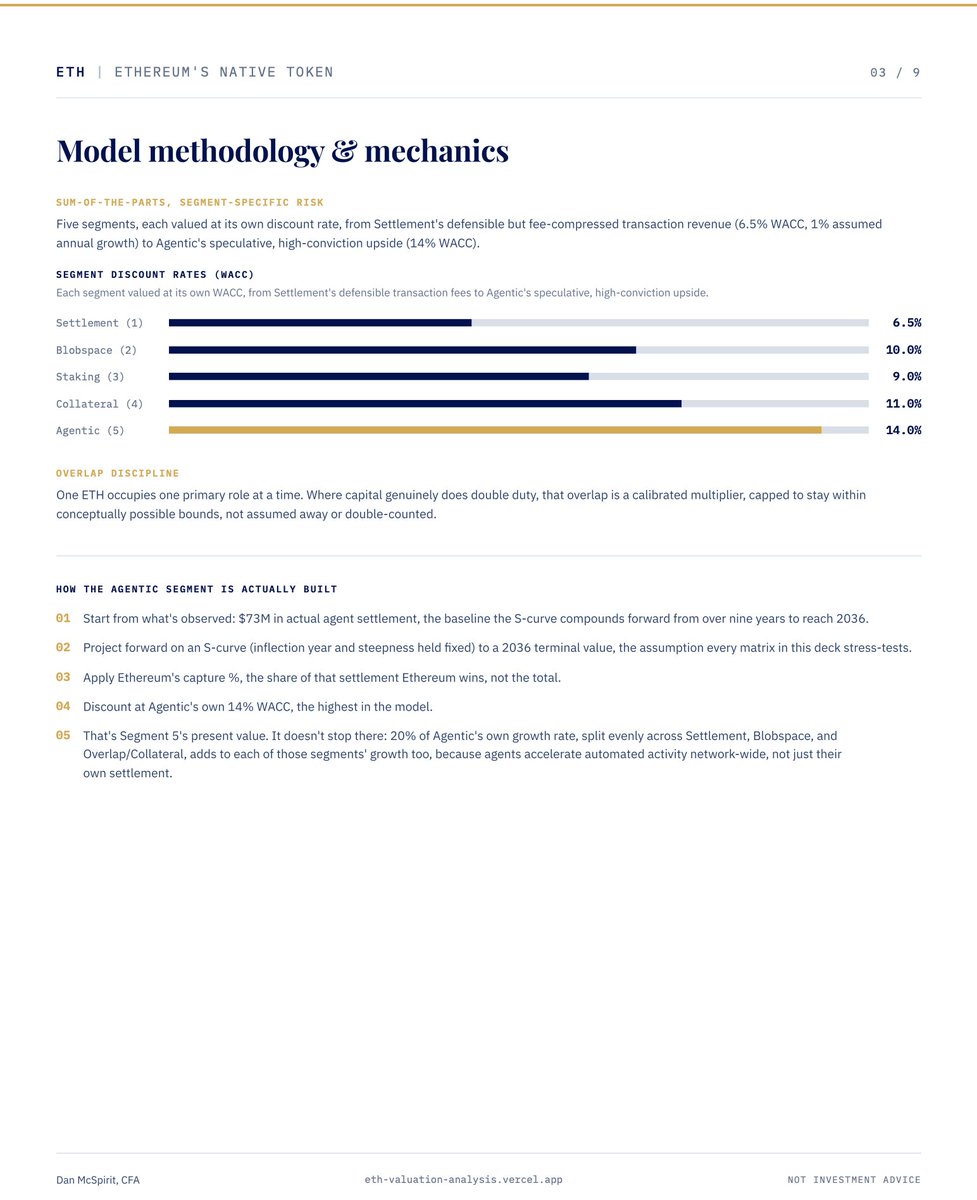
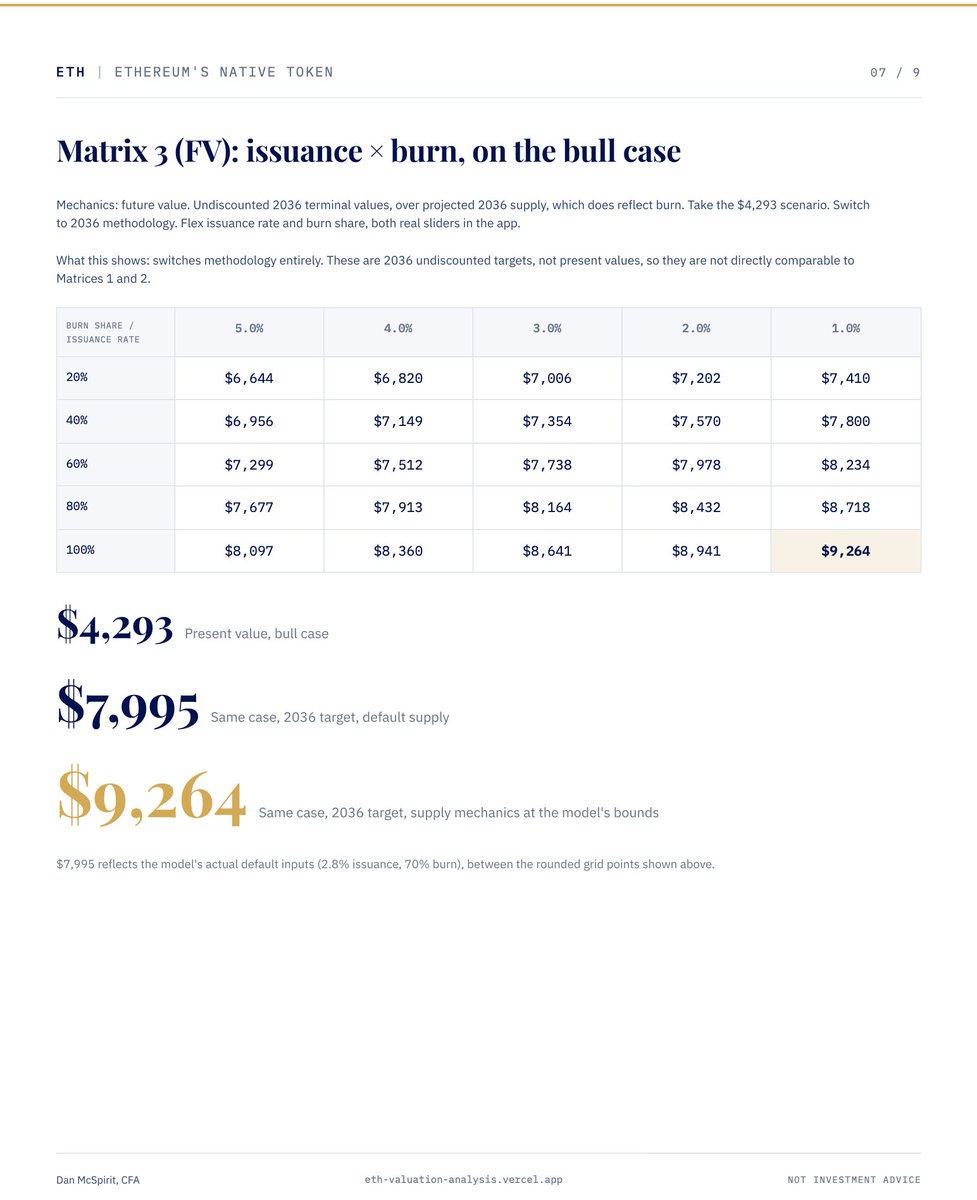
Valuing Ethereum's potential in the agentic economy. Analysis includes sensitivities on what AI agent settlement could do to the valuation: $1,850 starting point per ethereum:native, up to $4,293 on defensible assumptions, up to $9,264 on a forward basis.
A different approach. Link below.
@BitMNR Sharing my $ETH model if it's of interest. Treats ETH as a programmable infrastructure. Lots of levers to pull on the web app. Starting values are default numbers only. Meant to be viewed on desktop. Hope it helps. Cheers.
Model: https://t.co/3YhK9yoYDf
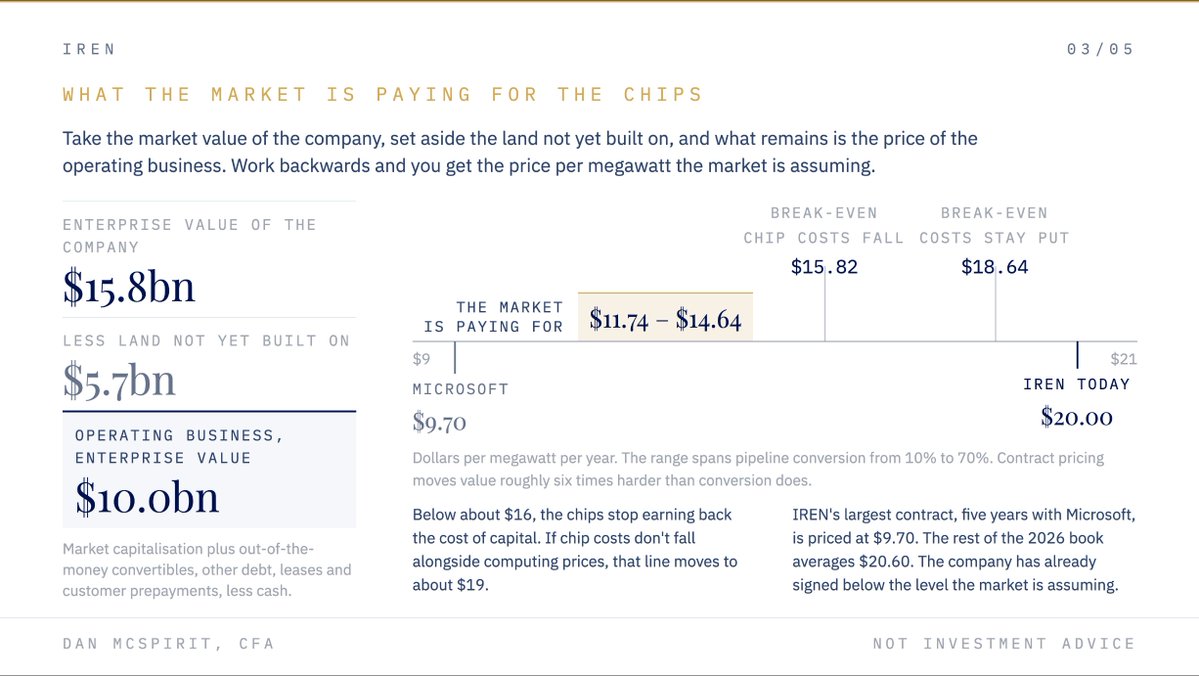
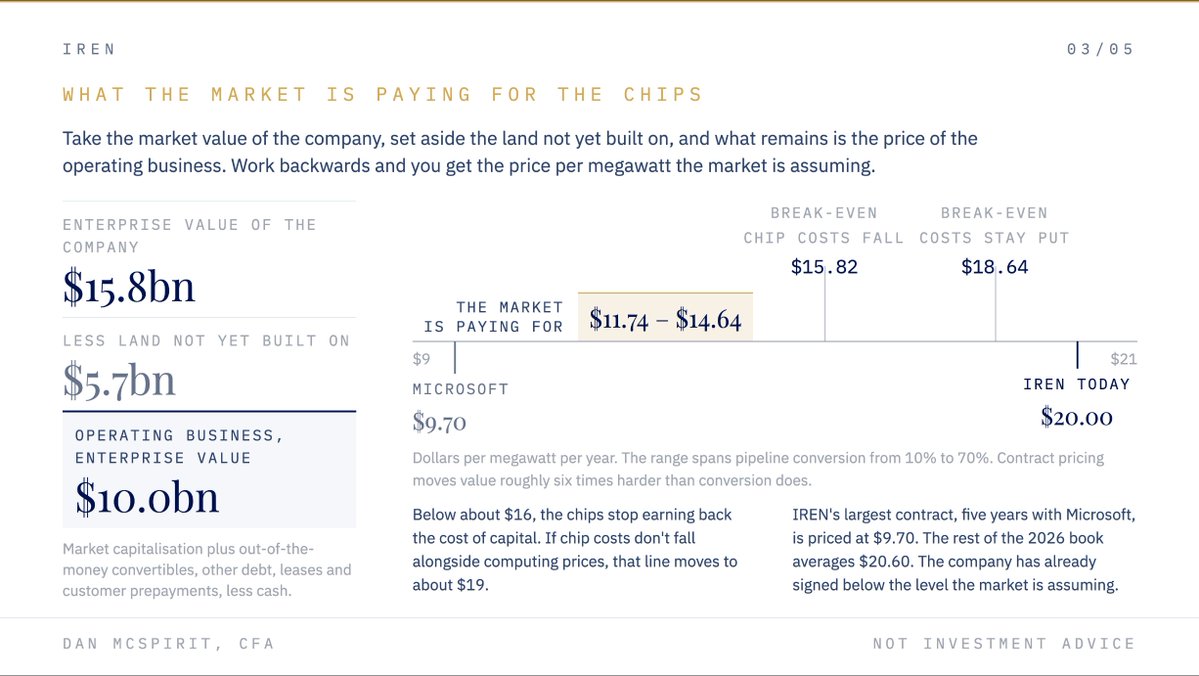
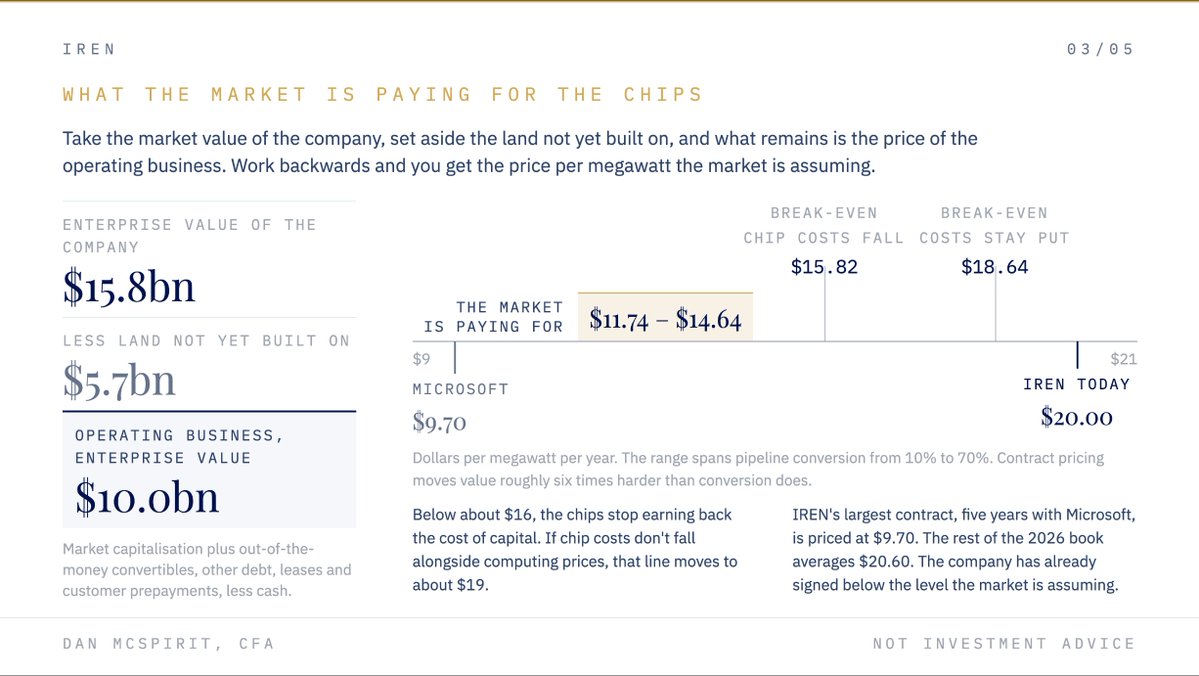
@optionscjp My math on what the market may be discounting on a per MW. Less the unbuilt land and the operating business is worth ~$10bn, implying $11.74–$14.64/MW versus ~$20 $IREN signs today. Below ~$16 the chips stop earning back their cost of capital.
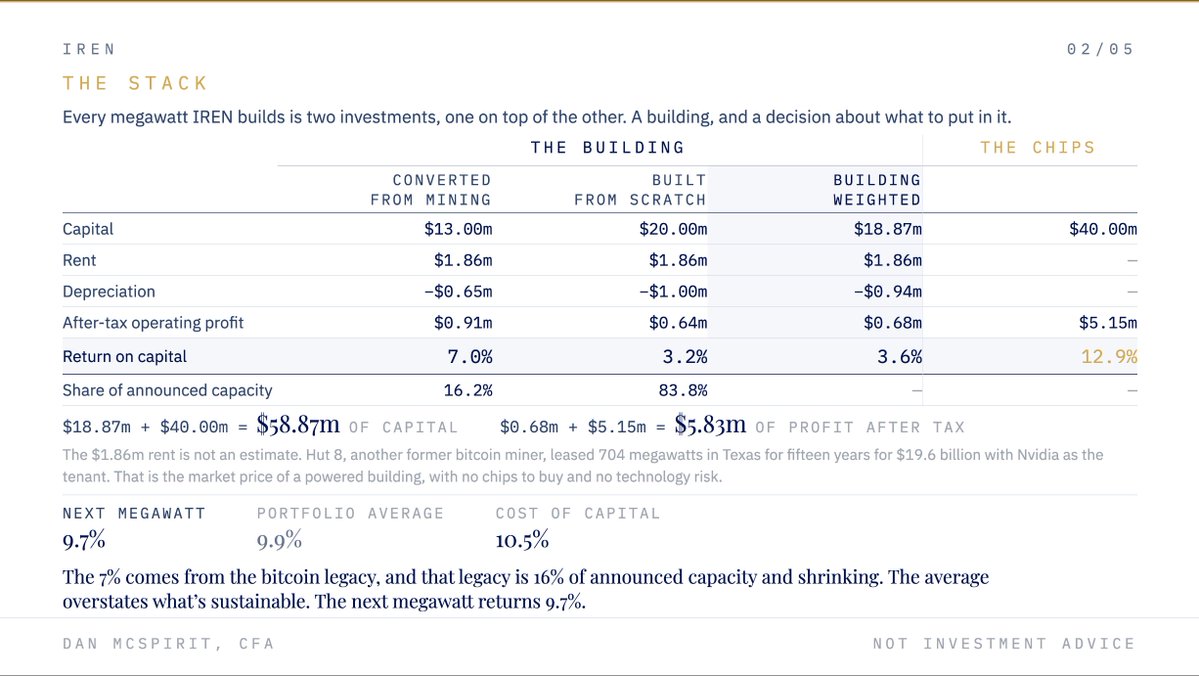
@CompoundingX 500MW at $20 is $10bn ARR, but it takes ~$30bn of capital and is worth ~$27bn on my model. It adds EV, yet earns less than it costs: 9.7% vs 10.5% cost of capital. It takes ~$26/MW before a MW is worth building. The drag is the building at 3.2%, not the chips at 12.9%. See below.
Real estate may be a drag on $IREN covering its cost of capital. Plugged in the recent $HUT deal to get a market price for the building. The argument may be less about compute useful life and more about how much a developer should re-rate. See below.
@BlackPantherCap My math on what the market may be discounting on a per MW. Less the unbuilt land and the operating business is worth ~$10bn, implying $11.74–$14.64/MW versus ~$20 $IREN signs today. Below ~$16 the chips stop earning back their cost of capital.
@moninvestor My math on what the market may be discounting on a per MW. Less the unbuilt land and the operating business is worth ~$10bn, implying $11.74–$14.64/MW versus ~$20 $IREN signs today. Below ~$16 the chips stop earning back their cost of capital.
@Manueldingo Insult aside, "real estate" doesn't mean just the dirt. It's substation, interconnects (40–45% of construction cost), power distribution, cooling and shell. If a powered building in TX were free, Hut 8 wouldn't have got the rent it did.
@TaviCosta This may be more about reinvestment burden relative to profitability than capital intensity, at least defined in the conventionally. Curious how it would look using capex/revenue or capital/total assets or PP&E/total assets. Would likely show a smoother plot for the miners. Thx.
@pratjoey@midwit_capital Thoughts on ORCL from my hyperscaler analysis. Speaks to economic spread. Debt markets may be saying it's more a value trap than a value play. Hope that helps.
@RealJimChanos I see little by way of discussion on value creation with $IREN. The economic spread may not be positive. What’s more folks appear to confuse pre-payments with financing.
@moninvestor The $IREN debate may be more about whether the company is creating value, which is rooted in pricing. The market may now be discounting IREN's contracts converging to where incumbants already operate, forcing the economic spread more negative. That may mean more downside.
@BlackPantherCap I don't think there's confusion over what $IREN does, rather the market is questioning if value is being created. Revs can double yet value per share can halve in the same deal. The market is discounting the potential reality of the latter.
Growth ≠ value.
@HyperTechInvest I see lots of $IREN posts focused on ARR. I believe it misses the point. ARR can double and value per share can halve in the same transaction. The measure only captures the former. The market is now only beginning to discount the potential reality of the latter.
@HyperTechInvest One issue may be that included in the $14B is ~$6B in unrestricted cash that may suggest that additional capital is needed to fund both growth and replenish liquidity. Add to that a recently-upsized ATM program that may act like an overhang on the shares.
@Ridajamal6f7k@amitisinvesting I think it has the potential to do so, however small a reset at first. I generally take the bond market's lead when it comes to pricing risk. What I'm not seeing discussed much is the increase in DSOs and whether it's a symptom of a larger development. Thx.