🚨Anthropic just showed a 24-minute workshop on how to actually do prompts for Claude.
Taught by the people who built it.
Free. No registration. No paywall.
I've seen $300 courses that don't cover what they teach in the first 8 minutes.
Watch it and bookmark it now.
complexity first, simplicity second
people say “keep it simple,” but most approach it backwards. they start from simple, then add on complexity without seeing the whole. that’s how you end up with frankenstein products: clean-looking components awkwardly stitched together, held in place by duct tape and wishful thinking.
true simplicity emerges only after you’ve grasped the full complexity first. you can’t abstract away what you don’t fully comprehend. once you deeply understand the entire system — the edge cases, feedback loops, emergent behaviors — then the elegant patterns start to surface, creating solutions that genuinely click.
people often misunderstand complexity as the enemy of simplicity. but complexity isn’t the enemy, it’s reality. your goal isn’t to ignore complexity, but to master it. when you think holistically, you create systems whose parts reinforce each other rather than clash. the UI naturally mirrors the underlying data model. the API aligns seamlessly with how users think. the entire product feels inevitable.
real builders dive into the messy reality and embrace it. they map out the bizarre edge cases, user mental models, technical constraints, and business pressures. they sit patiently with complexity until the right patterns emerge. only then do they craft the simple, intuitive interface that makes all that complexity invisible. it’s like a swan, serene on the surface but paddling like hell beneath.
this is why Notion succeeds where most productivity apps fail. we didn’t start by saying, “let’s build a simple notes app.” we asked, “how would people organize and share information, with the fewest primitives” then we built abstractions that aligned with those conceptual models.
systems thinking is essential because it’s the only path to building products that scale — not just technically, but cognitively. users shouldn’t need to grasp your internal complexities to extract value. that’s the paradox: the more deeply you embrace complexity in your thinking, the simpler the experience becomes.
Imagine every pixel on your screen, streamed live directly from a model. No HTML, no layout engine, no code. Just exactly what you want to see.
@eddiejiao_obj, @drewocarr and I built a prototype to see how this could actually work, and set out to make it real. We're calling it Flipbook. (1/5)
Have you ever wondered how I make some of the illustrations for https://t.co/Em92bQM8y3?
Well, I made a video walking through some of the tooling I've made. Hopefully its interesting.
Working with Christina on Vanta is one of the great privileges of my career. I so admire her combination of curiosity, competitiveness, and decency. She’s built a company that is accelerating at scale and one that will stand the test of time. Somehow still underrated.
Listen👇
This is wild.
Cursor just completely changed the coding game.
Anyone can now code, combined with Claude 3.5 Sonnet, Vercel v0, Replit, etc.
10 wild examples:
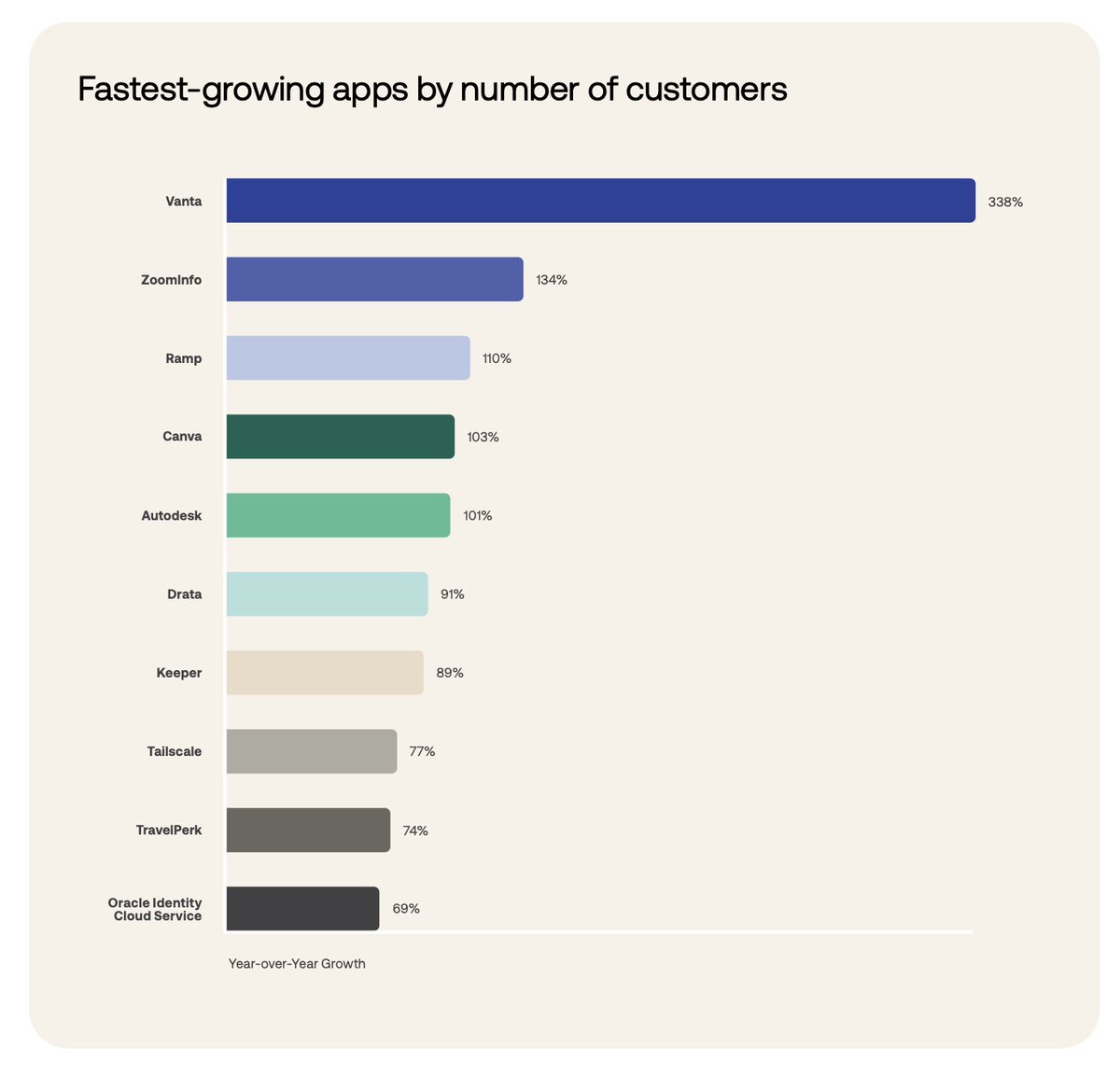
I used to look forward to and read Okta's Businesses at Work report each year (I'm great at dinner parties I promise.)
So it was a surprise to see Vanta at the top of the Okta charts, hitting the highest growth rate Okta's seen *in seven years.* https://t.co/5sZm6Qkf3Z 🦙🚀
It's crazy to me that people thought about this any other way. Anecdotally I think anyone who ever worked on any team knows that smaller (ideally high caliber) teams move faster.
this is exactly what i tell folks about work at apple. feels like magic on the outside, but there’s no special process—just folks making lots and lots of work.
Meet Promptac
This real-world interface connects to generative AI through a suite of sensors.
- Thimble eyedropper sensor
- RFID picks up textures
- Color sensor
- Bending sensor
- Pressure sensor
This thing is made by Zhaodi Feng – more links in thread.
Q: How do you build effective teams?
Keith Rabois, Founders Fund Partner and former COO of Square, has a great framework for building effective teams that he calls: “Barrels and Ammunition.”
When most companies begin scaling, they just hire a lot of people. Naively, they expect that—as they add people—their velocity of shipping will increase. But startups don’t work that way, and in fact you sometimes get less done when you add more people.
Keith argues that the reason for this is that most people in your company—even great people—are what he calls “ammunition.” But what you need in your company are “barrels”. He defines barrels as extremely talented people who can take ideas from inception all the way through to fully shipped product.
To increase company velocity, you need to add “barrels” and then stock them with “ammunition.” Most companies start with one barrel (the founder) and then double their throughput when they add another one.
In the clip below, he explains this framework and some specific tactics for identifying and managing barrels:
Students at NYU asked the creators of South Park the million-dollar question:
“What makes a good story?”
They gave one of the best explanations of story I’ve heard:
“If we can take the beats of your outline, and the words ‘and then’ belong between those beats… you got something pretty boring.
What should happen between every beat you’ve written down is the words ‘therefore’ or ‘but.’”
They go on to say, “That gives you the causation between each beat, and that makes a story.”
Point 1:
There’s an idea in storytelling called ‘Promise, Progress, Payoff.’
Essentially, a story is a neverending cycle of promises that are paid off over the span of the story.
It’s a cycle of expectation and resolution. Cause and effect. Conflict and progress.
Point 2:
A story isn’t a bunch of random events thrown together.
A story is a series of but / because / therefore moments.
A famous example:
• Harry discovers he's a wizard. Because of this, he goes to learn magic at Hogwarts.
• But then he learns Voldemort wants to kill him and rule the world.
• Therefore, he must find a way to defeat him.
Point 3:
‘And’ implies a simple continuation.
‘But / Therefore’ give prior events meaning through causation.
‘But’ implies conflict. ‘Therefore’ implies progress.
I’m reminded of a Hemingway quote:
“Prose is architecture, not interior decoration.”
Great writing is intentional. It doesn’t wander. It builds upon itself.
***
I hope you enjoyed that! If so, follow @nathanbaugh27. I study the best storytellers ever and share what I learn.
demo of a @browsercompany AI feature for Arc
manipulate websites (via code) using natural language
longer video with context on Browser Co YouTube page
When players - or "users"- can do anything with your product.
It becomes incredibly challenging to navigate them toward goals.
Nintendo solved that in a very elegant way.
And so can you!
https://t.co/ttUOnHwTLI
Source: @gamemakerstk