that’s exactly my issue too bro.
I’ve tried a lot of vibe coding tools over the last year, and emergent had one of the worst ROI experiences for me. too many credits used, too little quality compared to Codex and Claude.
if they’re watching this, they should make credit usage more transparent and improve output quality before pushing it as a serious builder tool.
with my current usage, if I ran the same workflow on emergent, I’d probably go poor before the app shipped.
India trades more options contracts than any country on earth. And most Indian retail traders are still reading that market with half the dashboard US traders take for granted.
I have been studying both markets closely, and the gap is not skill. It is tooling.
Here is what I mean.
The US options trader in 2026 has a whole layer of market structure intelligence available.
- Gamma exposure (GEX)
- Dealer positioning
- Live options flow
- Dark pool prints
Tools like Unusual Whales and SpotGamma turned the question of where market makers are forced to hedge into a daily, retail accessible read.
The serious US trader does not just see the option chain. They see who has to buy or sell, and where.
The Indian options trader, meanwhile, is working in one of the most active markets in history and analyzing it almost entirely through Open Interest, put-call ratio, and max pain.
Sensibull, Opstra, and Quantsapp are genuinely good products but that framework is a generation behind the dealer positioning lens US traders now consider basic.
Now look at what is at stake.
NSE is the world's largest derivatives exchange by contracts. Retail went from 2 percent of derivatives volume in 2018 to roughly 41 percent today.
Unique investors are near 119 million or more. And yet, by SEBI's own data, about 91 percent of F&O traders lose money, with net retail losses near 1.05 trillion rupees in a single year.
Read those two facts together. The biggest options market in the world. And nine in ten participants losing.
Some of that is leverage and behavior, and regulation is rightly tightening. But part of it is that millions of traders read the market with tools that never show them the one thing that actually moves price into expiry. Where the dealers are positioned, and whether the flow is with them or against them.
That is the opportunity I cannot stop thinking about.
The dealer positioning layer US traders treat as normal has barely reached the largest options market on earth.
It is exactly the gap we are building to close.
If you trade Nifty, Bank Nifty, SPY, or QQQ, what is the one piece of market-structure data you wish your current tool actually showed you?
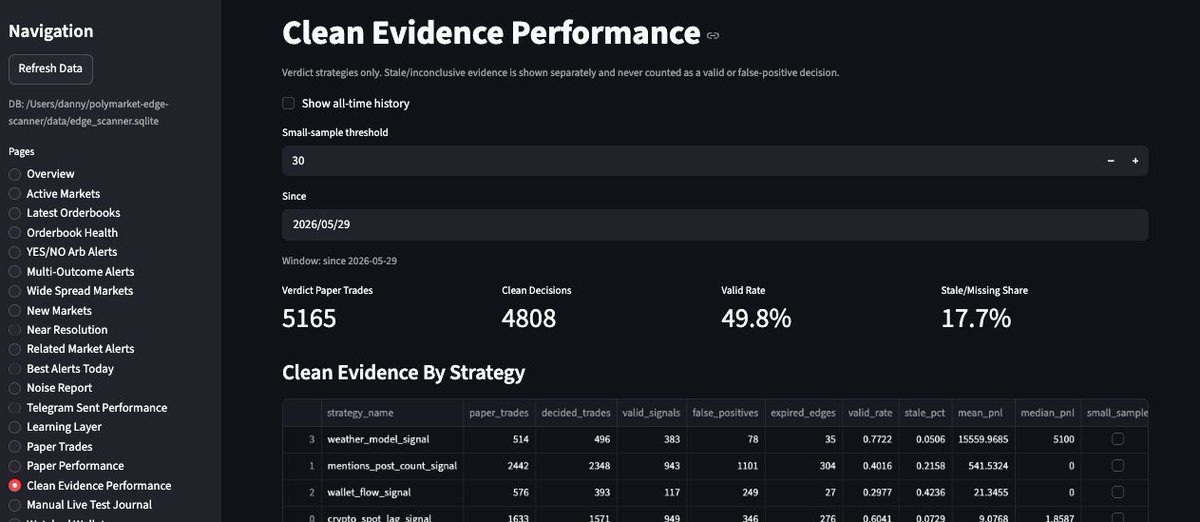
100%. I’m building this with Codex right now where agents that research markets, track fresh data, run paper trades, and measure evidence before any live execution. Native Polymarket AI agents would be powerful if they include guardrails, PnL tracking, and know when not to trade logic.
100%. I’m building this with Codex right now where agents that research markets, track fresh data, run paper trades, and measure evidence before any live execution. Native Polymarket AI agents would be powerful if they include guardrails, PnL tracking, and know when not to trade logic.
Another hyperliquid:native short, but here's the part worth paying attention to.
The entry was graded B at 67.4 and all auto setup without my intervention.
That's the whole point of grading before you risk.
bitcoin:native bearish on 4H, but 15M gave a clean long scalp.
Would you take both sides?
BTC is a good reminder that “trend” depends on timeframe.
On the 4H, the larger structure was still bearish. The short idea made sense because price was pushing with the broader downside move.
But on the 15M, the lower-timeframe setup started showing a clean bounce opportunity with defined invalidation and target room. That is where blindly saying “BTC is bearish” can make you miss a valid scalp in the opposite direction.
For me, the important part is not whether the label says buy or sell. It is whether the setup answers:
- what timeframe is this trade for?
- where is the idea wrong?
- is the stop logical?
- is there enough room to target?
- does the setup deserve risk?
Same market. Bearish higher timeframe. Bullish lower-timeframe scalp. Both can be valid if the risk and timeframe are clear.
This is the kind of multi-timeframe decision process I use @QuantumGradeA for, not to predict BTC, but to separate trend bias from executable trade setups.
bitcoin:native bearish on 4H, but 15M gave a clean long scalp.
Would you take both sides?
BTC is a good reminder that “trend” depends on timeframe.
On the 4H, the larger structure was still bearish. The short idea made sense because price was pushing with the broader downside move.
But on the 15M, the lower-timeframe setup started showing a clean bounce opportunity with defined invalidation and target room. That is where blindly saying “BTC is bearish” can make you miss a valid scalp in the opposite direction.
For me, the important part is not whether the label says buy or sell. It is whether the setup answers:
- what timeframe is this trade for?
- where is the idea wrong?
- is the stop logical?
- is there enough room to target?
- does the setup deserve risk?
Same market. Bearish higher timeframe. Bullish lower-timeframe scalp. Both can be valid if the risk and timeframe are clear.
This is the kind of multi-timeframe decision process I use @QuantumGradeA for, not to predict BTC, but to separate trend bias from executable trade setups.
hyperliquid:native again.
Same system, another clean run.
Multiple graded entries on the way up, each one confirmed before the candle closed.
The AI didn't predict the move. It just kept giving you stronger confirmation as the trend built.
This is the type of setup with more advanced features we're building.
When call OI starts stacking, OTM demand increases, and strikes begin acting like magnets, price action alone doesn’t tell the full story.
The real signal is in the structure underneath the move.
Flow first. Price later.
Zafir coming soon..
Hyperliquid Strategies ($PURR ) will have a gamma squeeze in the next 60 trading days (similar to GameStop)🧵👇
$PURR just had its largest day of trading volume, indicating how aggressively investors are establishing positions into the regulatory change for Hyperliquid
On top of this, call open interest for $PURR is surging, as traders buy the OTM tails. Watch very closely because once more OTM calls get listed, it will almost certainly cause a gamma squeeze. Right now, $PURR is the only liquid location to buy OTM calls on Hyperliquid, squeezing into the regulatory acceptance.
There is a massive problem with the calls right now, though. The strikes aren't listed very high. I'll explain this in the next tweet below for you.
@Globalflows This is why gamma structure matters so much.
Volume tells you attention is here, OI tells you positioning is staying and strike distribution tells you where the squeeze path may form.
All three together are much more useful than just looking at a breakout chart.
@ZayedETH why do assume "if it hit $40"? trading is not an assumption game sir. you might win this one but you can loose it all as well.
so better grade your system before you trade like how i did https://t.co/uf0Y9N2HPA
hyperliquid:native again.
Same system, another clean run.
Multiple graded entries on the way up, each one confirmed before the candle closed.
The AI didn't predict the move. It just kept giving you stronger confirmation as the trend built.
hyperliquid:native again.
Same system, another clean run.
Multiple graded entries on the way up, each one confirmed before the candle closed.
The AI didn't predict the move. It just kept giving you stronger confirmation as the trend built.
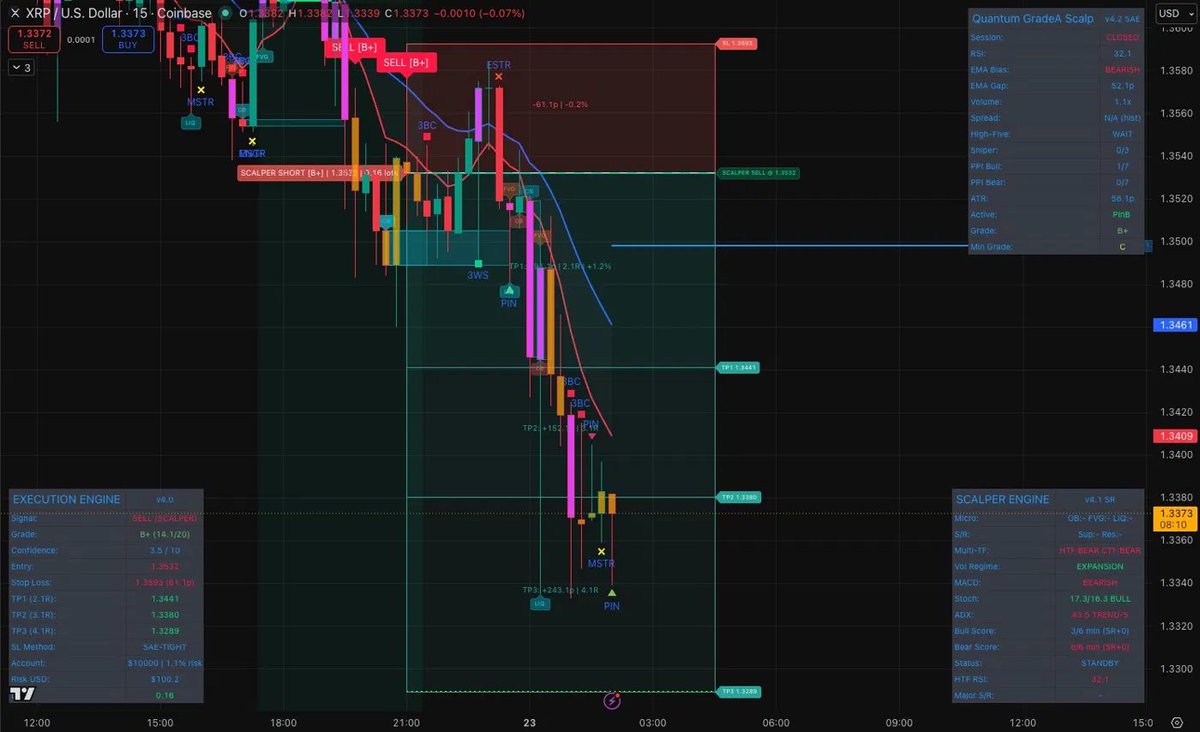
After getting back to back trading opportunities on $HYPE $SOL $MON $BNB $DOGE, got a new entry on ripple:native
Different ticker. Same AI-Powered Indicator. Same process.
The crypto market doesn't care which coin you're trading.
It cares whether your decisions are fast enough to keep up.
That's the part @QuantumGradeA is built for.
@0x_zozo@tryquantio This is the useful layer. Cleaner inputs only help if they lead to cleaner risk decisions. That keeps the tool tied to better execution.