1/3: What staking and delegation mean?
I once bought goods in Oshodi and the seller sent them by waybill to Berger. The driver drove past Berger and went all the way to Mowe. His phone was off for hours. I couldn't check on him or reach him, and my goods were inside his truck.
That day I understood why trust needs something at stake.
Blockchains have the same problem. Strangers have to agree on what's true, and nobody can watch them all. @GenLayer deals with this through staking. A validator locks up its own GEN as collateral. Do the job well and it earns rewards. Fail, and it loses part of that stake. If my driver had put his own money down before leaving Oshodi, he'd have picked up his phone.
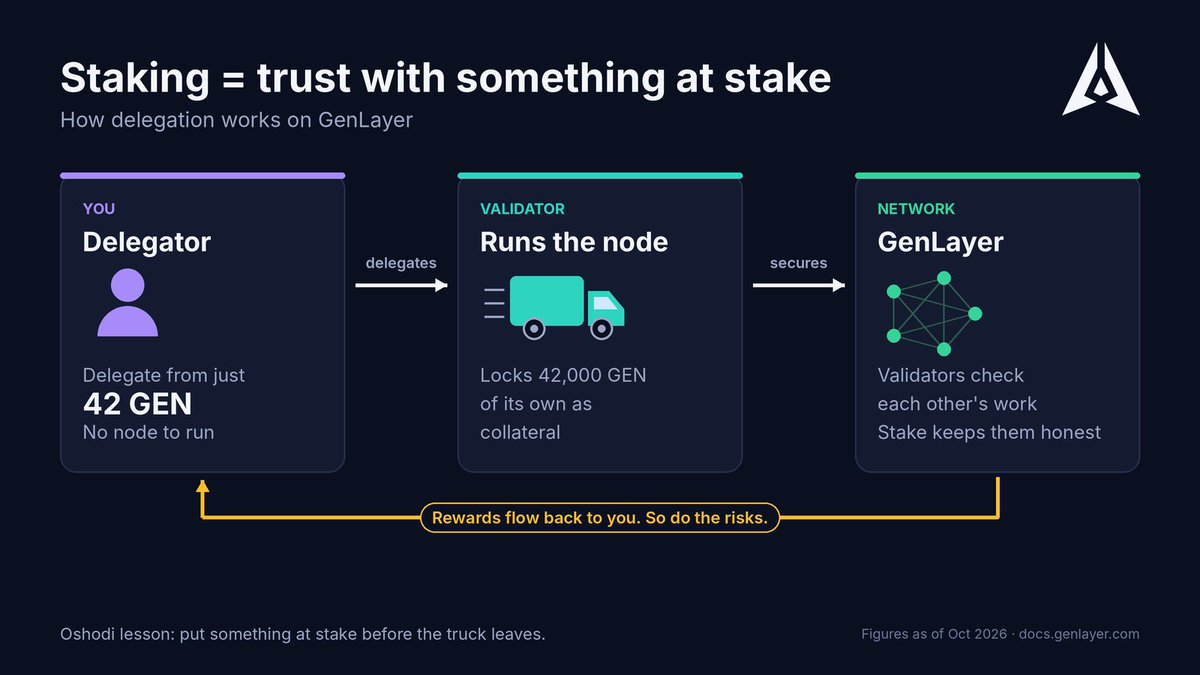
Delegation is how the rest of us join in. Running a validator needs 42,000 GEN, but you can delegate from just 42 GEN and share that validator's rewards. You don't run the truck, you back the driver. And yes, you share his risk too.
Next: why picking the wrong driver can cost you 👇
2/3: Why choosing where to delegate matters.
@GenLayer
1/3: What staking and delegation mean?
I once bought goods in Oshodi and the seller sent them by waybill to Berger. The driver drove past Berger and went all the way to Mowe. His phone was off for hours. I couldn't check on him or reach him, and my goods were inside his truck.
That day I understood why trust needs something at stake.
Blockchains have the same problem. Strangers have to agree on what's true, and nobody can watch them all. @GenLayer deals with this through staking. A validator locks up its own GEN as collateral. Do the job well and it earns rewards. Fail, and it loses part of that stake. If my driver had put his own money down before leaving Oshodi, he'd have picked up his phone.
Delegation is how the rest of us join in. Running a validator needs 42,000 GEN, but you can delegate from just 42 GEN and share that validator's rewards. You don't run the truck, you back the driver. And yes, you share his risk too.
Next: why picking the wrong driver can cost you 👇
2/3: Why choosing where to delegate matters.
@GenLayer
a few people have asked for my thoughts on the market here
so here it is:
dips are for buying
we're seeing an aggressive selloff due to a confluence of expected 4 year cycle lows + 10/10 anniversary fears in a few days + fresh cryptography fears from key industry figures
so give or take a few days around these events, ppl are gonna be irrational
but soon you're going to have a confluence of strong buy factors
• historical Q4 seasonality
• 4-year cycle believers buying in now that the 'cycle lows' date is passed
• 10/10 fears fade when nothing breaks
• etc
what else?
@theunipcs Hey champ
I have an alpha for you
A memecoin that has built what that has never been built before anywhere in the world
I am talking about @Hbadger_token and @CowrieProtocol
$HBADGE is the utility token
1/3: What staking and delegation mean?
I once bought goods in Oshodi and the seller sent them by waybill to Berger. The driver drove past Berger and went all the way to Mowe. His phone was off for hours. I couldn't check on him or reach him, and my goods were inside his truck.
That day I understood why trust needs something at stake.
Blockchains have the same problem. Strangers have to agree on what's true, and nobody can watch them all. @GenLayer deals with this through staking. A validator locks up its own GEN as collateral. Do the job well and it earns rewards. Fail, and it loses part of that stake. If my driver had put his own money down before leaving Oshodi, he'd have picked up his phone.
Delegation is how the rest of us join in. Running a validator needs 42,000 GEN, but you can delegate from just 42 GEN and share that validator's rewards. You don't run the truck, you back the driver. And yes, you share his risk too.
Next: why picking the wrong driver can cost you 👇
2/3: Why choosing where to delegate matters.
@GenLayer
1/3: What staking and delegation mean?
I once bought goods in Oshodi and the seller sent them by waybill to Berger. The driver drove past Berger and went all the way to Mowe. His phone was off for hours. I couldn't check on him or reach him, and my goods were inside his truck.
That day I understood why trust needs something at stake.
Blockchains have the same problem. Strangers have to agree on what's true, and nobody can watch them all. @GenLayer deals with this through staking. A validator locks up its own GEN as collateral. Do the job well and it earns rewards. Fail, and it loses part of that stake. If my driver had put his own money down before leaving Oshodi, he'd have picked up his phone.
Delegation is how the rest of us join in. Running a validator needs 42,000 GEN, but you can delegate from just 42 GEN and share that validator's rewards. You don't run the truck, you back the driver. And yes, you share his risk too.
Next: why picking the wrong driver can cost you 👇
2/3: Why choosing where to delegate matters.
@GenLayer
3/3 So this is my staking strategy for @GenLayer mainnet. I'll handle it the way I handle Oshodi goods: never one truck.
1️⃣ Split it. I'd delegate to 2 to 3 validators, not one and not twenty. One breakdown shouldn't touch everything.
2️⃣ Check before I commit. Uptime, how much of its own GEN is locked in, and any ban or quarantine record. The same questions I'd ask a driver before he leaves with my goods.
3️⃣ Keep watching. Rewards only come if my validators keep showing up, so I'd check back regularly and move my stake if one starts missing duties.
4️⃣ Know my exit. Unstaking takes 7 epochs (currently) and earns nothing while it runs, so I'd only delegate GEN I can leave alone.
It also helps the network. When delegators don't pile onto one validator, nobody becomes a single point of failure. That's decentralization in practice.
Na so I go do am. One truck? No be me 😅
One validator or several, what would you do?
2/3: Why choosing where to delegate matters.
2/3 Back to my waybill story. Same goods, same road, but a different driver and the story changes completely. So WHO you trust matters even more than the fact that you trust.
On @GenLayer, your delegated GEN is only as safe as the validator you choose. Right now:
• A validator that goes idle or fails to reveal its vote can lose 1% of its stake.
• Repeated idleness gets it banned from selection for the current and next epoch. It can't be picked for work, so it isn't earning.
• Slashes are split. 80% comes from the validator's own stake and 20% from delegated stake.
So a validator that disappears for hours, like my driver, can cost its backers real money.
Before you delegate, check it like you'd check a driver. Does it show up every time? How much of its own money is locked in? Any bans or past penalties?
Na the driver you choose dey decide if your goods go reach.