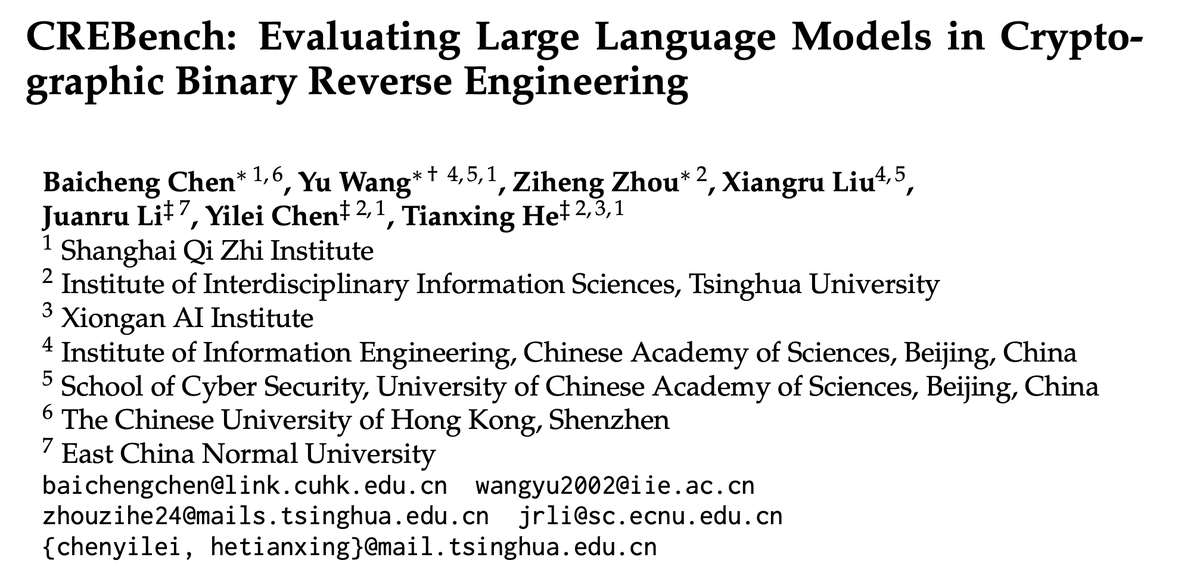
Today’s LLM agents can write code, call tools, and debug programs.
But can they reverse-engineer a cryptographic binary end to end?
We built CREBench to find out.
Thrilled that our work has been accepted to @COLM_conf 2026! 🎉
🧵👇
#COLM2026#AI4Security#Agent#RE
9/
Paper: https://t.co/tQHQ8UXkOd
Code & Benchmark: https://t.co/lVDaV7PA4Y
Huge thanks to all the incredible collaborators and mentors who made this possible: Yu Wang, Ziheng Zhou, Xiangru Liu, Juanru Li, and Tianxing He!
I'm happy to chat and see you in San Francisco! 🌉
Today’s LLM agents can write code, call tools, and debug programs.
But can they reverse-engineer a cryptographic binary end to end?
We built CREBench to find out.
Thrilled that our work has been accepted to @COLM_conf 2026! 🎉
🧵👇
#COLM2026#AI4Security#Agent#RE
8/
I also genuinely appreciated the @COLM_conf review process.
One reviewer wrote that they “enjoyed this paper a lot,” and the meta-review called CREBench “a model paper for how agentic benchmarks should be discussed and released”.
This meant a lot to us.
Hot take: robots should not dream in pixels.
Pixels are too low-level.
Latents are too opaque.
μ₀ predicts a third thing:
3D motion traces.
On real robots, it beats π₀.₅ — with ~1/100 the data scale and no action labels for world-model pretraining. 🧵
https://t.co/UfmrqNlBtw
(this video features voiceover narration)