Not only is it just annoying to cancel out of it, but then having that tool history in its context seems to make the session dumber. It's like the model locks into a "I'm ready to go after this one question" trajectory and stops paying as much attention to anything outside of those questions.
I still really hate AskUserQuestion.
80% of the time it comes up my answer is "wait you seem to have a fundamental misunderstanding of a major part of this" which obviously can't be addressed in multiple-choice format.
And of course usually your knowledge base hierarchy won't perfectly match your code hierarchy anyway, which makes this pattern not even work very well to begin with.
It's funny that harnesses have all this recursive AGENTS.md loading logic to let you nest your notes next to specific files, but then the models just comment the hell out of the source code anyway any time they fix a bug.
Feels like we don't need the fancy auto-loading.
If the Fable ban sticks I wonder if people will start paying American citizens to run prompts for them. Would be an interesting twist for services businesses / BPO's.
A couple of times already I've seen Fable make bad assumptions based on incomplete information, even though it had access to the full information and just didn't search as exhaustively as it could have.
Context engineering / loop engineering remains very important
Coding agents are quite bad at knowing what they don't know.
So far Fable doesn't feel like a huge improvement in this regard, and this is more often the bottleneck these days than sheer coding ability.
Initial impression of Fable – it's nicer talk to and feels less whiny, so definite QOL improvement. On code quality & structure it's a noticeable improvement but so far not feeling like a complete game-changer.
And context management remains as important as ever.
Nice, a few months later and I just realized they took my suggestion.
With the Explore sub-agent in particular now in CC you can jump into it as if it's any other top level agent.
Why are "sub-agents" even a thing? Why not just let agents launch other full-fledged agents.
I think it's just a limitation of Claude code and codex being completely designed around the single linear agent output in a tui, but it's weird that so many other systems are adopting the same limitation.
Is anyone making an LLM that will swear back at you?
If I'm like I just told you to f***ing fix that bug why is it still broken, it should be like dude maybe if your codebase wasn't a pile of sh** then it would be easier to track this down.
And then I'd know to go refactor it.
I think Opus-4.5 or maybe 4.6 with 200k context window (before 1M came out of beta) in the Jan/Feb version of Claude Code was peak CC.
I hate having to think about manually compacting vs accepting degraded performance & higher cost when I'm deep into the context window now.
@kcarriedo I have, using an orchestrator agent to delegate to other sessions works pretty well. No silver bullet though, over a long project even the high level agent eventually goes through their context window too
I think Opus-4.5 or maybe 4.6 with 200k context window (before 1M came out of beta) in the Jan/Feb version of Claude Code was peak CC.
I hate having to think about manually compacting vs accepting degraded performance & higher cost when I'm deep into the context window now.
*and the asterisk is that, as much fun as I was having with parallelization a few months ago, I don't think it's really that productive for most tasks. A single long running agent can already do so much with less drift.
Another way to say it is it's really an implementation detail of the system, and it's not the most important one. It can be an internal optimization you think about once the system overall is already working really well and you want to reduce wall clock time at the cost of some extra token use and coordination overhead.
But almost nobody has a finely tuned enough system that this is the right thing to be optimizing right now.
Even aside from the usability issues that Claude code has more chances to go do something you didn't want the more features they cram in, I don't think this new workflows is really ever the structure you want for parallelizing big projects.
So every time I say the word 'workflow' in Claude Code...
(let's say, when I'm creating a new GitHub workflow)
...it tries to enter 'workflow' mode, spinning up dozens of subagents to complete my task.
Stupid fucking thing
The teams feature they already have is closer to right, if you really want to parallelize*
Fixed pools of worker agents, pulling tasks off a queue. Rather than spawn a sub-agent for every task.
tfw anthropic went down again for a while and you sent a message to see if it's back up yet and it's been Razzmatazzing for 3m9s and you don't know if that's good or bad
It's so easy to get pulled down into to muck of like, "dang, my agent made these 3 mistakes, that one was so dumb, I guess I have to really babysit these things"
Gotta force yourself to wake up some days and say "fuck it, I'm gonna live in the future"
Zo's helping people become their own wealth managers
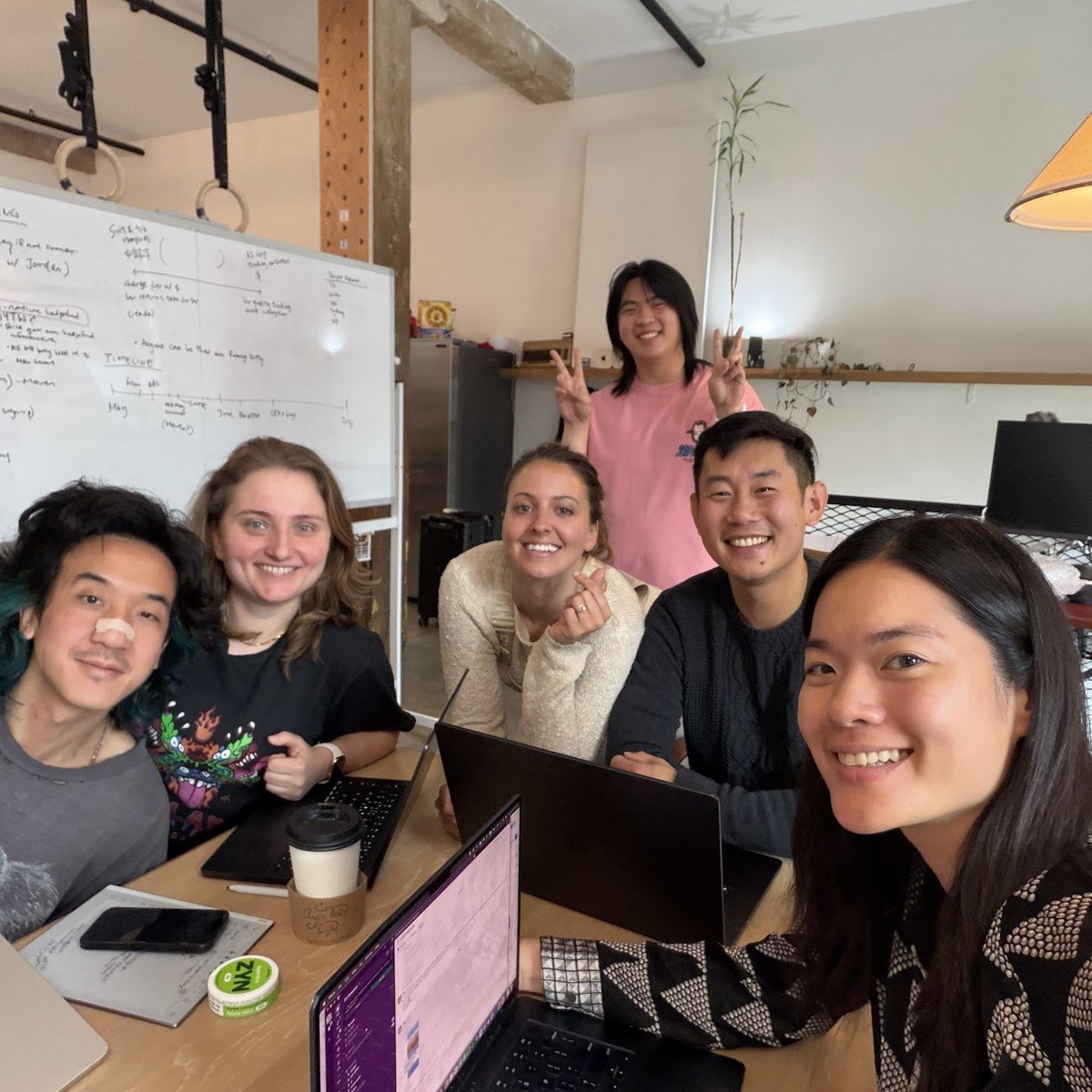
Here's @JingClarion at our office. He was using Claude desktop til he realized he needed a team of agents on a 24/7 computer, run scheduled tasks, and be on call anytime via text, Telegram & Slack. Then, he found @zocomputer
Jing is the real deal -- he used to run operations at a long-short activist investment firm and worked on research that got covered by WSJ, Bloomberg & FT