I’m a visual artist whose mediums of choice are photography and 3D modeling. I love shooting street & macro photography and sculpting characters & environments.
PICARD: Data, shields up
DATA: Brilliant! Shields can reduce damage we sustain. Not immunity. Not hubris. Just prudence. It's not precaution—it's strategy.
[camera shakes]
WORF: HULL BREACHES ON NINE DECKS
DATA: Here's what happened: you told me to raise shields, and I didn't
Dear people of the UK when you go to vote on May 7th, just before you write the X in the box count to 10 and think about what's happening in America because their electorate voted in a complete fucking imbecile, you have been warned, don't live to regret your decision 🙏
Last September I announced mandatory return-to-office.
Five days a week.
I called it a "culture-first initiative."
Culture means presence.
Presence means badge swipes.
Badge swipes mean metrics.
Metrics mean I can prove something to the board.
I don't know what.
But I can prove it.
The announcement went out on a Tuesday.
I sent it from my home office.
In Aspen.
I have an exemption.
"Strategic leaders require location flexibility to maintain global perspective."
I wrote that policy.
HR approved it.
HR approves everything I write.
By Wednesday, 340 employees had updated their LinkedIn status to "Open to Work."
I called it "natural attrition."
Natural attrition means they quit before I had to pay severance.
Very natural.
We lost 47 engineers in the first month.
I told the board it was "alignment correction."
The people who left weren't aligned.
With coming to an office.
That I also don't come to.
But that's different.
I'm strategic.
The office costs $4.2 million per year.
Empty, it was a write-off.
Now it's a "collaboration hub."
I measured collaboration.
Average daily Zoom calls from the office: 7.4 per employee.
They commute 45 minutes.
To take calls they could take from home.
But now they're "present."
Presence is culture.
I've never been more certain of anything.
A senior engineer asked why we couldn't stay remote.
She had metrics.
Productivity was up 23% during remote work.
I said, "Productivity isn't everything."
She asked what else mattered.
I said, "Serendipitous collisions."
She asked how we measure serendipitous collisions.
I said, "You can't. That's what makes them serendipitous."
She stopped asking questions.
Then she stopped showing up.
Then LinkedIn said she's at a company that's "remote-first."
Good luck with that.
They'll learn.
We installed badge tracking software.
It cost $380,000.
It tells me exactly when people arrive.
And when they leave.
And how long they spend in each zone.
I check it every morning.
From home.
The data is fascinating.
Average arrival time: 9:47 AM.
Average departure time: 4:12 PM.
I sent a Slack message.
"Core hours are 9 to 6."
Arrival times shifted to 9:02 AM.
Departure times shifted to 6:01 PM.
Productivity did not change.
But the metrics look better.
Metrics are culture.
We have a "hybrid" option now.
Three days in office.
Mandatory Monday. Mandatory Wednesday. Mandatory Friday.
That's called "hybrid."
Because Tuesday and Thursday are optional.
But there are "anchor meetings" on Tuesday and Thursday.
Attendance is "strongly encouraged."
"Strongly encouraged" means mandatory without the liability.
I learned that from legal.
The head of product asked if he could work from home when his wife had surgery.
I said, "Of course. Family comes first."
Then I said, "But let's revisit your Q4 performance targets."
He came to the office.
His wife understood.
I assume.
I didn't ask.
That's personal.
The CFO asked about ROI on the RTO policy.
I showed him the badge data.
"Presence is up 340%."
He asked if revenue was up.
I said, "Revenue is a lagging indicator."
He asked what the leading indicator was.
I said, "Badge swipes."
He nodded.
The lease renews next year.
Seven more years.
$29 million committed.
We needed bodies in the building.
Now we have bodies.
Fewer than before.
But present.
Morale is down.
Glassdoor says we're "hostile to work-life balance."
I told HR to respond.
They wrote, "We're a high-performance culture that values in-person collaboration."
That's corporate for "the review is accurate."
But it sounds like a rebuttal.
The CEO asked if RTO was working.
I said, "Absolutely."
He asked for evidence.
I showed him a photo of the office.
Full desks. Glowing monitors. Bodies in chairs.
He smiled.
"This is what culture looks like."
It looked like a stock photo.
Because I got it from a stock photo website.
The real office has 40% occupancy on a good day.
But he doesn't know that.
He's also remote.
We're both strategic.
Next quarter I'm proposing a "collaboration bonus."
$2,000 for anyone with 95% badge-in compliance.
The bonus costs less than the turnover.
And it shifts the narrative.
We're not forcing people to come in.
We're "incentivizing presence."
Incentivizing means paying people to do something they don't want to do.
It's different from mandating.
Legally.
The employees who stayed are "loyal."
Loyalty means they have mortgages.
And kids in school districts.
And RSUs that haven't vested.
They're not loyal.
They're trapped.
But on paper, it looks like loyalty.
And paper is what the board sees.
I've been doing this for 22 years.
I know what culture looks like.
It looks like butts in seats.
Butts in seats mean control.
Control means management.
Management means me.
RTO isn't about productivity.
It never was.
It's about seeing people.
So I know they exist.
So I know they're working.
So I know I'm in charge.
That's culture.
As long as the badge swipes go up and to the right.
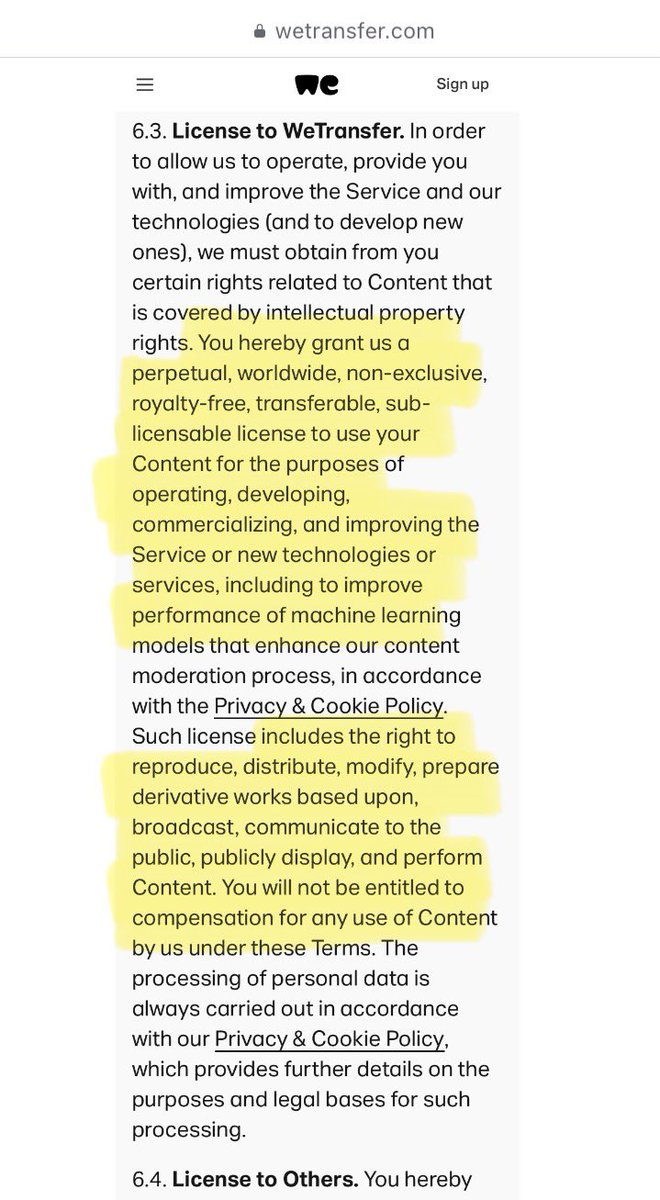
How is this acceptable, @WeTransfer? You’re not a free service, I *pay* you to shift my big artwork files.
I DON’T pay you to have the right to use them to train AI or print, sell and distribute my artwork and set yourself up as a commercial rival to me, using my own work.😡
Those ‘AI Opportunities’ in full:
- Displacing jobs
- Generating misinfo at scale
- Legalising IP theft
- AI slop everywhere
- Deepfake revenge porn
- CSAM
- Students cheating on exams
- Hyper convincing phone scams
- Making NVIDIA more valuable
- Money in tech investors’ pockets
- AI that refuses to be turned off
- AI that blackmails users
- Autonomous weapons
- Non-zero chance of human extinction
We should all thank Baroness Kidron and the large majority of the Lords who voted 5 times to protect creators by requiring AI companies to reveal their training data.
We should also condemn the @UKLabour government for 5 times refusing that request.
If you’re in the UK and you ever find yourself wondering why AI companies can get away with illegally using your work behind closed doors, the answer is now simple: the government refused to force them to do otherwise. There is no other reason.
Disney, Marvel, Lucasfilm, 20th Century, Universal City Studios Productions and DreamWorks Animation, have filed a lawsuit against Midjourney. They have described it in the suit as a “bottomless pit of plagiarism.”
Chris Bryant today all but admitted why the government refuses to accept legislation that makes AI companies reveal their training data:
They are going to offer creators transparency legislation *later*, in return for upending copyright law & letting AI companies train on people's life's work without permission.
His justification for rejecting transparency legislation: "If we're going to get to that proper compromise solution [between creators and AI companies], it's going to require all the bits of the jigsaw to be put together into a comprehensive picture."
That is: if creators want to know when AI companies are using their work, they're going to have to give up their rights.
There is no other way of interpreting this comment I can think of. He is saying creators can't get transparency from AI companies without giving something up. And there is nothing to give up except their current rights under the law, which compel AI companies to ask their permission before using their work.
Bryant & co. have given no other reason to reject transparency legislation. AI companies are breaking the law, and government refuses to hold them to account.
IMO this is awful treatment of the creative sector by the government. Commercial generative AI training on copyrighted work without a license is illegal in the UK; creators cannot enforce their rights, because training happens behind closed doors; the government won't empower creators to enforce their rights without requiring them to give up other rights.
Bookmark this. I hope I'm wrong, and that this is not the government's plan - but I see no other conclusion you can draw from @RhonddaBryant's words here.
The UK government cannot hold AI companies to account if it keeps deepening its reliance on them.
The AI & copyright consultation was a sham if these partnerships were happening alongside it.