Evaluating LLMs usually requires sophisticated human designs and with the continuous improvement of LLMs, it is difficult for humans to find their limitations.
Can LLMs find their own limitations by proposing questions to themselves? Check our new paper: https://t.co/lDkBCQsIVR
From my experiments, they can hardly generalize to tasks not included in the instruction tuning dataset, meaning they are highly biased towards captioning/OCR/VQA tasks.
Does instruction tuning of large vision language models really make sense? My understanding of instruction tuning is that it can allow the model to exhibit strong generalization capabilities, but the LLaVA family and other models don't seem to be good zero-shot learners.
Can GPT-4 serve as expert translators? No, Not Yet a Match for Expert Translators
In our latest preprint, we benchmark GPT-4 against human translators at various levels of expertise and professions.
https://t.co/4RIge7hUMe
By popular request, I wrote a separate article on effectively managing and running experiments during a PhD in AI. I learned that effectively running experiments can be a crucial aspect of a PhD and I wanted to share some of my learnings 🧵: https://t.co/zDN4MAxlbC
@NielsRogge@victorsanh Thank you for your response! It would be very helpful if there is a notebook for multi-GPU training and loading for inference. BTW, do you have any suggestions for freezing more layers, like which ones to prioritize?
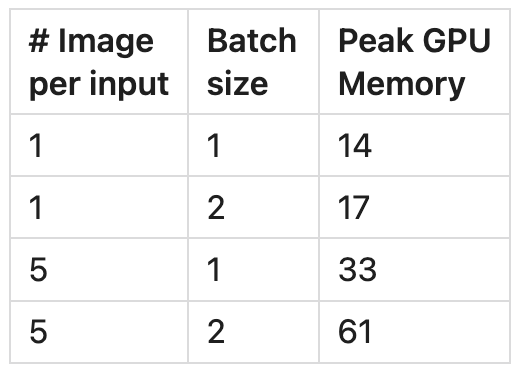
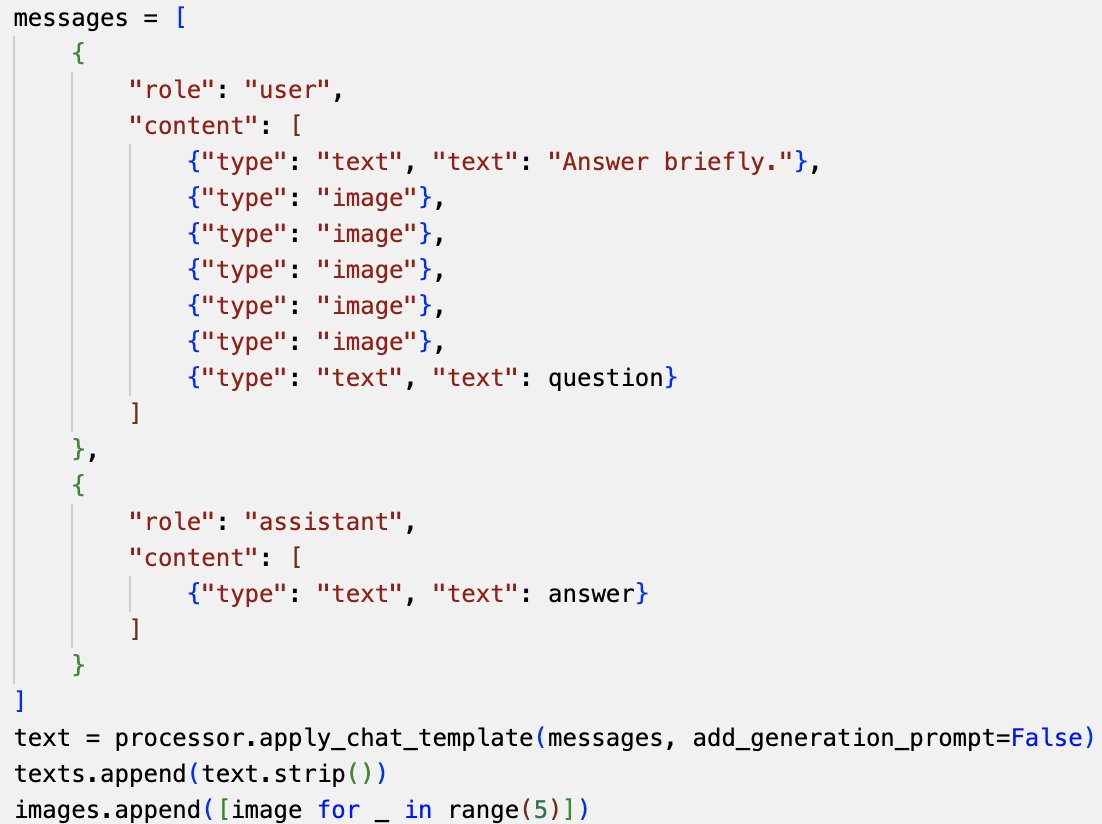
@mervenoyann@llamafactory_ai I tried repeating the image in the input twice, and the peak GPU usage increased to ~30GB under the qlora setting (5 images -> 60GB). The model only takes 7GB. Does that mean adding one image to the input will use an additional ~3GB of memory? do_splitting is set to False.
@mervenoyann@llamafactory_ai Thanks for the reply! I tried fine-tuning idefics2 using the colab tutorial, but I noticed some unusual GPU memory usage. With qlora and bsz 2, a single image input takes 17GB, but five images input use around 61GB. Is this normal? I'd appreciate your thoughts on this!
Create your 3D portrait with only a single image using our powerful model Era3D. @ylecun
Era3D is a new high-resolution cross-domain diffusion model, which produces 512x512 color images and normal maps (Wonder3D and Syncdreamer only support 256x256 resolution). With such 2D representations, it's feasible to create such detailed 3D reconstruction. Many thanks to the efforts from @pengli_hkust
The reconstruction part cannot be integrated into huggingfaca demo. Vist our github repo for complete experiences.
Github repo: https://t.co/npB34quAIe
Webpage: https://t.co/3cDxi3GVri
Huggingface demo for MV color and normal prediction : https://t.co/zEt9KlAgYM