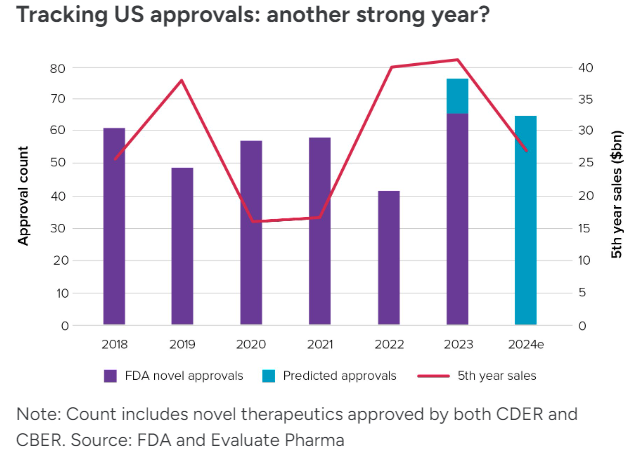
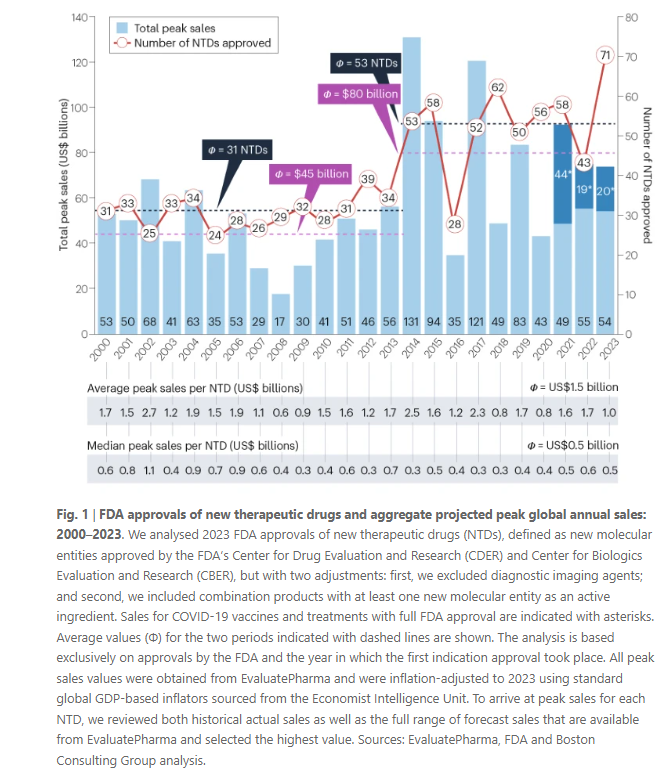
More recent launches are inherently lower as peaks often outside the 2023-28 window, but the general observation definitely holds true. More approvals but not necessarily higher value, and prediction for 2024 class suggests trend continues. More here: https://t.co/TkbWhFEf3I
While the number of new therapeutics approved by the FDA last year hit a high, the expected overall commercial value of these therapeutics is moderate - find out more in this annual analysis by authors at Boston Consulting Group https://t.co/tc3dvKkXQM
@a_kaltenboeck@evaluatepharma For what it's worth, I think the shortening of drug lifecycles has its upsides, I just dislike the characterisation of lifecycle management as a negative. My stance is to let pharma make the judgement calls on how to best allocate finite R&D budgets.
Creative use of @evaluatepharma data to show post-approval R&D spend exceeds that required to reach the market for the subset of 2026 IRA drugs. The economics of running post-approval studies, fully exploring patient benefit, is jeopardized by IRA and shorter drug lifecycles.
Up next in Medicare negotiation: Manufacturers submit data to CMS on the economics of selected drugs. As a benchmark, @ATIAdvisory estimated revenues and R&D spending. Numbers are eye-opening! 1/10 @DusetzinaS@MarkMiller_DC@peterneumann11@ProtectOurCare
https://t.co/b1SlrNbqaj
@a_kaltenboeck@evaluatepharma Hi Anna, agree that IRA tilts R&D towards new products, but that does not guarantee that those R&D dollars are being better spent-patient impact, ROI or otherwise. That 61% fig is a great baseline stat and I imagine it will drop, but competitive pressure can be a force for good.
First tranche of IRA drugs to be negotiated. Like everyone else, my predictions had some hits and misses - it looks like CMS is not in the business of predicting when generics/biosimilars will be available, despite it being a key criteria for eligibility. https://t.co/ha6Yy6SMrJ
Provocative to characterise spend on negative trials or discontinued assets as failed R&D, but an interesting case study and worth extrapolating the lessons to broader cancer R&D, and beyond. Tempted to dive into @evaluatepharma data and spend on other notable drug classes.
$50 billion a year is spent on failed cancer drug development by the pharma industry. Our new paper is a case study on what goes wrong. @consiliumsci @Jhickmana
https://t.co/jdkIdFpZae
A powerful message from @Bayer in the @FT today speaking to @hannahkuchler. Europe (including the UK) are becoming 'innovation unfriendly' as governments make it more difficult to generate commercial returns on investments. Read it in full (£) https://t.co/iwHkxnDq2N
Similar sentiment to comments from Novartis last year ahead of its US-focused revamp. Commercial squeeze is forcing clinical innovation and investment to other regions, as seen by the stagnation of Europe's drug pipeline in relative terms.
Bayer shifts pharma focus away from ‘innovation unfriendly’ Europe, as AbbVie / Lilly withdraw from UK NHS pricing agreement citing its "punishing" impact on innovation https://t.co/RoPDoiX5mm
I had some great conversations at #JPM23 with companies and investors generally optimistic about the way forward for biopharma in 2023. In case you missed, see our free-to-read coverage of the meeting. (1/3) https://t.co/BBKtCPvBEM
The latest from @amandamicklus and Tish at @Citeline on dealmaking trends. Tiny upfronts and big biobucks is the main trend that sticks out for me. Alliances are increasingly preclinical, driven by pharma demand and biotech imperative to secure capital.
Biopharma dealmaking in 2022 https://t.co/fELtgAfr17
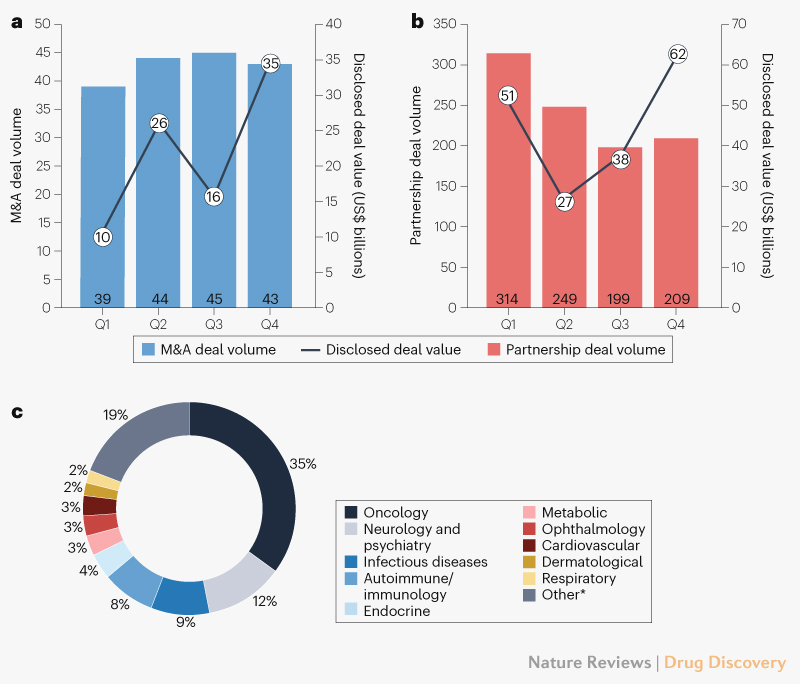
An analysis of M&As and licensing partnership trends last year, which saw volumes of both declining, as well as highlights of major deals
.@ScripMandy parses the full data for #lecanemab in #Alzheimers presented at #CTAD22 including the safety concerns prominent in recent days #pharma
Eisai/Biogen’s Lecanemab Effective Across Endpoints, But Will Safety Limit Use? https://t.co/bGKMcuIUdx
@csbostoncs @McKinsey@LifeSciVC@Citeline Fully agree - it shows the gravitational pull of risk, commercial opportunity and regulatory is strong. Just something to bear in mind the next time you hear an idealistic industry leader talk about how if you solve for the patient need then everything else will fall into place.
This @McKinsey analysis, plus subsequent visualisation by @LifeSciVC, has gained a lot of traction in the last month.
As we own all of the data here at @Citeline, I wanted to address some unanswered questions - where is CNS, I&I burden seems low, plus others... [1/n]
@biobrainbox Absolutely - next iteration would be to focus on major markets where ROI decisions are based on. Will take a look if I have time to develop this further. You can imagine how the DALY burden might shift, but I think some of the underlying themes would remain.
@Frank_S_David@Citeline Thanks Frank - good suggestion and "de-investment" as a relative concept is interesting.
One of the issues with the original McKinsey chart is that it is %, although certain TAs are missing, not to mention drugs can be double counted. Wanted to avoid that, for better or worse.
@ByAmyBrown What do you think?
Better to stand out from the crowd rather than be an also-ran in its primary TAs. That said, I don't think Oncology spending is slowing down any time soon... so I'll sit on the fence. Ask again in another decade!
For the pharmas out there, it should also factor into long-term portfolio strategy. At what point does downsizing investments in the most crowded TAs (Onc/Neuro/I&I), diverging from peers, become the winning strategy? [9/end]
That's all - hope this was as interesting to you too. This will become more relevant as cost-conscious payers need to distribute health spending equitably, and the interesting question is how this is reconciled with incentivising against future threats (e.g. AMR). [8/n]