Ever wondered how underwater scenes would look like without water?🪸🤿
Come check our work at #ECCV24 in Milan tomorrow.
Osmosis: RGBD Diffusion Prior for Underwater Image Restoration.
Opher Bar Nathan, Deborah Levy, @TreibitzL.
Poster#237 16:30
Code: https://t.co/1KB1HajLbo
https://t.co/DkIBbdzo5g
Sea Thru #NeRFs enable us to model the underwater environment and as a result remove the water and expose how the scene looks like without water. Come see our poster (number 6) Tue AM in #CVPR2023.
@dakkaynak@SimonKorman@danrsm
How do you synthesize novel views underwater? Happy to share results from our new #CVPR2023 paper: "SeaThru-NeRF: Neural Radiance Fields in Scattering Media", Deborah Levy, Amit Peleg , Naama Pearl, Dan Roesnbaum, Derya Akkaynak, Simon Korman, Tali Treibitz.
@dakkaynak@SimonKorman@danrsm@CVPR #NeRFs #nerf #3dmodeling #Photogrammetry #ocean #oceans
https://t.co/DwNDDhBBd8
Previously we had introduced *functa*, a framework for representing data as neural functions (aka neural fields, INRs) and doing deep learning on them.
In our recent work *spatial functa* we show how to scale up the approach to ImageNet-1k 256x256.
📝https://t.co/Gw4Fu37V4W
Ever wondered why deep learning is always done on array data?🤔 Happy to announce our work:
From data to functa: Your data point is a function and you can treat it like one
📝https://t.co/cgudChXTI1 w/ @emidup@arkitus@DaniloJRezende@danrsm, to appear in ICML22
Ever wondered why deep learning is always done on array data?🤔 Happy to announce our work:
From data to functa: Your data point is a function and you can treat it like one
📝https://t.co/cgudChXTI1 w/ @emidup@arkitus@DaniloJRezende@danrsm, to appear in ICML22
If you're interested in dynamic protein structure, cryo-EM data, and/or inverse graphics approaches, come see our talk and poster today at the MLSB workshop at NeurIPS 3:30PM GMT! https://t.co/IyQqeEP7U0
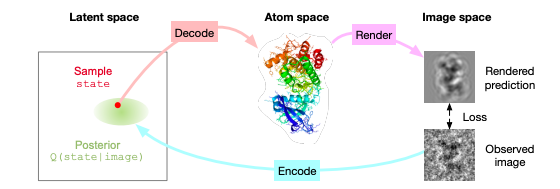
@fraser_lab and I, along with many colleagues (including @irisdyoung), held a journal club on the exciting new @DeepMind paper 'Inferring a Continuous Distribution of Atom Coordinates from Cryo-EM Images using VAEs' https://t.co/sphuBJ1ehQ.
Excited to share "Volume Rendering of Neural Implicit Surfaces" (VolSDF): a volume rendering framework for implicit neural surfaces, allowing to learn high fidelity geometry from a sparse set of input images.
with @thoma_gu@yoni_kasten@lipmanya
https://t.co/WlUcVzRw0y
(1/8)
Cryo-EM: fascinating open vision problem I wouldn't even know about without this collab. Images are so noisy that each one gives only a little info on the 3D shape. We need Bayesian inference in generative models to explain all images w/ a physically-plausible state distribution.
Interested in generative models, 3D computer vision or inverse graphics?
We use ideas and techniques from these fields to show the possibility of imaging very small objects (e.g. proteins) more effectively.
In this setting we cannot fall back to supervised learning!
By framing generative modeling as learning distributions of functions, we build models that act entirely on continuous spaces, independently of data resolution 🌿
📄 Paper: https://t.co/mNMf0du4mU
💻 Code: https://t.co/NdfMXONTCU
with @yeewhye@ArnaudDoucet1