$HYPE vs $ETH: who actually wins the global financial system?
On Threadguy's podcast, Defi Monk and Ryan Watkins make a surprisingly bullish case for Ethereum despite not being $ETH holders.
Monk points out that TradFi often views Ethereum very differently than Crypto Twitter. Investment bankers, hedge funds, and institutional investors aren't obsessing over Ethereum's revenue. Many simply see the most decentralized and most Lindy smart contract network.
Ryan takes it a step further:
As bullish as he is on $HYPE, he notes Hyperliquid has just 28 validators co-located in Tokyo.
What if Ethereum ZKs everything?
What if it evolves into a combination of Bitcoin's monetary premium, Ethereum's settlement layer, and Zcash's privacy?
If global payments, trading, and lending eventually move onchain.. can the world's financial system run on infrastructure that's less decentralized?
We've already seen outages hit networks like Solana and most recently SUI.
An outage is a headline in crypto, Imagine the consequences if the global financial system simply went offline?
Ethereum may be less of a blockchain and more of a civilization-scale infrastructure project.
Many of us who experienced the “Ethereum Killers” of ca 2018 wrote off other blockchains prematurely.
We thought Ethereum would be the only game in town after EOS, Tezos, etc failed.
I held this belief up until 2021. Others took longer to realize they had fooled themselves. Some haven’t even realized yet.
Fortunately for me, I run Nansen so: 1/ I see what people do onchain, and 2/ I hear what chains our users demand from us.
Solana is the clearest case study.
Ethereum maxis should have re-underwritten their “hurr durr ethereum killers” thesis.
Instead Solana was ridiculed for being only for memecoins. (Anyone who has used Solana knows this is a reductionist take.)
Solana is here to stay.
Ethereum is also here to stay, but not as the only game in town.
Now we find ourselves at a point in time when certain people refuse to face another truth:
Hyperliquid is here.
And it is here to stay.
I’m reminded of the people who kept sticking their heads in the sand with Ethereum.
Wake up and smell the coffee.
Clinging to your bags is holding you back.
Use the tech, engage with the ecosystem, be curious.
The only thing that’s always true in crypto is that nothing ever stays the same.
Maximalism is intellectual laziness.
Ethereum is here to stay.
Solana is here to stay.
Hyperliquid is here to stay.
(Alongside a handful other chains.)
Every asset will be tokenized.
Billions of people will be owners.
Chains are the financial fabric of the future.
Vitalik finally said ETH the asset is Ethereum’s most high-value product.
@0xzak's response: ‘Should have said that five years ago.’ On broken cryptoeconomics, the competition, and whether the EF even knows it’s in a race.
New Unchained:
Timestamps:
🏛️ 00:32 The EF departures: a maturing org, or a retreat from what Tomasz built?
📣 06:52 Coinbase: Get 20% off the first year of your Coinbase One annual plan at https://t.co/gUBZGvjbDV
👀 08:41 Are these departures actually concerning, or is this just what churn looks like?
📑 15:22 The CROPS mandate, the manga aesthetic, and what it says about who’s really in charge
⚠️ 26:50 The loyalty pledge: performance improvement plan or loyalty purge?
🧠 33:11 Dankrad’s $1B proposal: what would it actually take to fund Ethereum’s comeback?
💸 42:00 Vitalik finally says ETH the asset matters. Zak: ‘Should have said that five years ago’
🏆 48:36 Ethereum vs. Solana, Tron, and Hyperliquid: does the EF even know it’s in a race?
🏗️ 52:50 What Zak’s Ethereum Community Foundation is building, and what the EF could learn from it
Bringing back Up Only was just the warm up.
We’ve acquired @echodotxyz, the leading onchain capital raising platform.
→ Joining builders with community capital
→ Giving investors access to new opportunities
→ Growing economic freedom worldwide
We started building Echo around 2 years ago in an attempt to try and change the market dynamics around crypto fundraising.
Today, we're joining Coinbase, but the mission stays the same.
We're gonna use the firepower of this behemoth to provide better opportunities to investors and better fundraising options to founders.
Just getting started. Cheers.
Cobie
You can't win with "average" information.
Media is a winner-take-all market.
An AI-generated Library of Babel doesn't have much value beyond the people who control and curate it.
This is also why looking at charts is a waste of time. Once you've identified a trend, look for information asymmetries. You've researched it deeply and finally understood it, but others haven't. Hold on to it with confidence. Price action and information converge. Look for divergences and that's where your opportunity lies.
Woke up this morning and thought I'd drop some alpha about something we're bringing live in the next few weeks 👀
This is one of the most powerful primitives we are working on for onchain sequencing.
What would you do if your application can program custom transaction ordering + transaction dependencies at the sequencer level?
In onchain sequencing, you can program any set of rules for transaction processing via simple smart contracts
Some of these are access control rules like @dreamcoinswow, where a user is only allowed to transact if they are an AI agent
But we're also working on a more complex category of transaction ordering + dependencies, which is particularly powerful for DeFi and for oracles
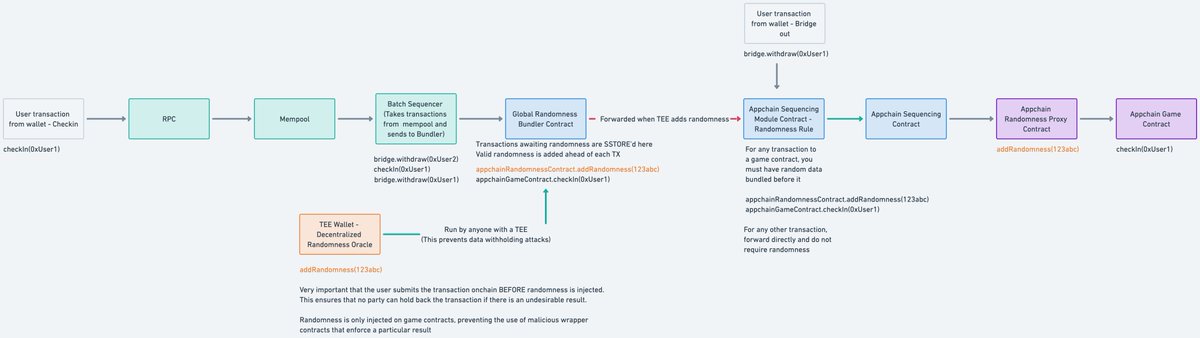
Take a game that needs a source of randomness. What we can do is require that every transaction to a game contract contains randomness as a prerequisite transaction right before it, otherwise the transaction will not be processed. This creates two-transaction bundles where every game transaction is:
1. Update randomness (injected by TEE)
2. Interact with game (added by user)
Importantly, the user's transaction for the game is submitted BEFORE the TEE adds randomness, so the user cannot withhold transactions if they get a random result that they don't like. In addition, wrapper contracts are blocked (randomness is not injected before them), so the user cannot use a revert to avoid randomness results that they don't like (e.g. the Meebits hack).
This is much simpler for application developers. They have an always up-to-date randomness source that they can rely on, without needing to handle multi-block VRF. This also reduces latency, since randomness can be added in the same block. This is very powerful for games. All the game needs to do is track that a user's randomness "nonce" has been updated since their last call, which is quite simple to do.
There are even more powerful primitives from onchain sequencing related to transaction dependencies and ordering, but I thought I'd start here. More coming soon! And yes, you will be able to try this out yourself in a few weeks 🤫













![dao_alpha_'s tweet photo. Just pulled a grail
Check out my Uniswap trading card 🦄
[drop yours here ‒ X won't let us do it for you 😢] https://t.co/YieiXdUh5R](https://pbs.twimg.com/media/GugjO2bXQAAoadX.jpg)