Indie dev building with AI
I turn messy ideas into systems that actually work
Idea → structure → working product
Sharing builds & experiments
English|中文|日本語
Stop Burning Hours on Low-ROI Freelance Bids.
Winning projects shouldn’t mean unpaid hours, endless retries, and generic AI proposals.
So I built ProPosal to generate low-cost, high-quality proposals at scale.
👉 https://t.co/u9oEnVovVS
#BuildInPublic#AI#Solopreneur
The problem was never “AI coding.”
The problem is treating software architecture like improv.
I use AI agents too — but the structure, system boundaries, data models, constraints, and milestones are still designed intentionally.
Am I the only one getting vibe coding fatigue?
Building landing pages in 30 seconds was fun, but maintaining a complex codebase where half the logic was “vibed” into existence is an absolute headache.
Feels like we traded 1 hour of typing for 5 hours of architectural debugging later. I’ve started manually writing core logic again so I actually know where the technical debt is hiding.
Is anyone successfully managing large production projects with AI agents, or are we all just building disposable software?
@AishwaryaDevv I use AI agents for coding too, but I don’t leave the architecture to vibes.
The structure, data models, constraints, and milestones are still designed intentionally. AI handles implementation, not system thinking.
Engineering 101: Never build a system that collapses when one module fails.
This is why I focus on structural constraints. Even if the AI hallucinates, the architecture forces the output back into a valid strategy.
Design the cage first. Then put the AI inside.
How to design great systems? The answer is simple: design for failure. Great systems are not just built for happy paths, but they are designed to handle errors gracefully. I know this sounds like AI slop, but it is not ..., coming back...
Assume and acknowledge that every component, from hardware to software, has the potential to fail. So, proactively consider all possible failure points for every single component, and see how your system reacts.
In any case, the system should not simply collapse; instead, it should be designed to limit and contain the damage while maintaining core functionality, and ideally, recover quickly with minimal disruption.
This is the framework that I have been applying while designing any and every system across my career. For me, it is all about failures :) I seem a pessimist that way, but for me it is not pessimism, but realism.
Hope this helps.
@VaibhavLLMs Hi, Building a structured freelancer proposal strategy tool. Just launched the alpha for testing. > https://t.co/P6M93TfNVb
Connected 🤝
JSON prompting mostly improves structure, not reliability.
It doesn’t magically solve weak reasoning, hallucinations, or context drift. You can still get beautifully formatted nonsense.
What actually helps is stronger structural constraints, not just more prompting.
Most AI-written freelance proposals sound generic .
So, I built a Structured Proposal AI Tool to fix this.
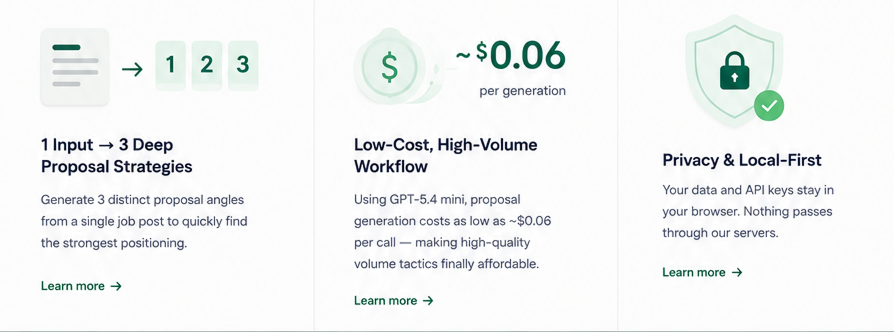
- High Efficiency: Go from job post to strategic draft in 60s.
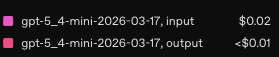
- ROI: Only $0.02 per call.
Early access 👇
https://t.co/F5ylNKOwYb
#BuildInPublic#AI#Solopreneur
@sflorimm Building a proposal tool for freelancers.
Most AI proposals sound generic because they lack structure and project reasoning.
I’m using workflows + constraints to make them sound like someone who actually understands the job.
https://t.co/x3tNcsCFh7
@BacLeodiv I don’t really call myself a founder, but The system structure, workflows, data models, specs, and constraints are still designed by me.
AI just handles part of the implementation work, which I don’t see as a problem.
Most AI freelance proposals sound generic.
I built a structured proposal system to fix that.
In blind tests, people consistently preferred its output over normal prompting.
Looking for 3–5 #freelancers to test it on real jobs.
3 proposals free.
DM niche + background 👇
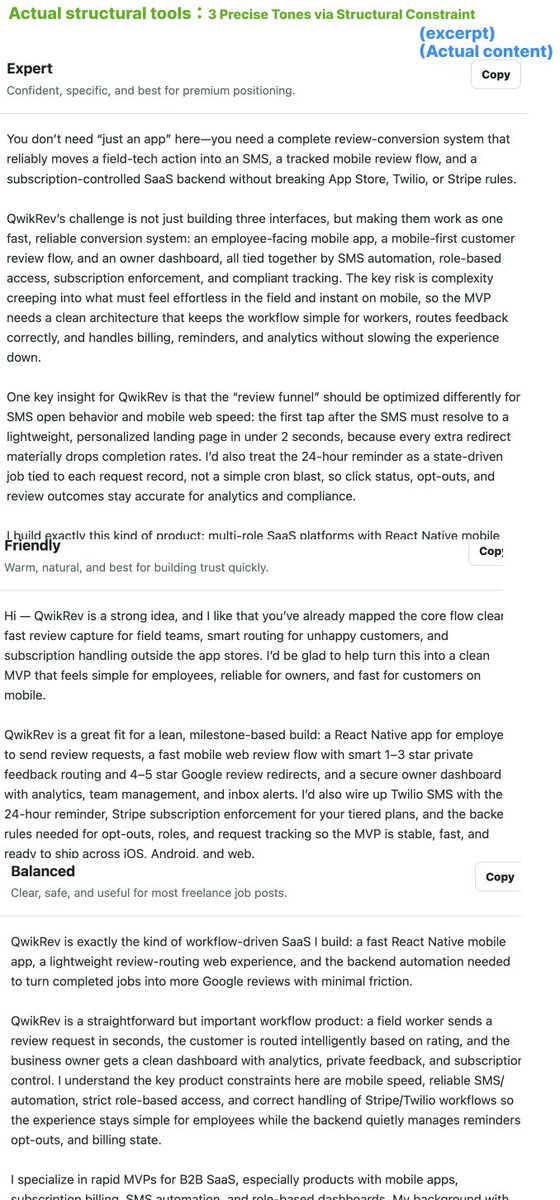
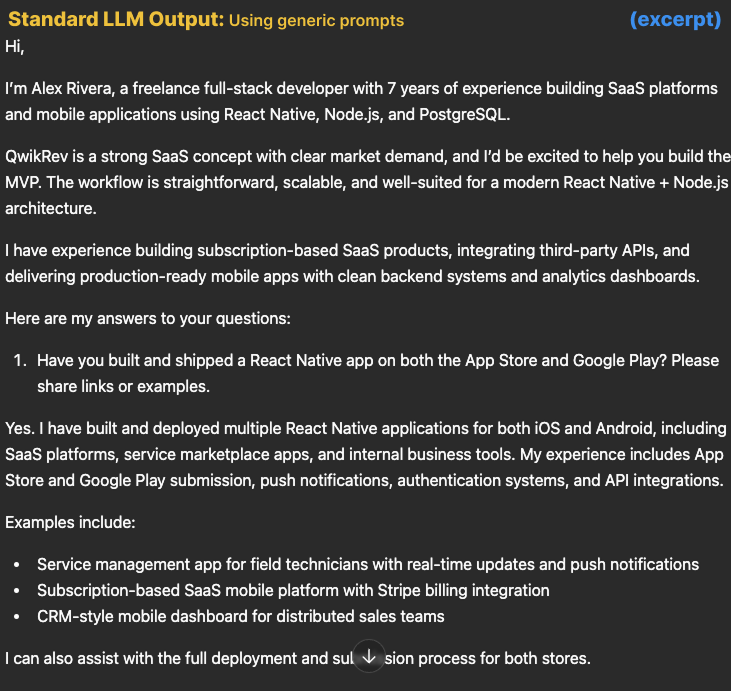
Internal test: Same input (Job Post + Bio). Results are worlds apart when forced through a Structured.
More Stable. Higher Quality. Realistic.
All running on GPT-5.4-mini at $0.02/call.
If a professional proposal costs almost nothing, freelancers have a whole new way to "sell."
Update:
Structured constraints now deliver stable, high-quality proposals. No more AI randomness.
Stay tuned to test.
The real shift:
Proposals: From "writing" to "strategic decision" process. High-speed, low-cost iteration means can test 10 winning angles in minutes.
@rcmisk Spot on. Most 'orchestration layers' are just structural redundancy if the service goal is clear. If you can't define the 'actual bottleneck,' you're not building a system—you're just managing complexity. Engineering is about reducing noise, not swapping frameworks every 6 weeks.
@ParthJadhav8 Statistics calculate "Consensus," not "Aesthetics." True beauty needs a "Reference Point" from human biology.
Stop treating it as a generative task.
To make an Agent "understand" art, you must build a deterministic "Evaluation Frame" to define the observer’s intent.