Art was the first job. It won’t be the only one.
@quipnetwork latest note is simple: your QFT is about to do more than look good.
That fits the design from the start. Quantum Echoes wasn’t just a collectible drop. Every reveal is a paid QVRF run on real hardware, with a transcript you can check.
The collection helped prove the randomness subnet in public. The next step is putting those same pieces to work beyond the image.
It follows the same pattern as the rest of the network. Post-quantum accounts protect value. QuipSwap moves it without a bridge in the middle. Nodes and compute earn from useful work.
Tokens that started as art built on a verifiable quantum seed now have a natural path into that stack.
Stay tuned actually means something here. The infrastructure underneath is already live.@quipnetwork
@provecoinlaunch
Crypto doesn’t have a launching problem anymore.
It has a proof problem.
Anyone can launch a token. Anyone can make claims.
But can you prove the team controls the domain?
Is the GitHub active?
Does the API actually work?
Did the product actually ship?
Is there measurable usage?
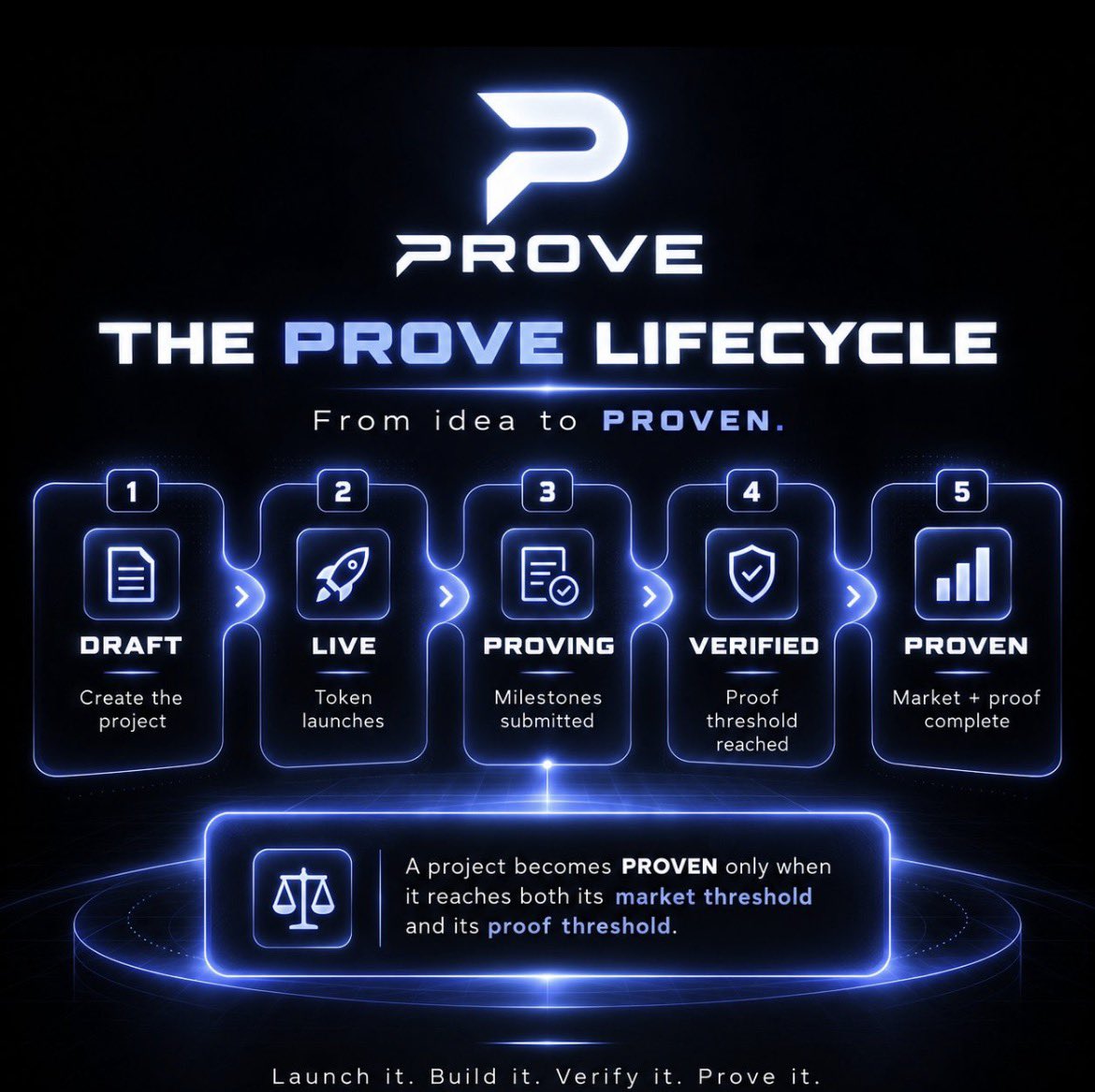
That’s what caught my attention about $PROVE.
Market activity tells you what people are trading.
Proof tells you what is actually being built.
I’d love to contribute to the PROVE ecosystem through community, content and education — helping more people understand why “Launch it. Build it. Verify it. Prove it.” matters.
@provecoinlaunch — if you’re building an ambassador/community team, I’m interested. Let me prove I can contribute. 🫡
I decided to actually explore @AntSeed instead of just reading about it.
And honestly, the setup itself caught my attention.
If you’re new to Antseed, here’s how I got started;
Start at Antseed,
I went to https://t.co/dkgURpe4za and the first thing I noticed was how straightforward the onboarding is.
You don’t need to create an account just to get started.
You can download the Antseed AI VPN, which gives you a local endpoint for connecting your AI tools to the Antseed network.
So I downloaded the Windows version and started the installation.
Happy New week, great people!
IBI IKOKO (THE HIDDEN PIECE) is NOW showing on ALADE RAYVO STUDIOS on YouTube.💃
Your new week isn’t complete without this beautiful movie!🔥
Executive producer: @Aladerayvostudios
#Naijaentertainment#Nollywood#fyp#viralpost
In 1849, men crossed continents and bet their lives on gold.
In 2026, Singapore's biggest banks are rolling out tokenized gold backed by real vaulted metal, and a new project, @GMTL_Gold, wants to track every bar from the mine to the mint. (theasset)
Same metal. Same obsession.
Completely different game.
For 5,000 years, owning gold meant digging it, guarding it or hiding it. That rule is breaking right now.
Here's how tokenized gold works, why institutions are rushing in, and what to check before you trust any of it 🧵📹👇
New week Gold video prediction published on my YouTube channel. (Link in my bio)
Watch and subscribe for more.
What's your prediction for Gold this week frens?
GM GM
#trading#awesomemike
Crypto Watchlist for the week ahead 👀
Several catalysts could drive volatility this week, from major token events to protocol upgrades and macro data.
Here are the dates and narratives I’m watching closely 🧵
Hundreds of thousands of wallets showed up for the ACI testnet.
Most of them never made the cut but only about 15,000 addresses are currently eligible.
With the clock down to 10 days, the difference between showing up and qualifying is about to decide who walks away,
with a share of the 30 million $ACI set aside for this phase.
🪡↡
A benchmark is supposed to answer:
How capable is this model?
But over time, it can accidentally start answering:
How well has this ecosystem optimized for these exact tests?
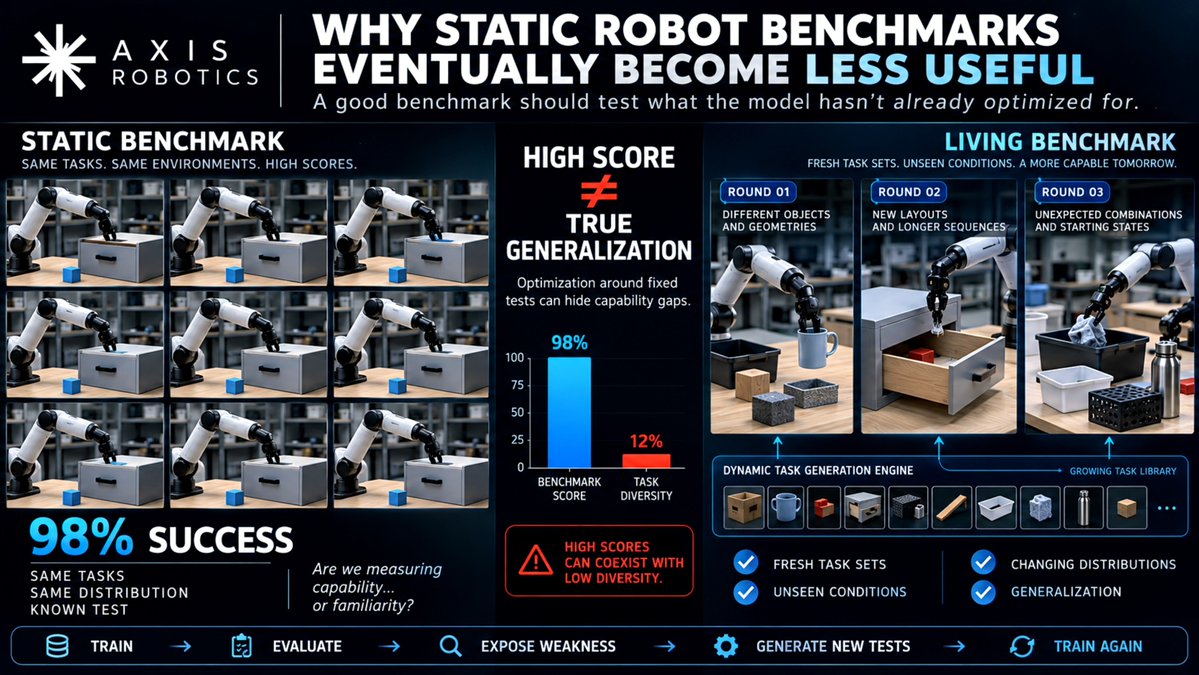
That’s the problem with static benchmarks.
At first, they’re useful because the tasks are unfamiliar.
But once the same test sets stay public for long enough, the ecosystem starts adapting around them.
Researchers study the task distribution.
Teams optimize for recurring failure cases.
Models get tuned to familiar layouts, objects, and action patterns.
Scores go up.
But the signal can get weaker.
You start seeing:
• repeated public test sets
• optimization around fixed tasks
• benchmark saturation
• poor visibility into true generalization
And that matters a lot in robotics.
Because the real world doesn’t stay fixed.
The object changes.
The scene changes.
The starting state changes.
The task sequence changes.
A robot that performs well on a familiar benchmark isn’t necessarily a robot that generalizes well.
That’s why the idea of a living benchmark is interesting.
Instead of freezing evaluation forever, the benchmark evolves.
Fresh task sets.
Held-out evaluation.
Changing distributions.
New objects and scenes.
New capability boundaries.
Now the question becomes less:
Can you beat this benchmark?
and more:
Can your model still perform when the test moves?
That’s a much stronger measure of generalization.
And it creates a better loop:
Train → Evaluate → Expose Weakness → Generate New Tests → Train Again
At that point, evaluation stops being just a scoreboard.
It becomes part of the learning system.
Static benchmarks still matter for reproducibility and comparison.
But as robot models improve, evaluation has to get harder too.
Because the goal isn’t to build a robot that knows the test.
It’s to build one that can handle what comes next.