STRIKES ON IRAN COULD PUSH CHINA BACK TO US OIL
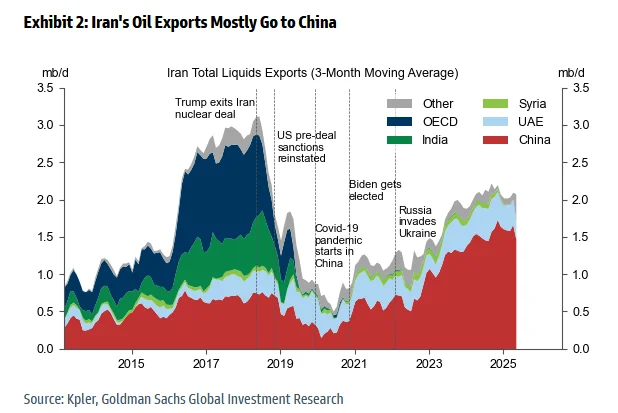
If Iranian oil supplies are disrupted, China could face a shortfall of up to 1 million barrels per day. To cover the gap, it may boost imports from Russia and resume buying US crude—halted since May 2025 due to trade tensions.
Tensions in the Strait of Hormuz, a key route for over 20% of global seaborne oil, could drive prices higher. That would squeeze margins for major refiners like Sinopec and smaller independent plants.
Irán está siendo bombardeado en este momento.
No puedes salir con oro, menos aún con la plata o los inmuebles.
Solo te quedan las doce palabras. Ahí está tu riqueza allá donde vayas.
La primera vez en 10.000 años que la riqueza puede existir como puro pensamiento sin peso.
BREAKING: The US Dollar now represents ~40% of global currency reserves, the lowest in at least 20 years.
This percentage has declined -18 percentage points over the last 10 years.
Over the same period, gold’s percentage has increased +12 points, to 28%, the highest since the early 1990s.
Gold now accounts for more global FX reserves than Euro, Yen and Pound combined.
This comes as central banks continue diversifying away from the US Dollar while rapidly stockpiling gold in their vaults.
As a result, gold prices rallied +65% in 2025, the largest annual gain since 1979, while the US Dollar Index declined -9.4%, its worst annual performance in 8 years.
Gold is changing the world.
We’ve been quietly building something new on Hyperliquid.
Here’s a first look at Hypercall - an on-chain options venue for every asset on Hyperliquid.
Over the past 6 months we've been busy building a best in class on-chain options experience
🔊 Sound on
Things I got wrong this cycle:
- restaking
- Runes/Ordinals
- Friend tech
- Stacks ecosystem
- Sonic
- Arweave/AO
Weirdly, a few good decisions fixed the above mistakes:
- Not fading Sol
- Buying Hype
- Selling airdrops
- No leverage.
Not many lessons to take from these mistakes: I believed and still believe in clicking buttons.
But the amount of clicking has decreased significantly since late 2025.
The R/R for alts seems bad and great airdrops are few and rare.
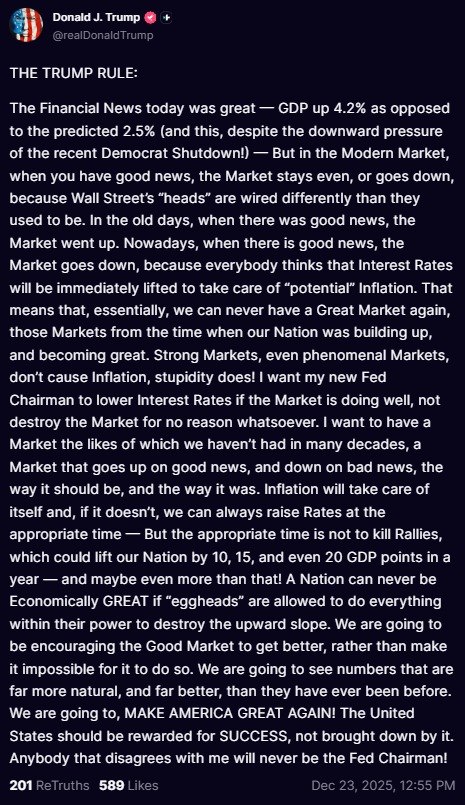
BREAKING: President Trump says anyone who disagrees with him will "never" be Fed Chairman.
He also says he wants his new Fed Chair to lower interest rates if the market is doing well.
Own assets.
BREAKING: President Trump is asked where he wants interest rates to be next year.
His response: “1% and maybe lower than that.”
You don’t own enough assets.
Los modelos de IA chinos de código abierto y gratuitos, como DeepSeek, Qwen, Kimi y GLM están experimentando una adopción masiva en Asia y África, impulsada por bajo coste, eficiencia y accesibilidad, en claro perjuicio de los de EEUU.
La irrupción de los modelos chinos es una amenaza real, está erosionando la cuota de mercado de los modelos americanos (principalmente cerrados y de pago, como los de OpenAI o Anthropic), ya que priorizan la perfección sobre la difusión.
Los americanos lideran en calidad para tareas complejas y en mercados premium pero si no responden con modelos abiertos y competitivos, perderán mercados de miles de millones de usuarios potenciales (Asia y África) y la carrera por el liderazgo global en IA se podría inclinar en su contra.
En tal caso, se acentuarían las dudas sobre ¿Burbuja IA en USA?, ¿ROI de CAPEX?
The dollar has weakened over the past week or so, which is good new for risk assets like stocks and bitcoin.
We've had two bearish dollar factors - ultra-dove Hassett emerging as clear favorite for Fed Chair, and December rate cuts odds flipping wildly from less than 35% to more than 80%.
I think we might have been getting close to "dollar wrecking ball" territory in recent weeks.
Generally, the more the dollar (DXY) strengthens, the more risk assets struggle.
This is often a leading relationship (i.e. the dollar often moves first).
Risk asset bulls probably want to see DXY weaken a lot further from here.
If we look at DXY from a very simple technical perspective - you can see it two different ways.
A big rounding bottom and all set for a move higher.
Or a long "consolidation range" type pattern before another eventual leg lower.
You can choose which one you prefer to fit your narrative.
It's "pick your own adventure"!
Durante semanas se interpretó que Michael Burry tenía posiciones cortas en NVDA y Palantir por unos 1.000 millones de dólares. La prensa —y muchos inversores— deberían saber leer correctamente los formularios 13F, porque en realidad las posiciones eran de apenas unos 10 millones cada una: 50.000 puts 2027 sobre Palantir y 10.000 puts 2027 sobre Nvidia.
En los formularios 13F, las 100 acciones subyacentes de cada put se multiplican por el precio de la acción, lo que se refleja —de forma inexacta— como si fuese el tamaño real de la posición.
Happy Thanksgiving! 🤪😎
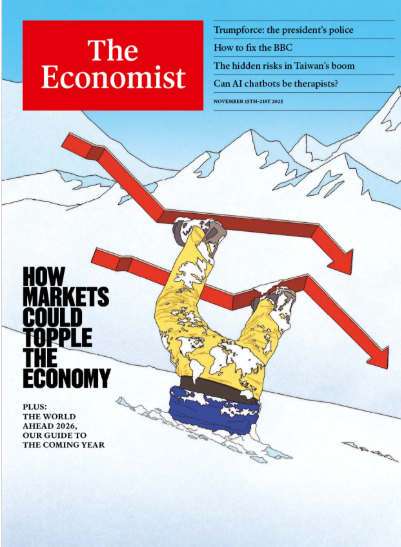
Tres semanas seguidas con muchos más bajistas que alcistas en la encuesta de inversores individuales, y estamos a tan solo a 1,5% de máximos históricos en el S&P500. Si añadimos la portada del The Economist como clásico "contrarian", creo que no es muy osado decir que veremos el 7.000 del S&P500 antes de final de año.
The stablecoin dynamics are getting increasingly difficult for central banks aiming to have complete control over money.
In the US, Trump is building a separate financial infrastructure that curtails traditional monetary policies.
Meanwhile, the largest stablecoin, USDT, turns things around by adding gold to its reserves rather than US Treasuries. Basically, this tells you that Tether is asking the right question: how weak is trust in fiat-denominated reserve assets?
If this doesn't trigger a sense of urgency to at least evaluate whether your investment portfolio aligns with these trends, I don't know what will.
In the Blokland Smart Multi-Asset Fund, we hold ZERO bonds, only scarce assets, including physical gold and bitcoin.
The ECB is soooo stuck in an outdated narrative, it's just sad.
120k $AAVE bought back… and counting. 🔥
Next milestone? 200k $AAVE buyback sooner than anyone expects.
With $1.5M/week in max-rate buybacks now live, the @aave engine is running at full power.
Muchos comentan que se avecina un desplome. No lo veo. Todo puede ser pero un "Índice de Miedo" en 9, situado en "miedo extremo" solo ha provocado en el S&P 500 una caída del 4% desde su máximo histórico. Recordemos que sube más de un 35% desde su mínimo en abril. No parece un crash.
En casi todos los años, el S&P 500 sufre retrocesos importantes en algún momento, a veces bastante profundos, como caídas del 20%, 25% o incluso más del 30%. Estas bajadas intraperiodo son normales, forman parte de la volatilidad habitual del mercado y no implican necesariamente que el año vaya a terminar mal. De hecho, desde 1980 la caída máxima promedio dentro del año ha sido del 14,1%, lo que muestra que estas correcciones son más la regla que la excepción.
Lo interesante es que, pese a esas bajadas temporales, en el 80% de los ejercicios el S&P 500 termina cerrando en positivo. Es decir, aunque a lo largo del año haya momentos de pánico, los mercados tienden a recuperarse y cerrar por encima de donde empezaron.
La idea sería que si te metes a largo, no salgas.. y eso con muchas otras cosas que ahora están cayendo a plomo...