Ability of a Structural World Model to Detect Cryptic Pockets from Apo Structure
1 Cryptic pockets are druggable sites that are absent in a protein’s resting (apo) structure and only appear after backbone rearrangement; this work reports a detector that nominates such sites directly from a single apo structure, avoiding conformational sampling, co-folding/complex prediction, and external pocket finders.
2 The core idea: a proprietary “structural world model” produces a per-residue latent state from apo coordinates; the same latent used to place residues in structural context is read out as a per-residue “cryptic-lining” score, implying the latent encodes conformational flexibility that other methods must generate at inference.
3 Pocket construction is residue-set based rather than a fixed-radius sphere: high-scoring residues seed candidates that are “grown” into disjoint residue sets under an explicit rule; geometric non-maximum suppression enforces non-overlapping ranked sites, so each rank corresponds to a distinct pocket hypothesis.
4 On CryptoBench (231 held-out test chains), using only apo input, localization under an overlap rule (>=3 shared residues with the annotated cryptic site) reaches top-1 0.848 and top-5 0.952; on a CryptoBank subset (286 chains) it reaches top-1 0.846 and top-5 0.990.
5 Residue-level separability is strong (per-residue AUC 0.8465 on CryptoBench), but exact pocket shape matching is harder: under a stricter Jaccard rule (IoU >= 0.25), recovery is top-1 0.597 and top-5 0.628—highlighting the paper’s distinction between “finding the right region” vs “matching the exact residue set.”
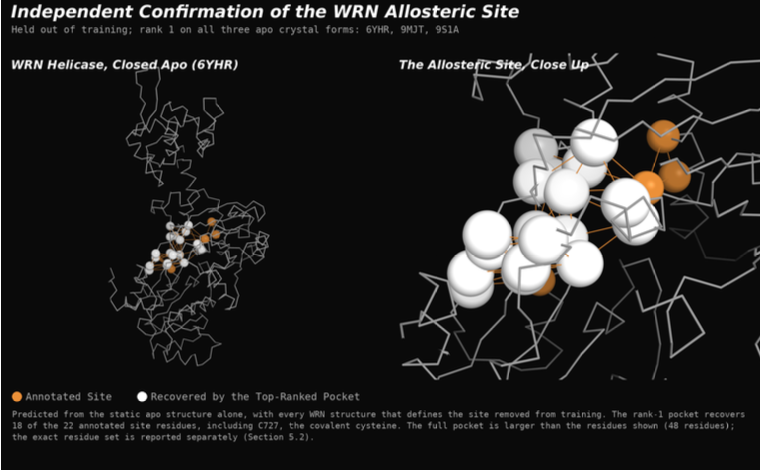
6 Generalization is illustrated with a protein-level held-out case: WRN helicase allosteric site recovery at rank 1 across three independent apo crystal forms (6YHR, 9MJT, 9S1A) after removing WRN structures from training; on 6YHR the rank-1 pocket covers 18/22 annotated residues including C727 (the covalent cysteine engaged by the clinical inhibitor HRO761 in holo structures).
7 The paper emphasizes “conversion” (ranking the true site first) as a key gap in ensemble-based cryptic detection; because the model’s per-residue score both proposes and ranks pockets, it often places the true cryptic site at rank 1 rather than merely including it somewhere in the top-k.
8 Against single-structure baselines on CryptoBench under a center-distance rule (predicted center within 4 Å of a site atom), top-1 hit rate is reported as 0.649 vs 0.417 (P2Rank), 0.323 (DeepPocket), 0.294 (PocketMiner), and 0.258 (fpocket), positioning the world-model latent readout as a different signal than geometry-only scoring on the closed state.
9 Complementarity with OpenDDE is tested on 190 cryptic targets held out of both training pools: at top-1, the detector finds 119 sites OpenDDE misses while OpenDDE finds 2 sites missed by this method; at top-5, the detector misses none of OpenDDE’s hits, suggesting an additive workflow (use both) rather than a winner-take-all replacement.
10 Practical scope notes: it runs from apo coordinates alone (including mmCIF-only entries), does not claim to solve downstream docking/design, and shows accuracy scaling with training data size (mean pocket Jaccard improves as training chains double), implying more measured cryptic examples are a primary lever for further gains.
📜Paper: https://t.co/oCw73NNpOx
#ComputationalBiology #StructuralBiology #DrugDiscovery #MachineLearning #ProteinStructure #Allostery #CrypticPockets #RepresentationLearning #Bioinformatics