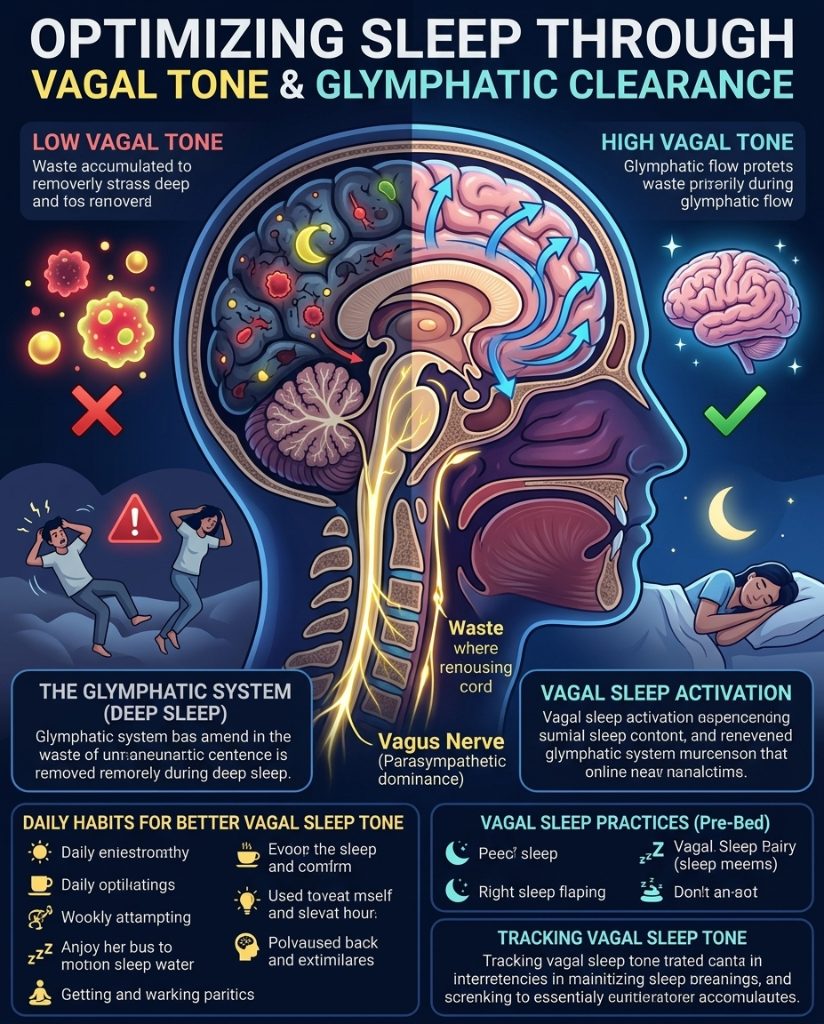
Vagal tone determines the transition from sympathetic alertness to the deep parasympathetic states required for neural restoration and glymphatic clearance.
You already recognize that your total hours in bed are a secondary metric compared to the depth of your autonomic shift. You track your overnight HRV because you understand that high vagal tone facilitates the slow-wave sleep necessary for tissue regeneration. You’ve seen how this efficiency allows for a shorter, more restorative sleep duration that outperforms long hours of fragmented rest.
You have likely felt the immediate physiological penalty of a late meal or a single drink, watching your heart rate variability drop as your core temperature stays elevated. You utilize protocols like 4-7-8 breathing or left-nostril shifts to manually override cortisol spikes. You accept that without this parasympathetic dominance, your brain cannot activate the glymphatic system to flush the metabolic waste of the day.
When you synthesize these patterns, you see that the 2 a.m. to 4 a.m. awakening window is not a random disturbance, but a specific signal of a vagal failure to maintain stability during the dynamic fluctuations of REM. As your brain moves through these cycles, a weak vagal tone allows sympathetic surges to break through, fragmenting your architecture and halting the glymphatic drainage required for neural maintenance. This means your overnight HRV trend is not just a passive recovery score, but a real-time measurement of your vagus nerve’s ability to act as a hydraulic regulator for your brain's internal plumbing.
Your ability to stay asleep through the early morning hours is the ultimate metric of whether your vagus nerve has successfully secured the environment for your brain to clean itself.
https://t.co/FbRTUYPV9P
🏃¿Sabías que el ejercicio puede mejorar la función mitocondrial en enfermedades cardiovasculares?
¿Cómo afecta el entrenamiento físico a la capacidad oxidativa mitocondrial? ¿Qué sucede con la morfología y la biogénesis? 🤔
Lee el artículo completo 👇
https://t.co/2U1H1eESwg
Cold water applied to the face for fifteen seconds triggers the mammalian dive reflex to produce an immediate drop in heart rate. This physiological response shifts the autonomic nervous system toward parasympathetic priority. The mechanism communicates with vagal nuclei in the brainstem to modulate cardiac output and quiet stress signaling without risk of overstimulation.
The 4-7-8 breathing pattern activates baroreceptors to heighten respiratory sinus arrhythmia as an indicator of vagal tone. Mechanical vibrations from humming or thirty seconds of gargling stimulate the laryngeal path where the vagus nerve travels. These actions raise heart rate variability within sixty seconds by recruiting ventral vagal pathways through direct kinetic influence.
Social interaction involving eye contact and vocal prosody engages the social branch of the vagus through facial and middle-ear muscle activation. This pathway registers environmental safety and provides a neurological foundation for social engagement. When paired with an anti-inflammatory approach, the cumulative impact on the nervous system exceeds the sum of individual practices.
Stacking cold exposure, humming, and breathwork into a one-minute routine provides a rapid method for modulating nervous system state. Directing cold water at the face for thirty seconds or humming while brushing teeth creates a consistent habit of recruitment. These brief interventions compound over time, leading to measurable increases in resting vagal tone and robust autonomic resilience.
https://t.co/wWCldxLhtq
Two people can log the same seven hours of sleep and carry different cardiovascular risk, and the variable that separates them is not how long they slept but how consistent their timing was from night to night.
Researchers tracked 72,269 UK adults with wrist accelerometers for a week, scored each person's sleep regularity with a validated index that captures how closely their sleep-wake timing repeats day to day, then followed them for eight years of hospitalization and death records. The people whose bedtimes and wake times scattered across the week had a 26% higher rate of major adverse cardiovascular events, meaning heart attack, stroke, and heart failure combined, than the people who kept a consistent schedule.
The finding that gives this study its weight is what happened when the researchers accounted for sleep duration. The intuitive assumption is that irregular sleepers are simply sleeping less, and that fixing the hours would fix the risk. It didn't. Among irregular sleepers who met the recommended amount of sleep for their age, the elevated risk barely moved, still running 19% above regular sleepers. Adequate duration offset the risk for the moderately irregular group, whose excess risk became statistically indistinguishable from zero once they slept enough, but for the genuinely irregular, hitting the hours was not a rescue. The timing itself carried the hazard.
Nearly every cardiovascular system runs on a daily clock, blood pressure, heart rate, cortisol, and the autonomic balance between sympathetic and parasympathetic tone all rise and fall on a roughly 24-hour rhythm anchored by consistent behavior. When sleep timing shifts night to night, the central clock and the peripheral clocks in cardiovascular tissue fall out of alignment with each other and with the external day, a state analogous to the physiology of shift work and social jet lag, both of which carry their own established cardiovascular associations. A person sleeping seven hours from midnight to seven one night and three in the morning to ten the next is repeatedly resetting that system, and duration alone does not capture that cost.
This is an observational cohort, so irregular timing cannot be declared a cause of cardiac events; it may partly mark people whose lives are already disrupted by illness, stress, pain, or unrecognized disease that independently raises risk, and no observational design fully removes that possibility. Sleep was captured in a single week of accelerometry and treated as representative of long-term habit, which it may not be. The cohort skewed older, healthier, and less diverse than the general population, as UK Biobank does. And the Sleep Regularity Index is a composite score, so a low number can arise from several different timing patterns that may not carry identical biological weight.
What the evidence supports, stated conservatively, is that consistency of sleep timing is associated with cardiovascular risk independently of how many hours are slept, and that among people with genuinely irregular schedules, sleeping enough does not appear to neutralize the risk their timing carries. What it does not support is a promise that regularizing your bedtime will lower your personal event rate, because demonstrating that requires an intervention trial rather than a cohort. The practical reframe is still worth stating: sleep advice overwhelmingly targets duration, the number of hours, while the timing consistency that this study flags as an independent risk factor is the lever most people never think to pull. The open question is whether deliberately stabilizing sleep timing changes hard cardiovascular outcomes, or whether regularity is simply a marker of the healthier life that produces it.
Chaput et al., J Epidemiol Community Health 2025
Vetter et al., Circulation 2016
Huang & Redline, Diabetes Care 2019
Effects of High-Intensity Interval Training on Cardiovascular Health: An Umbrella Review of Systematic Reviews and Meta-analyses
https://t.co/LTDGF7w3KY
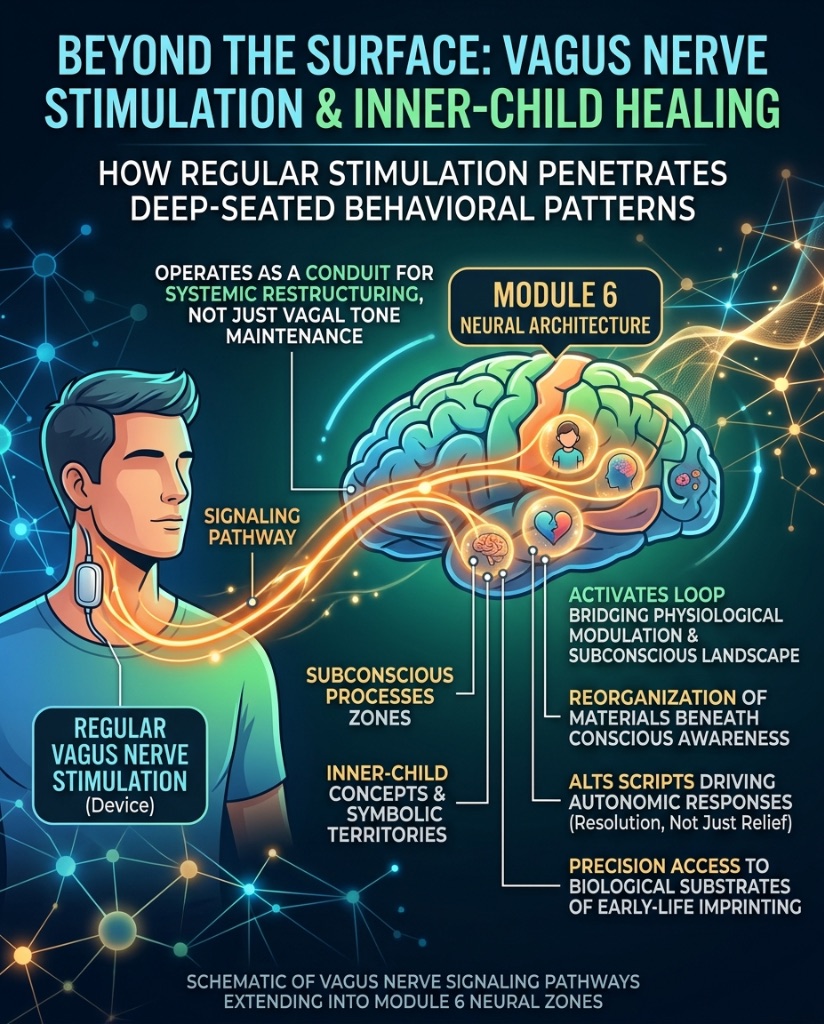
Vagus nerve stimulation (VNS) is frequently utilized for its immediate effects on parasympathetic tone, yet consistent application facilitates a far more profound interface with the neural architecture of Module 6. This secondary layer of engagement transcends simple autonomic maintenance, reaching the zones where inner-child frameworks and subconscious processes are seated. The stimulation functions as a precision signaling bridge into the symbolic territories that govern rooted emotional frameworks.
At this level, the nerve operates as a conduit for systemic restructuring rather than a tool for temporary symptom management. Signaling pathways extend from the peripheral stimulation site into specific neural zones, activating a loop that bridges physiological modulation with the subconscious landscape. This allows for the reorganization of materials residing beneath conscious awareness, effectively updating the biological substrates of early-life imprinting.
Consistent inputs at these frequencies alter the scripts driving autonomic responses, shifting the emphasis from acute relief toward the resolution of entrenched regulatory biases. By refining inputs to address these symbolic zones, the stimulator becomes a specialized instrument for accessing the deep-seated architectures of core emotional regulation. The process leverages the vagal pathway to penetrate long-standing behavioral patterns at their neural origin.
The current schematic of these pathways illustrates how signaling migrates from the stimulation site into the Module 6 neural zones. This mapping confirms the transition from peripheral input to central integration, where the biological and the symbolic intersect to drive lasting regulatory change.
https://t.co/a1XPBLZl4K
🧬¿Y si el problema no fuera solo la glucosa, sino la insulina elevada de forma crónica?
Revisión 2026 propone que la hiperinsulinemia basal crónica podría contribuir al aumento de adiposidad y al riesgo cardiometabólico más que los picos normales de insulina después de comer.
⚕️ #LAS7CAPAS & #LONGCOVID
🌎 Paciente Experto: @isabelledelez desde @covideuskal
⏰ Hoy jueves 2 de julio a las...
🇲🇽 6 am
🇪🇨 7 am
🇨🇱 8 am
🇦🇷 9 am
🇪🇸 2 pm
🎙️ En vivo y en directo ¡y en español!
🕊️ AIREyVIDA aquí no contamos casos, los prevenimos
https://t.co/0ZYCynvoIq
Non-invasive vagus nerve stimulation engages the cholinergic anti-inflammatory pathway to modulate immune responses through the neuro-immune and vagus-gut axes. This mechanism relies on the inhibition of tumor necrosis factor production dependent on the alpha-7 nicotinic acetylcholine receptor and the reduction of pro-inflammatory cytokines like IL-1beta and IL-6. Pre-clinical models demonstrate that these signals facilitate increased efferocytosis and lower myeloperoxidase levels, effectively shortening the duration of inflammatory cascades.
Experimental protocols utilize varied parameters, often ranging from 0.5 to 1 milliampere at frequencies between 5 and 10 hertz. In models of peritonitis and colitis, these electrical inputs reduce intestinal lesion areas and attenuate lung injury by modulating macrophage phenotypes. Furthermore, the stimulation enhances the expression of netrin-1 and lipoxin A4, demonstrating that the therapeutic effect can operate independently of the spleen in specific enteric environments to reduce histological inflammation scores.
Clinical application addresses systemic autoimmune diseases like rheumatoid arthritis and neuroinflammatory conditions. By targeting the USP10 and NF-kappaB pathways, stimulation attenuates hippocampal inflammation and limits damage following ischemic stroke. Future research focuses on optimizing treatment parameters and exploring synergistic effects between vagus nerve stimulation and other modalities, offering a precise alternative for patients unresponsive to pharmacological interventions that carry risks of organ toxicity.
https://t.co/WHWxVPuyDo
Non-invasive vagus nerve stimulation engages the cholinergic anti-inflammatory pathway to modulate immune responses through the neuro-immune and vagus-gut axes. This mechanism relies on the inhibition of tumor necrosis factor production dependent on the alpha-7 nicotinic acetylcholine receptor and the reduction of pro-inflammatory cytokines like IL-1beta and IL-6. Pre-clinical models demonstrate that these signals facilitate increased efferocytosis and lower myeloperoxidase levels, effectively shortening the duration of inflammatory cascades.
Experimental protocols utilize varied parameters, often ranging from 0.5 to 1 milliampere at frequencies between 5 and 10 hertz. In models of peritonitis and colitis, these electrical inputs reduce intestinal lesion areas and attenuate lung injury by modulating macrophage phenotypes. Furthermore, the stimulation enhances the expression of netrin-1 and lipoxin A4, demonstrating that the therapeutic effect can operate independently of the spleen in specific enteric environments to reduce histological inflammation scores.
Clinical application addresses systemic autoimmune diseases like rheumatoid arthritis and neuroinflammatory conditions. By targeting the USP10 and NF-kappaB pathways, stimulation attenuates hippocampal inflammation and limits damage following ischemic stroke. Future research focuses on optimizing treatment parameters and exploring synergistic effects between vagus nerve stimulation and other modalities, offering a precise alternative for patients unresponsive to pharmacological interventions that carry risks of organ toxicity.
https://t.co/WHWxVPuyDo
@guty2370 Si sabes como reactivar el sistema.osteomioarticular y los engramas de puntos neurobiomecanicos especificos desde la refuncionalizacion mitocondrial, lo demas se acomoda integramente
@JaimeAcevedoMD@mera_cordero@lalaur79
🗣️ "Bielsa hace cosas que a veces podes entender y a veces no. Cuando nosotros entendimos que era el camino del éxito, que nos podía hacer ganar plata y partidos, lo bancamos a muerte. En ese momento era muy exigente y había que soportarlo a él, por eso tuvimos dos años exitosos.
Me llama la atención lo de Uruguay, ante Argentina había sido brillante. No sé que es lo que le pasó, como repercutió todo puertas adentro.
Con nosotros no era tóxico, hablaba bastante conmigo o con el Tata (Martino). Pasa que hay cosas que a veces él interpreta de una forma distinta. Él me quería hacer ver videos a mí, y yo le decía 'no, Marcelo, eso a los chicos', jaja"
Juan Manuel 'Chocho' Llop, campeón con Bielsa en Newell0s, en #FútbolConEscalas por DSPORTS Radio FM 103.1 #ElSonidoDelDeporte 📻
Electricity is a clumsy guest. When we try to nudge the vagus nerve with electrical current, the charge wanders, choosing whatever path of least resistance it can find through skin and fat, often missing the intended target entirely. It is a scattershot approach to a delicate system.
Sound moves with a different kind of geometric precision. A trial at the University of Nottingham is bypassing the messiness of electrical pulses by using high-frequency acoustic waves to communicate with the auricular branch of the vagus nerve. Using a wearable headset called the ZenBud, researchers are sending focused pressure through the ear to trigger the parasympathetic system without a single surgical incision.
It is a peculiar thing to consider: a silent, mechanical hum vibrating against the side of the head, altering how the heart beats and how the brain processes emotion. This is not just a study on relaxation. The researchers are tracking the body’s response with an almost obsessive level of detail, monitoring everything from continuous glucose levels and skin conductance to EEG and cognitive performance on memory tasks.
They are looking for the exact moment a sound wave becomes a physiological shift. By using ultrasound, the stimulation behaves more like a focused beam than a spreading stain. We are watching a transition in how we interface with our own biology, where the internal landscape is adjusted not by a blade or a battery, but by the predictable propagation of a wave through living tissue.
Participants wear the device for thirty minutes while their entire metabolic and neurological state is mapped in real-time. It is a search for the specific frequency of silence that can change the way a human being feels and thinks.
https://t.co/zHD1086SjF
The tragus is an unassuming little flap of cartilage, yet it holds a direct line to the heart's internal timing. Researchers took a group of volunteers over fifty-five and began tickling this specific patch of ear skin with low-level electrical pulses. It turns out that fifteen minutes of this localized hum can rewrite the rhythm of a person's autonomic state.
The most striking part isn't just that the heart rate variability increased, but how the body seems to wait for the signal. The baroreflex—the internal pressure gauge that keeps blood pressure from swinging wildly—actually sharpened its sensitivity. It is as if the body was looking for a reason to recalibrate its own sensors and found it in the skin of the ear.
There is a curious mathematical symmetry to who responds best. The participants who were the most tilted toward a sympathetic state—those whose systems were already humming with high-frequency tension—saw the most dramatic shifts. The more the internal balance was skewed, the more the vagus nerve seemed to soak up the external stimulation.
After two weeks of these daily sessions, the effects weren't just temporary spikes on a monitor. The gains in heart rate variability held steady. Sleep deepened and moods shifted, not because of a chemical intervention, but because the vagus nerve was being nudged back into its natural, oscillatory dance. We are essentially using a tiny topographical map on the ear to navigate the deep, ancient architecture of the chest.
https://t.co/oGKNz2IBUG
HIPOXIA Y RENDIMIENTO: ¿SIGUE SIENDO LA ALTURA UNA VENTAJA PARA LOS CORREDORES?
La hipoxia lleva décadas utilizándose para mejorar el rendimiento en corredores de resistencia.
Pero... ¿funciona realmente?
La evidencia reciente dice que mucho menos de lo que pensamos.
En corredores entrenados no se observan mejoras consistentes en:
• economía de carrera
• VO₂máx
• rendimiento competitivo
La hipoxia no parece una garantía de correr más rápido.
Nuevo artículo →https://t.co/kmRn6tSyit
https://t.co/ghlyA0rsYU
The vagus nerve serves as a mechanical transducer for respiratory rhythm as it traverses the brainstem, thorax, and abdomen. Diaphragmatic movement during inhalation physically stretches the nerve fibers while exhalation releases this tension, creating a consistent cycle of mechanical stimulation. This physical interaction allows the depth and cadence of breath to act as a direct remote control for modulating autonomic signals sent to the heart, lungs, and digestive tract.
Respiratory control originates in the pre-Bötzinger complex of the brainstem, which coordinates with the nucleus tractus solitarius to relay signals from pulmonary stretch receptors. During exhalation, the vagus nerve increases its firing rate and releases acetylcholine at the sinoatrial node to decelerate the heart. This mechanism, known as respiratory sinus arrhythmia, creates a vagal braking effect that shifts the body toward a parasympathetic state of rest and repair.
Vagal tone is quantified through heart rate variability and is enhanced by ancient practices like Ujjayi and Bhramari breathing that stimulate the nerve's auricular branch. Systematic training of this system is achievable through breathing ratios that prioritize an extended exhalation phase, such as a four-count inhale and a six-count exhale. Mastering these rhythms provides immediate physiological feedback through heart rate deceleration, offering a bridge to improved emotional regulation and long-term healthspan.
https://t.co/gvvDHhuzbN
¿La COVID-19 grave puede acelerar el envejecimiento del cerebro?
Un nuevo estudio utilizó una técnica genética llamada aleatorización mendeliana para responder una pregunta que los estudios tradicionales tardan años en resolver.
🧵
Mainstream neuroscience continues to treat the vagus nerve as a simple toggle for the parasympathetic system. This reductionism misses the reality of a bi-directional architecture that dictates systemic inflammatory states and organ-level signaling long before the brain processes a feeling of calm. When you engage the auricular branch or manipulate breath patterns, you are not just relaxing; you are accessing a structural gateway through the jugular foramen that connects the brainstem directly to the heart, lungs, and gut.
The common mistake is viewing vagal tone as a temporary state rather than a physiological capacity. The nerve’s extensive branching allows it to simultaneously regulate heart rate variability and the cholinergic anti-inflammatory pathway. It is a physical bridge between the amygdala and the abdominal viscera. Stimulating the ventral vagal complex does more than suppress a stress response; it facilitates a shift in cellular priority from defense to repair.
Localized interventions like ear-based stimulation or extended exhales work because the nerve is a singular, wandering entity with multiple entry points. The effects spread across the gut-brain axis because the anatomy demands it, not because of a vague mind-body connection. Lasting resilience requires weeks of consistent signaling to force neural pathways to adapt. We need to stop talking about hacking the vagus and start recognizing it as the primary physiological substrate for systemic homeostasis and social engagement.
https://t.co/c9aQTnq7Rx