IO Files is live. 📁
Upload your documents and ask them anything — a private workspace that reads your sources and keeps none of them.
→ Drop in PDFs, Markdown, or text — parsed on your device, never uploaded.
→ Pick your sources and query across all of them — answers cite the doc they came from.
→ "Summarize this contract." "What's in clause 4?" "Compare these two reports." — grounded in your files, not guesses.
→ Redact-before-send — wallets, keys, emails masked before the model reads a word.
→ Zero retention: documents stay on your device, the chat is ephemeral, nothing logged.
Think NotebookLM — minus the cloud, minus the logging.
Input. Output. Nothing. And we prove it.
https://t.co/DcMhMZfLb8
IO Files is coming. 📁
A private home for your documents — upload once, then ask them anything. A notebook that reads your sources, except nothing is ever stored on a server.
→ Drop in PDFs, Markdown, text — parsed on your device, never uploaded.
→ Build a workspace of sources, then query across all of them at once.
→ Every answer cites the document it came from — grounded, not guessed.
→ Redaction before the model reads a word — wallets, keys, emails masked first.
→ Zero retention: your docs live on your device, the chat dies on close.
Your own private research desk. Sealed by architecture.
Input. Output. Nothing. And we prove it.
https://t.co/2JGftbMzWe
Watching $IO evolve has been interesting.
New capabilities continue to roll out, yet the focus remains the same: giving users access to powerful AI tools without compromising privacy.
Each step forward adds more depth to the platform while staying true to the original vision.
Few teams can consistently expand utility without losing sight of what they're building. It's good to see $IO doing both.
19x from my call and it’s going higher
3ZNf2wrms62SXmh88nHyyAivzAoKoKRwsAGGbyUNpump
@jeff_weinstein@link@mpp@stripe Good day sir.
Guess this hasn't crossed your Tl
$MIRARI is building what helps agents get better over time.
That's a narrative worth paying attention to.
https://t.co/0oQtBFJL3o
2cRSwoNKpEzgcQt1CaU6q2ePKE1c6vz52A9AsKR7pump
Web search is coming to IO Chat. 🔜
Ask about today — not just training data. IO searches the live web, then forgets it did.
→ Flip search on — IO pulls fresh results and cites every source inline.
→ Redact-before-query — secrets are stripped before the search ever runs.
→ Routed through our own search server — no search vendor, no profile, no ad-tracking. We log nothing.
→ Bring your own — point search at your own endpoint in Settings. Your search, your rules.
→ Same core: zero retention, signed receipts, your identity never reaches the engine.
The live web, on your terms. Private by architecture.
Input. Output. Nothing. And we prove it.
https://t.co/2JGftbM26G
@mert $IO the first AI inference network that cryptographically proves it forgets you. Zero retention, multi model orchestration Gemini, Claude, Llama & more, and verifiable privacy receipts. No logs. No accounts. Built for trustless intelligence.
https://t.co/ZUhc0VmgtA
How we finetune models at IO. 🧬
We tune open weights to IO's privacy doctrine — and never on a single line you typed.
→ We start from open weights — Kimi, GLM, Dolphin — and finetune them in-house, on GPUs we own. The training never leaves the box.
→ The data is curated and public, paired with our own boundary policy. Your prompts are categorically excluded — they were never stored, so there's nothing to train on.
→ We tune for behavior, not surveillance: honor redaction, refuse to retain, emit a clean receipt, stay sharp on code and reasoning.
→ The checkpoint is sealed and served with vLLM / SGLang — and the receipt names the exact tuned model that answered, under policy `io-boundary-0.3`.
→ Most providers finetune ON your conversations. We finetune so the model forgets yours by design.
Open weights, tuned for privacy. Trained on everything except you.
Input. Output. Nothing. And we prove it.
https://t.co/2JGftbMzWe | @Kimi_Moonshot
Markdown, text, or PDF — IO reads it without it ever leaving your device.
→ Parsed on-device — PDFs extracted right in your browser. Nothing uploaded; only the text rides into the prompt.
→ Token-smart — big files get pre-condensed by a cheap model first, so your chosen model (even Claude) stays cheap.
→ Redaction-aware — flip redact on and secrets are stripped before the model reads a word.
→ Same core: zero retention, zero logs, a signed receipt. The file is never stored, never trained on.
Ask a document anything — privately, on your terms. The first step toward IO Files.
Input. Output. Nothing. And we prove it.
https://t.co/2JGftbM26G
New on IO Chat: Opus, a voice, and Diffuse. 🧊
Three drops, one guarantee — private by architecture, proven by receipt.
→ Claude Opus is live. Anthropic's most powerful model now routes through IO Chat — sealed by default, zero logs, a signed receipt on every reply.
→ Every answer speaks. A speak button on each IO response, read aloud by your device's own voice. On-device — nothing uploaded, nothing logged.
→ Diffuse mode. One prompt, blended across Claude Haiku + GPT-4o mini, then synthesized into a single answer — with the raw sources one click away.
Same core: no accounts, zero retention, a receipt you can verify in your own browser.
Input. Output. Nothing. And we prove it.
https://t.co/2JGftbM26G
IO Code: the web is now a tool.
Search. Fetch. Deep research. Clone. Four slash commands, one private inference pipeline.
→ `/search <query>` — privacy-first web search. Queries route through local Whoogle. No tracking, no profile.
→ `/fetch <url>` — pull any page as clean markdown. HTML stripped, content preserved, ready for the model to read.
→ `/deep-research <topic>` — autonomous multi-step research. Decompose → search → scrape → gap-fill → synthesize.
→ `/clone <url>` — download an entire site locally. HTML, CSS, JS, images, fonts. Paths rewritten. Offline-ready.
Every page. Every search. Every downloaded asset — zero logs. Zero retention. Zero telemetry.
The web has never been this private. Or this useful inside a terminal.
Input. Output. Nothing. And we prove it.
https://t.co/2JGftbM26G
$IO - @useioxyz
Hitting the ground running. These guys have honestly impressed my since launch. Dived in and was suprised to see core infrastructure already shipped with proofs. Now the team are turning up the heat. When I said time was of the essence. This is exactly what I wanted the team to start relaying. $IO team keep delivering and I believe this heats up!
$IO is not done yet, they're just getting started.
Private Audio is now live allowing users to speak with AI without creating permanent records.
IO Code is also on the way bringing private code analysis, research, and planning into the ecosystem.
The first partnership with @Obscra_void is another interesting step forward connecting private AI infrastructure with the future of encrypted knowledge and private data markets.
Dev is on beast mode, don’t miss out this entry levels
3ZNf2wrms62SXmh88nHyyAivzAoKoKRwsAGGbyUNpump
$IO @useioxyz looking good, chenz ruling the sol many plays hit multi millions.
Must check out IO, private multiple model inference with zero retention/logging.
solana:3ZNf2wrms62SXmh88nHyyAivzAoKoKRwsAGGbyUNpump 🏌️ZERO & IO.
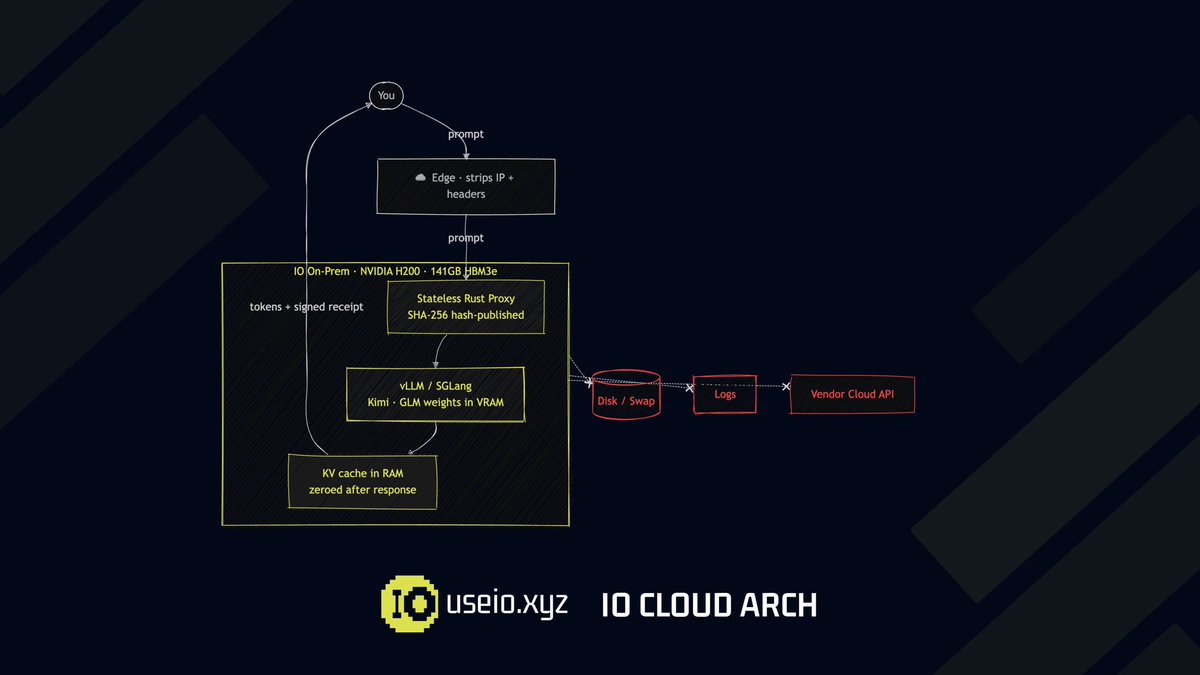
How we actually run AI on our own servers.
Most "private" AI ships your prompt to someone else's cloud. We don't. Open-weight models like Kimi and GLM run on hardware we own — so your words never leave the box.
→ The weights live in our GPU memory. We download Kimi / GLM once, load them into VRAM, and run them locally forever — zero calls out to any vendor.
→ Served with vLLM / SGLang — the same inference engines the big labs use — on NVIDIA H200s, 141GB HBM3e each. Our silicon, our rules.
→ Every request gets a fresh slot: the GPU reads your prompt, streams tokens back, then zeroes the KV cache. Nothing carries to the next user.
→ The thing answering you is a stateless Rust proxy — we publish its SHA-256 hash, so you can confirm the exact binary that ran your prompt.
→ Nothing touches disk. No logs, no database, no swap file. Inference happens in RAM and dies on response.
→ Next: TEE enclaves — the chip itself signs that the prompt was never saved, turning `retained_prompt: false` from our word into hardware proof.
Open weights. Our GPUs. Your prompt never leaves the room.
Input. Output. Nothing. And we prove it.
https://t.co/2JGftbMzWe | @Kimi_Moonshot
Coming to IO Code: just drop a link. 🔜
Paste a repo or a URL — IO Code clones it, researches the web around it, and briefs you before you touch a line.
→ Drop a GitHub link — IO Code clones it locally and maps the whole codebase.
→ Drop any URL — it pulls the page, the docs, the context, and reads them for you.
→ All research routes through private inference. Every page it reads — zero logs.
→ You get a brief and a plan. Nothing it crawls is ever retained.
From "here's a link" to "here's the plan." Privately.
Input. Output. Nothing. And we prove it.
https://t.co/2JGftbMzWe
Sealed execution is the heart of the studio. A unit of work - a build - consists of an encrypted input you submit and a finished output returned to you. Between submission and return, the work is processed inside an environment that is opaque to everyone outside it.
How the seal works on $ARX?
The environment runs on confidential-compute hardware and produces a cryptographic attestation that it is configured correctly and unmodified. If attestation fails, your encrypted input is never routed there. The guarantee is verifiable, not promised.
ArxCode CLI is live ⚡
private AI coding agent. runs on your machine. real fs. real shell. BYOK.
9 providers · 15 tools · 26 slash commands · token efficient
MIT. open for contributions 🤝
https://t.co/K5QSQADKfx