@leap_71@FarsoonAM Also, is the architecture based on surrogate models + optimization loops, or pure generative code?
Would love to hear your insights!
@leap_71@FarsoonAM Fascinating work! Big fan of LEAP 71's approach. 🚀 Just wondering: for Noyron's physics evaluation, do you use separate decoupled modules or a fully integrated multiphysics (thermal, fluid, structural?)-coupled framework to drive the AI iterations?
@afshawnl Congrats on v2! Quick question on positioning: how do you see this vs LEAP 71's stack (PicoGK + Noyron)? My read turbodesigner is a domain-specific axial generator (mean-line→blade flow→CadQuery BREP), while LEAP 71 is a general voxel/SDF kernel specialized per domain. Fair?
Microsoft researchers introduce MatterGen, a model that can discover new materials tailored to specific needs—like efficient solar cells or CO2 recycling—advancing progress beyond trial-and-error experiments. https://t.co/z9yOaV7VGo
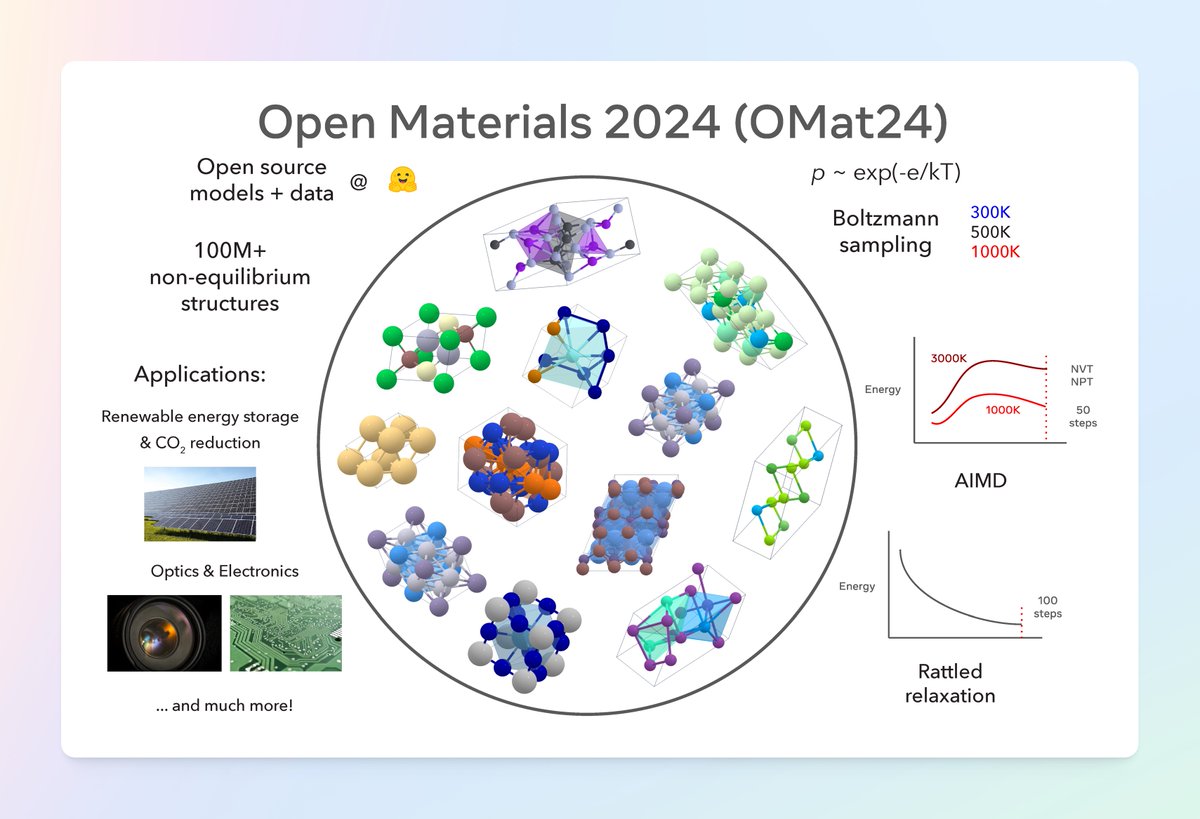
New open source release — Meta Open Materials 2024: a new open source model and dataset from Meta FAIR to facilitate inorganic materials discovery.
The Open Materials 2024 models deliver results putting them at the top of the MatBench-Discovery leaderboard. They use the EquiformerV2 architecture and come in three different sizes: 31M, 86M and 153M.
Get the models on @huggingface ➡️ https://t.co/bDZzxaFInx
The Open Materials 2024 dataset contains over 100 million Density Functional Theory calculations focused on structural and compositional diversity — making it one of the largest open datasets of its kind to train these types of models.
Get the dataset on Hugging Face ➡️ https://t.co/bDZzxaFInx
We’re happy to share this work openly with the community excited for how this work could enable further research breakthroughs in AI-accelerated materials discovery.
Today, we’re open-sourcing our SynthID text watermarking tool through an updated Responsible Generative AI Toolkit.
Available freely to developers and businesses, it will help them identify their AI-generated content. 🔍
Find out more → https://t.co/n2aYoeJXqn
Transformer: Multi-Head Attention ~ Math vs Code 🔢💻 ~ I made this visualization to show you how to implement the multi-head attention math in PyTorch within 50 LoC. Multi-Head Attention is what makes the Transformer's performance outstanding. It captures and represents more diverse linguistic relationships and patterns, and attends to different learned input embedding spaces. The parallel computing design also makes the model more efficient.
Introduced MatterGPT model, a GPT2-based large language model for solid-state materials, specifically designed for inverse design of crystal structures. It excels in multi-property inverse design. 🧠⚒️💎https://t.co/ID9AMJnzr1 https://t.co/b3ZZGEztH1 @DarkCosmos4#AI4Science
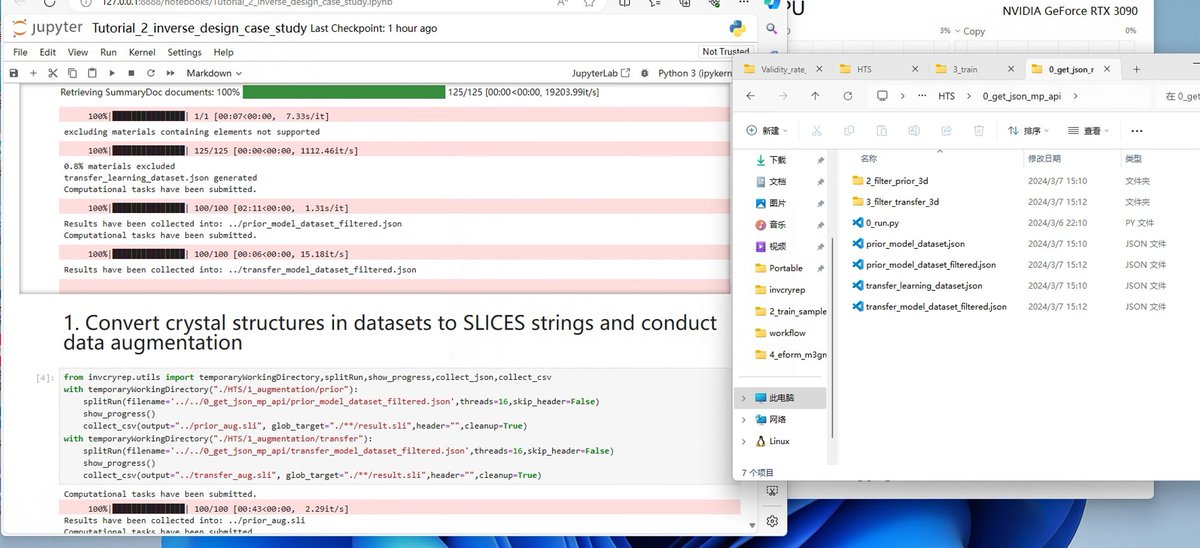
We have developed new tutorials for SLICES based on Jupyter notebooks. This comprehensive overhaul makes the tutorials much easier to use. Explore the updated tutorials through the link below. 🧠⛏️💎https://t.co/wYrBBH8N8U #ai4science#MaterialsDiscovery#SLICES#DigitalChemistry
SLICES, an invertible and invariant crystal representation, facilitates the discovery of new materials with specific properties. For example, we built a conditional RNN model capable of generating crystals with tailored formation energy #materialsdiscovery#materialsinformatics
Inspired by SMILES for molecules, SLICES representation acts as a bridge between crystal structures and text, showcasing potential
as a useful tool for the inverse design of functional crystalline materials. https://t.co/d8fkeAjXnG @NatureComms
[2/2] By developling SLICES, an invertible and invariant crystal representation, we have explored property-driven inverse design of materials using language models. More details are in our paper at https://t.co/d8fkeAjXnG.
Congratulations again on the impactful work!
[1/2] Very exciting work from @MSFTResearch team on using diffusion models for property-driven inverse design of crystals. We also been working on inverse materials design using AI. In fact, our SLICES representation took inspiration from CGCNN proposed by Tian Xie et al.
Excited to share our latest paper on SLICES, an invertible and invariant crystal representation. The lack of invertible and invariant crystal representations hinders the inverse design of crystals. https://t.co/d8fkeAjXnG #AI#GenerativeAI#materials#informatics 1/2
However, under bending deformation the local tension-shear load transfer is coupled with the global bending deformation which can't be described by the widely-adopted theoretical models in nacre-like structures, like tension-shear chain model and deformable tension-shear model.