ethereum:0xfaba6f8e4a5e8ab82f62fe7c39859fa577269be3 is trading at $0.3755 right now, sitting mid-range after a volatile year.
Here's the structure that matters.
Early trading was rough, a sharp spike shortly after listing, followed by a long grinding decline through the back half of last year.
By February, price had based out in the $0.25 to $0.30 range for months.
On May 8, ONDO spiked hard to roughly $0.50 in a single move, with RSI hitting 91.93 that day, deeply overbought.
That kind of spike rarely holds. It didn't. Price faded from there into a $0.30 to $0.45 range that's held since.
Within that range, ONDO dipped toward the $0.30 area in August before climbing back to current levels near $0.3755.
Momentum is mildly constructive, not extreme.
RSI(14) sits at 59.24, above the neutral 50 line, with its moving average at 42.30. Elevated but nowhere near May's overbought reading.
MACD's line is sitting above its signal line, a mild positive tilt.
In plain terms: ONDO is recovering inside an established range, not breaking out of one.
The range's ceiling near $0.45 to $0.50 and its floor near $0.30 are the levels worth watching for an actual break either direction.
Not a signal to act on, just what the chart is showing. I'm not a financial advisor, and this isn't trading advice.
A subnet lead on Bittensor scammed his own investors.
Within 24 hours, three competing subnets launched, doing the same thing. Better.
That's not spin.
That's what happens when a network is actually decentralised instead of just calling itself that.
Here's what's useful in this story, not just interesting.
The person behind what's now called the Covenant incident only owned 18% of that subnet.
The rest, investors, miners, contributors, didn't disappear when he did.
Because the code was open source by design, other builders forked it, improved it, and replaced it in a day.
Const's framing is the actual lesson.
"If you think it's about one individual instead of the network, go die on that hill."
The ideas came from Bittensor. Nobody can take them back out.
Second useful thing.
Bittensor just shipped something called conviction. Worth understanding if you're evaluating any subnet.
Bitcoin measures trust through proof of work.
Ethereum through proof of stake.
Bittensor just added a third dimension: time.
Subnet owners can now provably lock commitment to their project on chain. A public signal of how long they're actually staying.
It's opt in, not mandatory.
Which means you can now check whether a team backing your investment has put their money where their mouth is, literally, on chain.
Third. This is the part most people will scroll past without registering.
AI agents can already mine Bittensor subnets.
Const said it plainly. Point an agent like Claude at a subnet, and it figures out how to mine it, optimise it, even exploit it, in under a day.
What used to take a team of engineers weeks to work out now happens in an afternoon.
That's not a future prediction.
That's already working today.
If you're evaluating a subnet, check three things before anything else.
Is the code actually open source?
Has the team signalled conviction through locked commitment?
Can it survive a bad actor leaving without the whole thing collapsing?
The Covenant incident is now the live case study for what "yes" looks like on all three.
The $0.02 token and the $2.50 token both say "Apple" on the label.
Only one of them will ever let you redeem it for an actual share.
Read the framework before you read the price.
$RENDER just did the thing that traps every late seller.
Price bled from 2.45 in May straight into the mid August lows near 1.25.
The people who finally capitulated did it right at the floor.
Then the reversal showed up.
RSI snapped vertically off oversold to 58.16.
MACD flipped its cross with the histogram turning green beneath the zero line.
Price closed back at 1.399, up 2.19% on the day.
That is not a dead cat bounce.
That is momentum changing hands after two months of sellers running the tape.
The level that decides everything from here sits at 1.60.
That was support all spring and it is now the first real ceiling bulls have to reclaim to confirm the flip.
Lose 1.25 and the whole recovery read is dead.
Oversold reversals look obvious in hindsight and feel impossible in real time.
The chart was flashing fear at the exact spot it usually pays to fade it.
The signal was already on the screen.
Did you read it, or did you sell it?
$TAO has been quietly building a base while everyone's been watching the majors.
Current price: $206.17, basically flat on the day, +0.29%.
Here's the structure that actually matters.
TAO's all time high was $757.60, set back in March 2024.
What this chart shows is the more recent history: a local top near $520 in November, then a hard decline from there.
By February, price had fallen to $144.86, a roughly 72% drawdown from that November high alone, and TAO is still sitting around 73% below its true all time high.
Since that November peak, it's been a series of lower highs. A rally to $375 in April. Another to $320 in May. Each bounce topping out below the last.
That's the part worth sitting with. Not a straight line down, a staircase down.
But look at where price actually is right now.
Since July, TAO has been consolidating tightly in the $190 to $210 range.
No new lows. No breakdown toward that $167 or $144 support even being tested.
After six months of lower highs, a range that holds instead of breaking further is worth noting.
Momentum backs up the "cooling off, not collapsing" read.
RSI(14) sits at 57.20, above the neutral 50 line, with its moving average at 50.99.
Not overbought, not oversold, just neutral to mildly constructive.
MACD's line is sitting above its signal line, a mild positive tilt after months of the indicator hugging the zero line with no strong trend either direction.
The setup in plain terms: TAO stopped making new lows for the first time since the November top, and it's building a range instead of continuing the staircase down.
That's not the same as a reversal being confirmed.
A break above the $230 to $240 zone would be the first real signal the staircase pattern is broken.
A break below $190 would say the range failed.
Not a signal to act on, just what the chart is showing.
I'm not a financial advisor, and this isn't trading advice.
GM FAM 💚
$BTC just pumped 11% from $63,000 → $70,000.
Hope you enjoyed my analysis.
The 2023 accumulation fractal is getting More interesting by the day…
And if this fractal plays out again, the bigger target could still be ~$265K by 2030.
The setup is quiet. The potential move isn’t.
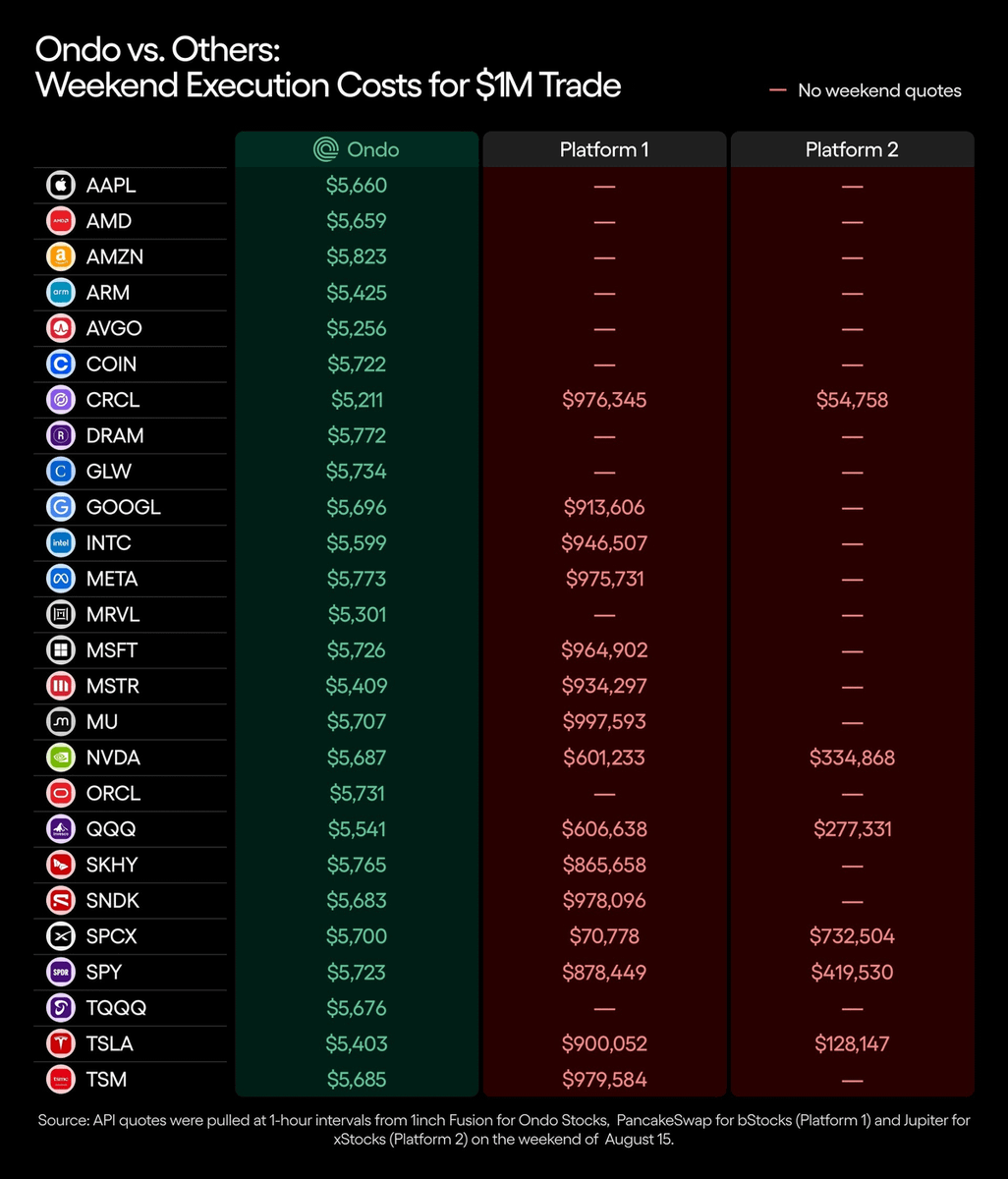
While Wall Street was closed this weekend, someone still paid $997,593 in costs to trade $1 million of Micron stock.
On Ondo, the exact same trade cost $5,707.
That's not a typo.
That's what happens when a market has to fake liquidity it doesn't actually have.
Traditional exchanges shut down on weekends.
So anyone trading tokenised versions of those stocks elsewhere is trading against thin, stale order books.
The spreads blow out because there's no real depth behind the price.
Ondo tested this directly on the same $1M trade:
META: $5,773 on Ondo vs $975,731 elsewhere.
GOOGL: $5,696 vs $913,606.
Same asset. Same moment. Roughly 170x cheaper.
This is the actual test of "24/7 markets."
Not whether a platform is technically open on Saturday.
Whether it can execute size without falling apart when the rest of the world's liquidity goes home.
Real liquidity doesn't clock out.
Most of the market just hasn't been built to prove it yet.
Nobody screenshots the buys that scared them.
They only remember the ones that felt safe and went nowhere.
$TAO around $191. Down about 32% over the last 90 days.
$RENDER around $1.27. Down roughly a third over the same stretch.
The best entries never announce themselves.
They feel like mistakes right up until they don’t.
Are you reading the network, or reading the fear?
SEPTEMBER 15: THE BIGGEST CRYPTO REGULATORY VOTE OF 2026 IS LOCKED IN
The U.S. Senate has scheduled a key procedural vote on the CLARITY Act for Tuesday, September 15 at 2:15 p.m. ET.
This is not final passage. It is cloture on the motion to proceed, the first real floor test that needs 60 votes just to open formal debate.
Quick facts:
House already passed it in July 2025, 294 to 134.
Senate Banking advanced it in May 2026, 15 to 9.
Thune filed the cloture motion in early August.
Key fights left: ethics rules, money laundering provisions, and stablecoin rewards.
Prediction markets price the chance of the full bill becoming law in 2026 at around 20%.
This is the clearest timeline crypto has had all year.
Mark the date.
Imagine every person on Earth getting their thoughts, facts, and worldview filtered through one company's AI.
No way to check it.
No way to audit it.
No alternative.
That's the exact scenario the founders behind Bittensor say keeps them building.
"Everybody in the world will be sipping from the mental biases of a single company that controls artificial intelligence."
Not a hypothetical to them.
The default outcome, if decentralised AI doesn't win.
Here's the thesis in one line:
Bitcoin organises money without a central authority.
Bittensor is trying to do the same thing for intelligence itself.
Transparent. Co-owned. Auditable.
Instead of being controlled by whoever owns the biggest data center.
Here's the part almost nobody knows.
At one point, a single subnet on Bittensor was serving more open source AI tokens than any other provider on Earth.
People were already using it.
They just didn't know Bittensor was underneath it.
Even Jensen Huang, CEO of Nvidia, has publicly namechecked Bittensor.
Not because it competes with Nvidia's chips.
Because he says he believes in access, competition, and freedom.
The bet isn't just that decentralised AI can compete on performance.
It's that the world won't fully notice why it mattered until the alternative is gone.
"If decentralised AI doesn't win, that's when people notice."