🚨Ancient Secret Revealing Day🚨
This day has finally come. On December 1, 2025 — that is, today, right now — I’m revealing the “secret ingredient” that more than 100 volunteers around the world have already used over the past two months to successfully cast artificial (fake) granite.
And since a hundred people do a hundred things a hundred different ways, we’ve made huge leaps forward. When I first announced the “secret material,” I was honestly convinced I knew everything and I was the one handing out wisdom.
Yeah, right! No.
In these two months I’ve had to introduce versioning, and we’ve jumped two major versions ahead — the recipe is now at v3.0. This team made it possible to invent no-mix casting, which kills two birds with one stone — actually, three:
1. No more hunting for gigantic ancient concrete mixers, because we don’t mix the material anymore (at least not when it’s wet).
2. No more cursed frequencies or ancient vibrators either, because with the v3.0 method we can produce perfectly bubble-free stones.
3. The role of nubs is clear.
These positive experiences led me to a decision: let a thousand flowers bloom. I’m not going to bother with patents or any other restrictions — I’m making the “secret ingredient” public. And it is:
A pinch of slaked lime 🤣
That's right! I'm not kidding! See the video.
Slaked lime borrowed from the leather tanning guy next door.
Now, some of you might say that this means I’ve been chasing my own tail for at least two years, because quicklime and slaked lime are also components of wood ash — and we’ve known for two years that wood ash, especially pine ash, creates stone when mixed with waterglass.
True. And yet no one before me tried adding even a pinch of slaked lime to waterglass — not 2,000 or 3,000 years ago. Why? Because it is counter intuitive!
This day has finally come. On December 1, 2025 — that is, today, right now — I’m revealing the “secret ingredient” that more than 100 volunteers around the world have already used over the past two months to successfully cast artificial granite.
And since a hundred people do a hundred things a hundred different ways, we’ve made huge leaps forward. When I first announced the “secret material,” I was honestly convinced I knew everything and I was the one handing out wisdom.
Yeah, right!
In these two months I’ve had to introduce versioning, and we’ve jumped two major versions ahead — the recipe is now at v3.0. This team made it possible to invent no-mix casting, which kills two birds with one stone — actually, three:
No more hunting for gigantic ancient concrete mixers, because we don’t mix the material anymore (at least not when it’s wet).
No more cursed frequencies or ancient vibrators either, because with the v3.0 method we can produce perfectly bubble-free stones.
These positive experiences led me to a decision: let a thousand flowers bloom. I’m not going to bother with patents or any other restrictions — I’m making the “secret ingredient” public. And it is:
A pinch of slaked lime. See the video.
Now, the sharp-eared might say that this means I’ve been chasing my own tail for at least two years, because quicklime and slaked lime are also components of wood ash — and we’ve known for two years that wood ash, especially pine ash, creates stone when mixed with water glass.
True. And yet no one before me tried adding even a pinch of slaked lime — not 2,000 or 3,000 years ago.
So what exactly does it do? The calcium ions in it destabilize the water glass and kick off the formation of silica gel. Our binder is dried silica gel — essentially a type of glass.
Meaning: natural granite’s binder is quartz, which is transparent, has a Mohs hardness of 7, and its chemical formula is SiO₂.
Our artificial granite’s binder is amorphous silica, also transparent, with a Mohs hardness of 6–6.5, and — no joke — its chemical formula is also SiO₂.
If someone looks at these stones without suspicion, it’s insanely difficult to tell the two apart. You need instruments — and an open mind.
And why is slaked lime counterintuitive in this recipe? Several reasons. First, it’s alkaline. Any acid — even lemon juice or vinegar — can precipitate silica gel from the solution, but an alkali? No way!
Also: lime turns everything white. And at first glance, that seems to be happening here too. But once it stops being lime and becomes just a thorn under the water glass’s fingernail — a catalyst — it turns transparent.
And no, this doesn’t turn our material into concrete. The binder is not Calcium Silicate Hydrate — you’d need at least ten times more slaked lime for that. This remains amorphous silica gel, even if calcium ions lurk inside here and there.
So what exactly does it do? The calcium ions in it destabilize the waterglass and precipitate silica gel. Our binder is dried silica gel — essentially a type of glass.
Compare:
Natural granite’s binder is quartz, which is transparent, has a Mohs hardness of 7, and its chemical formula is SiO₂.
Our artificial granite’s binder is amorphous silica, also transparent, with a Mohs hardness of 6–6.5, and — no joke — its chemical formula is also SiO₂.
If someone looks at these stones without suspicion, it’s insanely difficult to tell the two apart. You need instruments — and an open mind.
So the secret of the set is gelation. If you add nothing, water glass simply will not set at this thickness. The mixture can stay liquid for weeks, and you can just pour it back out. But once gelation starts, you’re dealing with a completely different set of physical properties.
Gelation gives the entire casting its own internal stability. I’m curious how this behaves at larger scales, but I’m hopeful you can cast multi-ton megaliths without the formwork bursting apart like it would with concrete. This stuff doesn’t flow.
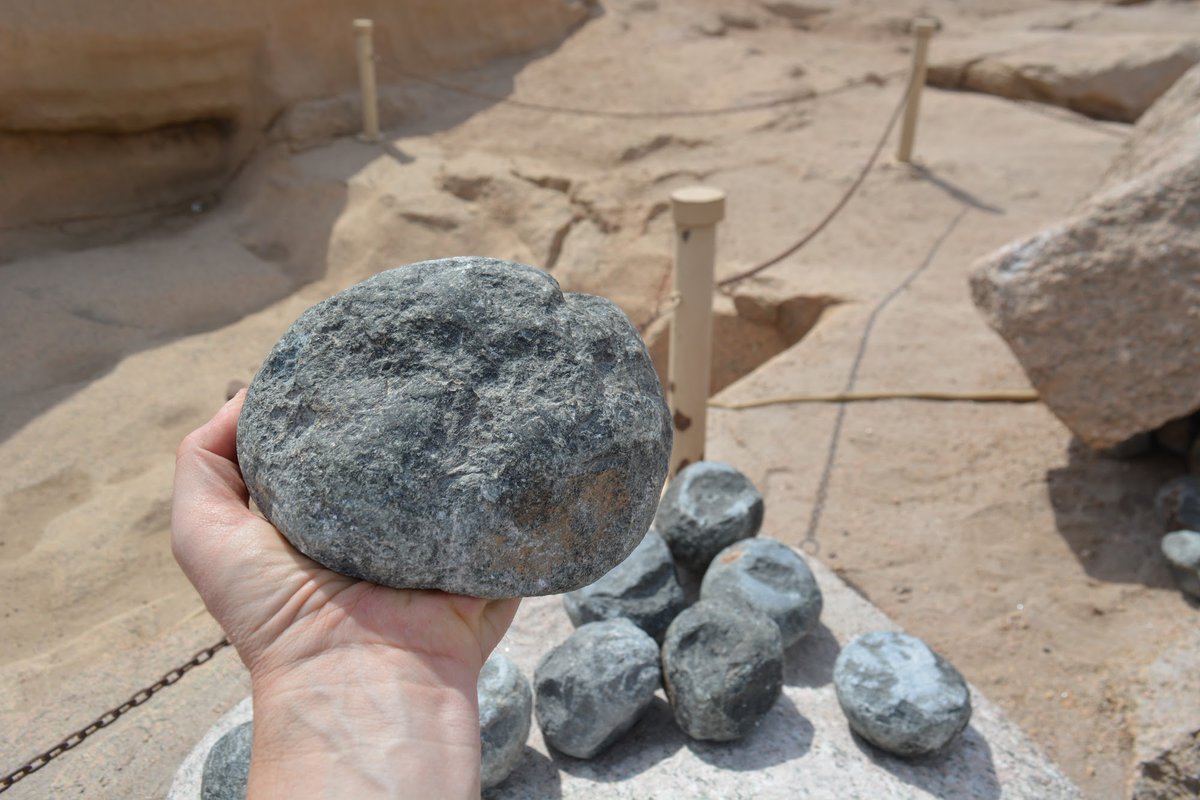
Gelation also explains why the surface ends up so smooth it looks polished. As for how the ancient Egyptians polished fist-sized depressions? They didn’t. Silica gel did the work.
Water resistance: store-bought waterglass is mainly sodium waterglass, which only produces moderately water-resistant stones. Fine for indoor decorations or desert scenery, but you can’t cast underwater cities — no Osireon — from it. For that you need potassium waterglass — in other words, lye from wood ash.
And if any mystery remains, it’s those white veins found in natural stone. “You can’t replicate that artificially!” cry the experts. Ignore them. We can’t replicate veins YET. But since every gear is meshing perfectly so far, the solution to that will come too.
Enjoy!
@chuckdawg95@Megalithic12000 the stone was probably constructed from local sand, shaped and hardened like concrete. Please see work of Marcel Foti https://t.co/LzkOL52hIj
🧵 1/7 Aswan granite is dog-hard. So why does the same granite shatter like glass further down the Nile, around Luxor and Giza?
Stand at Aswan, pick up a dolerite pounding stone, tap the bedrock with it, and you feel it at once: mercilessly hard rock, the kind where the chisel gives up before the person using it.
The official story says they carved out blocks of up to 50 tons with pounding stones, then (ancient helicopter?) loaded them onto a barge, floated them down the Nile, had a few thousand people haul them into place, and carved them further on site.