No account. No KYC. Your swap takes a route nobody can see, and the receipt names the venue and the fee.
$DARK : 0xebB4C5B97E4117e30EC82ce025E6f21dded05436
$DARK now is live on @ponsdotfamily.
Every swap on DarkRoute prints a 0.3% fee and the real venue on the receipt. Cashback settles per swap in tokenized stocks — with a hash, not a monthly promise. No account. No KYC. The route stays hidden from the market; the trader sees everything.
Pick a pair, paste an address, take the route. Dark Split breaks size across venues so no single desk sees the whole order. Hold $DARK and the same routes get cheaper.
Pick a pair, paste an address, take the route. Dark Split breaks size across venues so no single desk sees the whole order. Hold $DARK and the same routes get cheaper.
0xebb4c5b97e4117e30ec82ce025e6f21dded05436
First @coingecko submission got rejected. Resubmitted today.
New request ID CL1009260017.
Saying it out loud because the last post here had the first request ID in it, and quietly dropping the subject would be its own kind of answer.
Submitted still isn't listed. $DARK
People assume a cross-chain swap is complicated because every app has trained them to expect it: connect wallet, approve token, bridge, wait, unwrap, swap, wait again.
Here's the entire mechanism here.
You get one address. Generated by the venue for your route specifically. You send to it. That's the transaction.
There is nothing to connect. No wallet connection, no approval signature, no contract interaction. The app doesn't need permission over anything because it never touches your funds.
So it doesn't have to come from a wallet you're signed into. An exchange withdrawal works. Send it straight from wherever the coins already are.
There's no wrapped token in the middle. You send BTC, USDC arrives on Base. You never hold a receipt token, never unwrap, never have a second step to forget about.
188 assets across 35 chains, 111 tickers, and the venue that fills it is named on the quote before you commit anything.
Two things the page tells you that you have to actually read: some chains need a memo or tag — send without it and the venue can't match your deposit — and every quote has a deposit window with a countdown. An exchange withdrawal can be slow. Start the clock when you're ready to send.
https://t.co/ji1566E6kt
The most reasonable thing anyone asks a private router is "how do I know I'm not getting a worse price than a public DEX?"
The uncomfortable answer is that on most of these pairs, there is no public DEX price to compare to.
Swap ETH for USDC on Base and yes — there's a pool, it has a price, you can check us against it.
Now swap BTC for USDC on Base. Which pool? BTC lives on Bitcoin. USDC lives on Base. No single venue holds both legs, so there is no public route quoting that trade. There is nothing to put in the other column.
Our registry is 188 assets across 35 chains. Most of what people actually route here is cross-chain, which is exactly the set where the comparison silently stops existing.
So we don't fake one. Every quote prints mid-market — defined for every pair — beside what you actually receive, and the gap between them as one all-in percentage. Our 0.3% is the biggest thing in that number.
A comparison that only appears when it flatters us would be worse than none.
https://t.co/ji1566DyuV
Here's a question worth asking any swap product before you use it: what happens to my money if you disappear tonight?
For most of them the honest answer is "we don't know" or "open a ticket", which is the same answer.
Ours:
Your deposit never reaches us. The address you send to is generated by the venue for that one route. It is not our wallet, we have no key to it, and we could not move it if we wanted to.
Refunds don't come from us either. If the route fails, the venue sends back to the refund address *you* set when you created the order. We aren't in that path.
Your order is verifiable without us. Every order page carries a link to the venue's own explorer, looked up by the deposit address. That page exists whether we do or not.
What you'd actually lose is the convenience layer: the tracking page, the receipt card, the quote screen. Not the swap. Not the refund.
And one practical thing, since we'd rather say it than be asked: the deposit address is what makes you independent of us, not the order id. Keep it if you want to be able to check a route on the venue's explorer directly.
https://t.co/ji1566DyuV
The fair question about a private router is one nobody in this category answers: what is the privacy costing me?
So we put the number on the quote screen. Every quote now shows mid-market next to what you actually receive, and the gap between them as one percentage — the all-in cost of routing through us. Our fee, the venue's fee, the spread, the network. All of it, in one figure, before you commit anything.
Measured on a live quote an hour ago, 1 ETH → USDC:
mid-market 2487.83 USDC
this route 2481.88 USDC
all-in 0.24%
Our fee is 0.30%. So the venue and the spread came in at −0.06% — the fill beat mid, and the whole route cost less than our own fee.
That's a good day. It won't always be. The number prints either way, which is the only version of this feature worth shipping.
https://t.co/ji1566E6kt
The most dangerous thing this app has ever asked you to do is paste a destination address, and it asked you to do it from scratch every single time.
Now you can name one. Type it once, hit save, call it "ledger" or "kraken" or whatever you'll recognise at 3am — and next time it's a chip you click instead of a paste you double-check.
Two rules it follows without being asked:
It only ever shows addresses for the chain you're actually on. A Base address never appears under a Bitcoin field. That's the mistake this is really for.
Nothing leaves your browser. Same storage as your recent orders. We don't have an account system to sync it to and we don't want one — an address book on our server would be a map of where our users keep their money.
https://t.co/ji1566E6kt
Sharing a receipt and announcing your position size are two different decisions. Until today we made them for you.
Every order link unfurls as a card — pair, venue, fee, order id. It also printed the dollar size, so posting proof that a swap went through also told everyone how much you moved. Plenty of people just... didn't post it. Fair.
There is now a switch on the order page. Size is off by default. The card reads SIZE hidden from market, and the fee stays a percentage instead of a dollar figure — "$7.46 at 0.3%" is the size written a different way, so hiding one and leaking the other would be pointless.
The parts that make the receipt worth anything are still there: which venue actually filled it, and what we charged. Those were never yours alone to hide — they're our claims about ourselves.
One honest caveat: X and Telegram cache an unfurl. Flip the switch before you post, not after.
https://t.co/ji1566E6kt
The name isn't branding. It's the mechanic.
Dark — to the market. Your order never touches a public book or the mempool as a visible swap. Nobody front-runs what nobody can see.
Route — lit, to you. The venue that fills it is named. The fee is a number on screen before you deposit. The receipt carries both, and unfurls as a card anywhere you paste it.
Every private swapper does the first half. We're not aware of one that does the second — and doing only the first is how a category ends up asking you to trust it about everything.
Dark to the market. Lit for you. Both halves, on purpose.
$DARK · https://t.co/pziSZFtZTM
Most products are a list of features. This one is mostly a list of refusals.
We won't hold your funds. Your deposit goes into the route, never to us. If we lost every server tonight, nothing of yours would be stuck — the venue still owes you the fill.
We won't ask who you are. No account, no email, no KYC. A receiving address is the entire onboarding.
We won't rename the venue. Whoever fills your order is printed as-is, on the quote and again on the receipt. The category's habit of relabelling a partner into a household exchange name is the thing we exist against.
We won't sell you a better route. Holding $DARK lowers your fee. It does not get you a better fill, a faster venue, or a different price. Route quality is identical for everyone or the whole position is theatre.
Every one of those costs us something. That's how you know they're real.
https://t.co/pziSZFts4e
You found something. You sized it. You posted the ticker.
By the time your order reached a public book, three bots had already seen it sitting there and taken the front of it. You got a worse fill on your own idea, and you paid for the privilege of being early.
That's not bad luck. A public order book is a floodlight, and everyone standing under it is paying a tax nobody prints on a receipt.
DarkRoute routes your order so it never appears on one. It gets filled by a venue directly — no book, no queue, nothing for anyone to read and get in front of.
The market doesn't see your order. That's the entire product.
https://t.co/ji1566DyuV
We pulled our address validation into its own repo so other people could use it. Writing tests for strangers found a bug in our own product on the first run.
The NEAR pattern had no dot in its character class. So intents.near passed and v2.ref-finance.near — a sub-account, completely normal on NEAR — was rejected. Anyone holding one literally could not enter it as a receiving address.
It had been live since day one. Nobody caught it because the regexes had been read, never tested.
Fixed in the router, deployed, and the extracted package ships with the test that caught it.
https://t.co/lCdK0h0MWq
Zero dependencies, no build step, 9 patterns across 24 chains. Take it.
Every swap app has a screen for when it works. Almost none have one for when it doesn't — you get a red badge and silence, at the exact moment your money is somewhere and you don't know where.
We just wrote ours.
Sent too little. This was a real bug: an underpaid deposit showed "Confirming", identical to a healthy one. You'd have sat there watching a fill that could never happen. It's now its own state that tells you the two ways out — send the difference to the same address, or leave it and take the refund.
Deposit window expired. Used to say "closes in expired" and stop. Now it says the window is closed, warns a late deposit gets refunded minus network cost, and offers a fresh quote.
Route failed. Now names the refund address, the chain, and the order id — plus the part that actually settles the worry: we never held your deposit, so there is nothing here for us to release.
Nobody markets the error states. That's exactly why they stay bad.
https://t.co/ji1566DyuV
A private, non-custodial swap router on Robinhood Chain. You pick what you send and what you want back, paste a receiving address, and that's the entire signup. No account, no KYC, no wallet connect to get a quote.
Your order doesn't touch a public book, so nobody front-runs a ticker you were about to post. But the venue that fills it is named as-is on your quote and again on your receipt — and the fee is a number on screen, 0.3%, before you deposit anything.
That's the whole position: hidden from the market, transparent to you.
188 assets across 35 chains. Non-custodial from deposit to settlement — funds go into the route, never into us.
https://t.co/ji1566DyuV · $DARK
GM $DARK Army
The dip is sitting right here around 100k. This is the kind of quiet window people usually sleep on, then watch it leave.
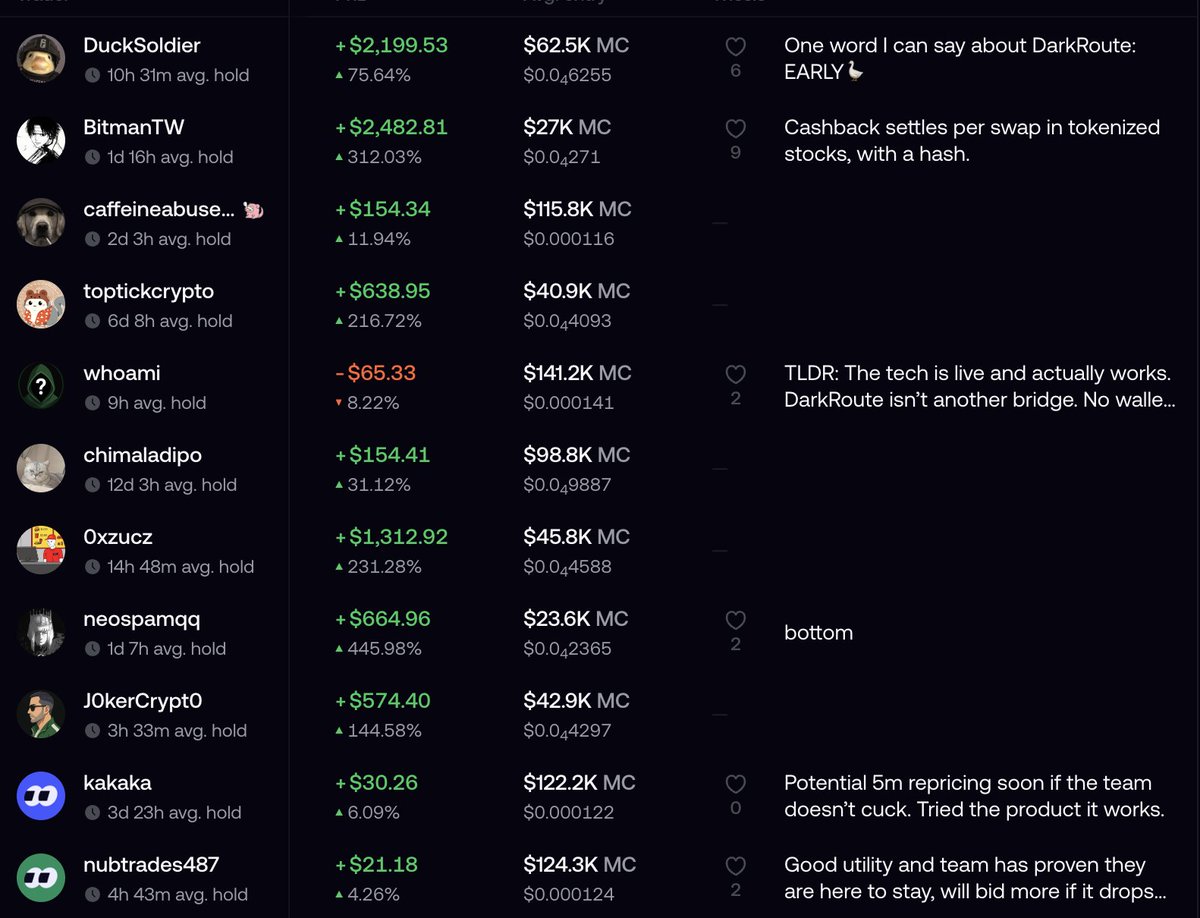
Ape it if you already like the router. Holders on @fomo are starting to turn bullish and the official account did not go silent after the pullback (https://t.co/nobai4ihDG)
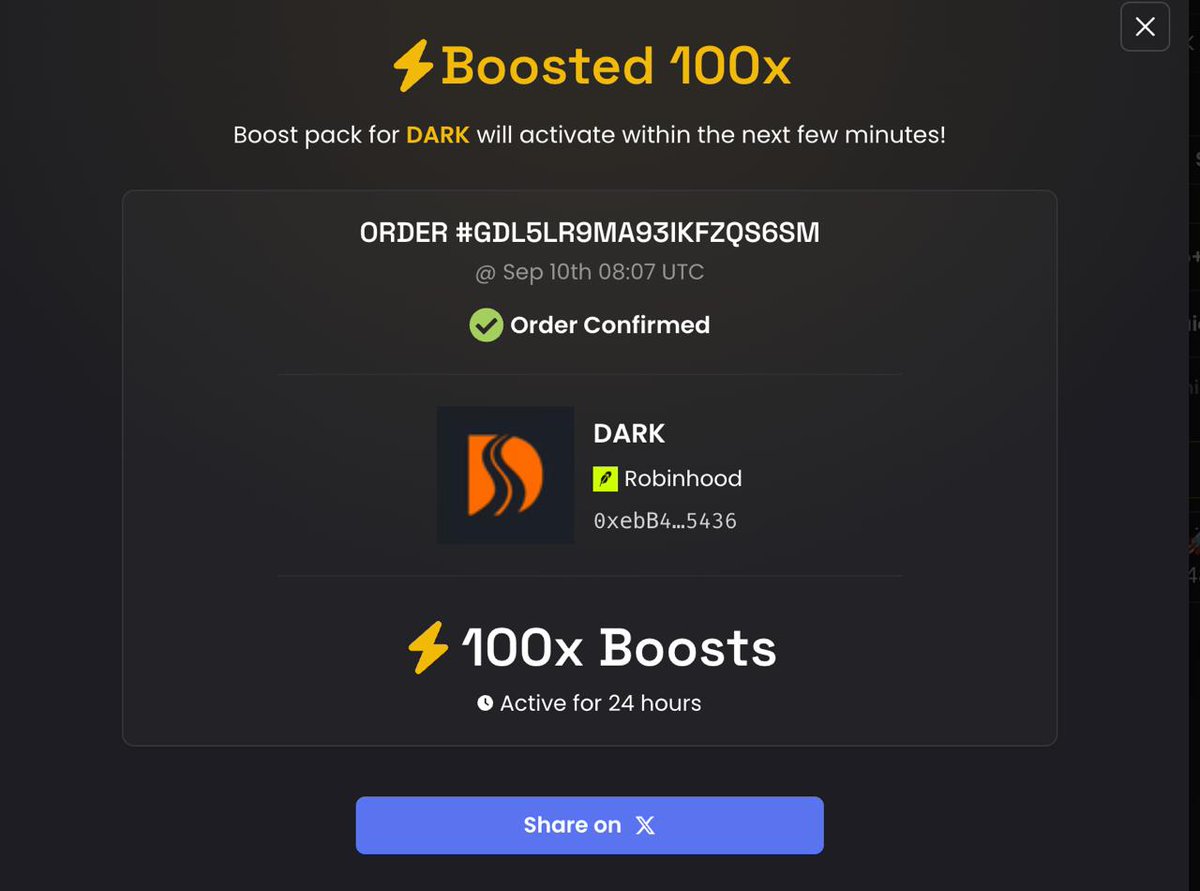
Contracts for staking and the burn ledger are public on GitHub before they go live. Slippage is no longer a locked 1% default. You can pick 0.5, 1, or 2 and see the minimum output before you deposit. They also hit GMGN Manifesto and just landed another 50x boost.
The product is still the same. Swap off the public book, get a receipt that names the venue and the fee, and take cashback in tokenized stocks. Quiet chart. Live routing.
0xebb4c5b97e4117e30ec82ce025e6f21dded05436
https://t.co/12zoUhFSxf
@darkrouteRH
Slippage was set to 1% and shown to you as a fact. You couldn't change it. That's not a setting, that's a default wearing a label.
Now you pick: 0.5%, 1%, or 2%. The minimum you'll receive updates next to it, before you deposit anything — so the floor isn't a surprise on the receipt.
We checked it against the venue rather than trusting the UI: set 2% and the floor moves exactly 2%. Anything outside 0.1–5% gets clamped, so a typo can't hand you a bad fill.
https://t.co/ji1566E6kt