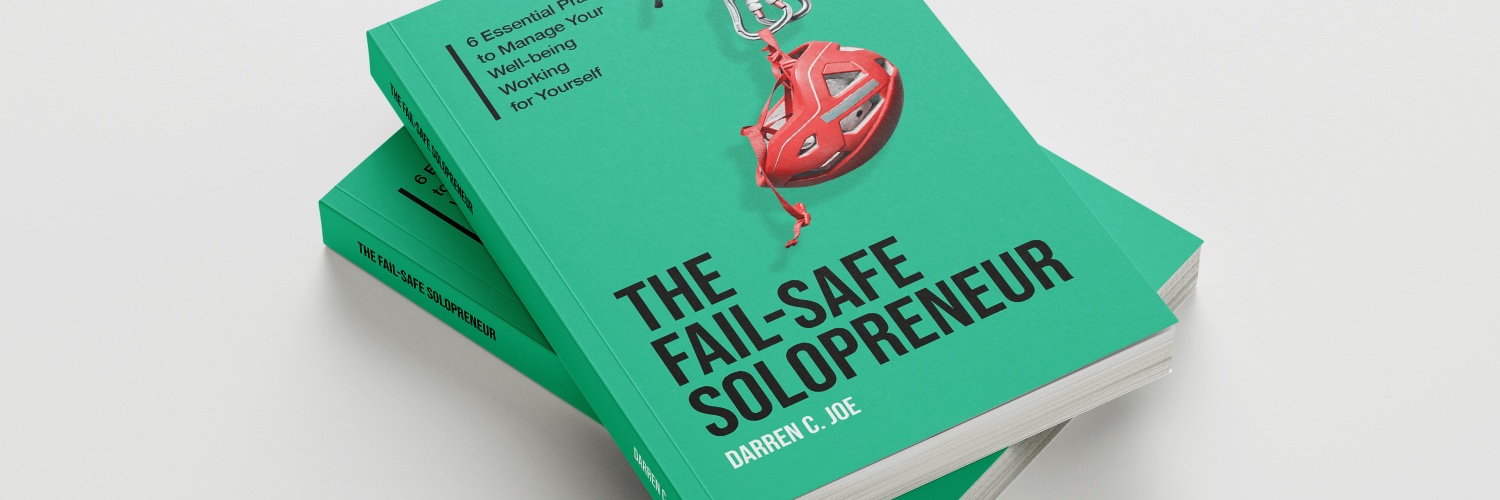
My new book, The Fail-Safe Solopreneur: 6 Essential Practices to Manage Your Well-Being Working for Yourself, is now available for purchase on Amazon, Audible & iTunes! https://t.co/dXL3ILTSi6
"By choosing careers that utilize a completely different set of cognitive skills, they give their writing brain a chance to rest during the day."🤔https://t.co/6ueuRs7ONu
Tim is selling 80% less print books than 4 years ago😓 "Will anything survive in roughly its current form? Probably. Experience that isn’t solely information: comedy, entertainment, storytelling, fiction, etc."
https://t.co/dbT2FIUvay
NEW blog post is up!
The Self-Help Trap: What 20+ Years of “Optimizing” Has Taught Me
The older I get, the more I think that self-help can be a trap. Sometimes the cure is worse than the disease. I say this after ~20 years of writing self-help and a lifetime of consuming it.
Spend enough time in the world of “improvement,” and you’ll notice something strange: The people most obsessed with self-help are often the least helped by it. Behind the smiles and motivational quotes, behind closed doors and after a drink or two, the truth is that they’re not able to outsmart their worries.
On one hand, perhaps this unhappiness is precisely what lands one in self-development in the first place, right? I long assumed this about myself, and it’s partially true.
On the other hand, what if self-help itself is actually creating or amplifying unhappiness?
Modern self-help contains an in-built flaw:
To continually improve yourself, you must continually locate the ways you are broken.
Fortunately, there are a few perspective shifts that make all the difference. It took me embarrassingly long to figure them out.
To get started, let’s take a fresh look at an old concept.
See the link below to the full blog post 👇
Chúc mừng năm mới!
Grateful to my ancestors and all ancestors who gave so much so the next generation(s) would have more opportunity, peace, and prosperity.
Happy Lunar New Year!
“Humans have been writing down their best ideas for 5,000 years. Read them.”
- Charlie Munger
The following facts about books keep astounding me whenever I stop to think about them:
1. Books are so ridiculously cheap and underpriced.
Keep thinking, with or without AI!
"At home, she has forbidden her 10-year-old daughter from using chatbots. 'She has to learn critical thinking skills first or she won’t be able to tell if the output is any good,' the rater said."
https://t.co/5vv0zuIJmM
Advice to my 21 year old self:
1. status is rented. self-respect is owned.
2. most advice assumes you know what you want. the real challenge is figuring that out.
3. the most important personal finance metric isn't net worth, it's "worry time." how many minutes per day do you spend thinking about money? reduce that number ruthlessly.
4. the modern badge of success isn't the car you drive but the phone notifications you've turned off.
5. how you recover matters more than how you perform. most high-achievers burn out not because they work too hard but because they have terrible recovery strategies.
6. most job interviews, pitches etc select for confidence, not competence. the truly skilled are often skeptical of their own abilities.
7. most people mistake intensity for quality of experience. the best moments in life are often mundane situations experienced with uncommon attention.
8. a lot of people optimize their lives for phase one (achievement) while completely neglecting phase two (enjoyment) and phase three (meaning). the truly fulfilled nail the sequencing.
9. the most valuable life skill is knowing how to want what you already have. without it, no achievement or acquisition will ever be enough.
10. having rare taste is more valuable than having rare skills. you can hire skills, but no one can substitute for your ability to recognize what's truly exceptional before others.
11. your life changes the moment you realize almost nobody is thinking about you.
12. most people spend their lives avoiding difficult conversations, not realizing those conversations are their lives.
13. we're told to "find our passion," but passion isn't found, it's developed. the most passionate people i know didn't start that way; they just stayed with something long enough to get good at it.
14. we massively overvalue optionality and undervalue commitment. the wealthiest people i know, in all senses of wealth, went all-in on something when everyone told them to hedge.
15. the ability to sit alone with your thoughts for 20 minutes is becoming a superpower. most people would rather receive electric shocks than be left undistracted with their own minds.
16. the psychological tax of ownership is barely discussed. each thing you acquire costs not just money but mental bandwidth for the rest of its life in your possession.
17. inspiration is just procrastination wearing a tuxedo. elite performers don't wait for it.
18. the most successful founders i know don't "work hard" - they work in concentrated 2-3 hour bursts of flow state intensity that would exhaust normal people.
19. nobody mentions that the biggest predictor of founder success is having enough personal runway to survive 1000 days of zero income. money buys you iteration cycles.
20. the people living the most interesting lives are following curiosity trails, not career ladders. conventional success is just socially-approved mediocrity with good marketing.
21. the top 10% of any field work hard. the top 1% have the courage to do embarrassingly simple things consistently when everyone else gets bored and moves on.
The Fail-Safe Solopreneur Revisited - how would I change this solopreneurship survival guide 4 years later? tbh, not much. I feel the 6 practices are still essential. maybe more imagination, more outsight, more investing in relationships... https://t.co/evMXhq5wpf
@neuranne@lukeburgis@p_millerd@kenneth0stanley Hi! I would add Herminia Ibarra's two books - Working Identity: Unconventional Strategies for Reinventing Your Career and Act Like a Leader, Think Like a Reader - which focus on doing the unfamiliar (over thinking) to evolve your career
I was going to write something similar about using energy as a career compass... but I think Graham expresses it in a much more relatable, shareable way. Glad he did so.
https://t.co/fahgczAVIR
What are you favorite business diagnostic questions? (The type you'd ask during a quarterly review, exec onsite, or coaching session).
I'm compiling a list of interesting, illuminating questions for those seeking to improve their businesses.
Here's some:
-What is your business worth? (90-day fire sale. Full 1-2 year exit.)
-What are your goals in terms of free cash flow annually or exit valuation?
Personal:
-How many quality hours per day do you plan to spend working on your business over the next 90 days? How about over the next 360 days? How much time do you take off from your business in terms of vacation or personal days?
-Describe the primary example of work that 1) Gives you energy and you are motivated to do 2) That you’re above average at and have examples of taking pride in 3) That also drives value for the business.
-Do you have any partners in the business? (Or key clients representing 25%+ of your revenue). If so, how would you describe the quality of that relationship?- Would you have the same arrangement if you could start over today?
-What type of personal relationship could help catalyze a breakthrough for your business?
-Describe your current approach to deep work (tackling tough business challenges with focused effort).
-Rate your stress level regarding non-business life and tasks. (Scale of 1-10)
Emotional:
-What is the one phone call you need to make?
-Do you have worries or stress associated with your business or the goals you’re hoping to achieve?
-Do you have people you can speak with on a weekly basis that are supporting your efforts? If not, can you paint a sketch of who that person would be and how you would interact with them?
-How would you rate your energy and enthusiasm for your business in the past 90 days? (Scale of 1 to 10)
-What are you most excited about learning or improving in your personal skill set this quarter?
Strategy:
-What is the mission of your business?
-Can you describe the market opportunity your business is pursuing?
-What is your best marketing channel and why?
-What does it take in energy or dollar terms to acquire a new customer?
-What is working best in your business right now?
-Describe your ideal customer profile (ICP). Do you have a reliable path to providing more value for them and acquiring more of them?
-What do you think a 10/10 skill level entrepreneur do with your business assuming the goal of unprecedented growth in the coming 12-24 months?
Plan:
-Describe the current constraint or bottleneck in your business. Are there systems that, if moved at a higher velocity and cadence, would improve your cash flow?
-Do you have the right data to understand what to do next?
-Do you know what part of the customer journey you need to address first - awareness, conversion, or retention?
-How are you planning to hit your goals? What are the concrete steps that need to be taken?
Executive:
There are 8 functions in most businesses. Divide your time allocation on each function by percentage:
Executive
Sales
Marketing
Operations
Customer Service
Technology
Finance
Human Resources
Team:
-Who are your direct weekly reports? What are their responsibilities?
-Do they have scorecards?
-What is the quality of your meetings and conversations with them? (Scale of 1-10)
-Would you rehire your team right now if given the opportunity? Explain.