Looking for new ways to engage with economics?
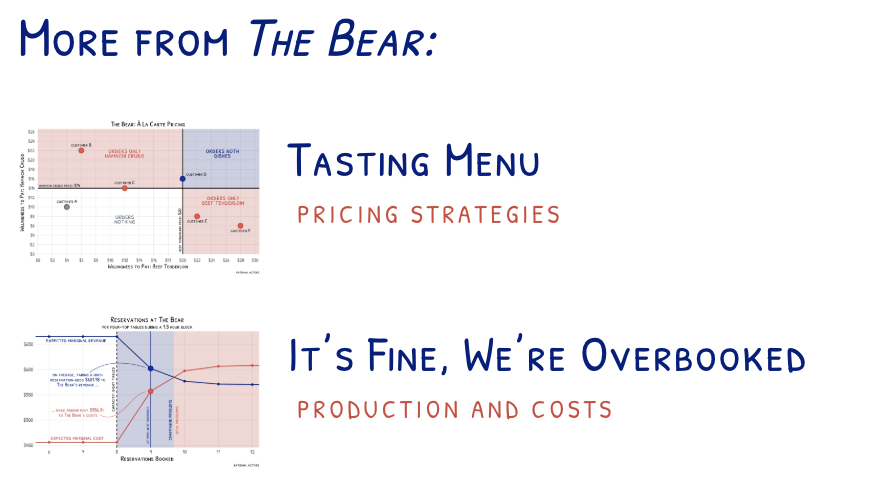
Rational Actors models scenes from your favorite TV shows. It's a perfect resource for students and instructors alike. Bookmark it: https://t.co/uU69D2FlmZ
This 4th of July got me thinking about centralization. With AI, it is once again a central question that we all need to grapple with. It is just absolutely incredible that the founding fathers, having achieved the almost-impossible by winning the revolutionary war, decided to build a government around decentralization by design.
Why is this so incredible? Smart, successful people have a tendency towards centralization. This makes a lot of sense: these are people who have typically seen their judgments and decisions proven "right". They understand concepts that many others can't, they win debates, they make more money and are widely admired. They see so many others fumble and make mistakes, it is natural to then come to the conclusion that things would work a lot better if similarly smart/successful people were put in charge. This type of logic goes *way back* all the way to Plato's vision of the philosopher king, and you can see it play out everywhere.
But there are critical problems with this type of system. One is the obvious Hayekian problem that it precludes information aggregation. Perhaps this can be solved with AI. But the bigger issues are incentives and durability.
Centralization requires setting up an infrastructure that concentrates power. This creates incentives for people with potentially less noble/altruistic desires to seize the infrastructure; it creates huge incentives for conflict. Even if the original centralized system was noble and good, and even if it did work for a while in creating social surplus (big "ifs" here, most of the time this doesn't happen), the incentives of centralization mean that many others who are just as smart and just as successful, but who may have *very different* worldviews from the group that originally set up the system will now be jockeying to take it over.
It's trivial to come up with examples: monarchies were characterized by constant assassinations and coups. Why? Because if you took the monarchy you would have ultimate power, if you took over the USSR as the premier, you had ultimate power. If you took the US presidency through force, what would happen? You'd have a few years of office where you had to constantly deal with congress and the judiciary.
This means that the original objectives of a centralized system is not very durable: new people/systems are constantly competing for the opportunity to assume control. In the case of people, even if there are not coups or assassinations, natural successors may simply be less capable than the original group.
Decentralized systems are not perfect by any means, but they are simply more robust. They are better designed to serve the needs of diverse viewpoints and constituents. This is the real beauty of America, of our amendments that protect our decentralization (in a broad sense). They are less prone to being hijacked by bad actors, and misguided/nefarious leaders are more contained by the institutions themselves.
I have this theory that the worse a dip looks, the better it tastes. Your chili cheese dip, your buffalo chicken, your seven layers of whatnot and what have you. If it looks like something the dog threw up after it got into the neighbors’ trash again, it’s gonna taste incredible.
And in soccer, the answer is that defenders would retreat a lot and those plays where a guy is barely offside wouldn’t even happen anymore. Attackers would be parked in front of the goalie all the time to distract him. Many more goals would be slop. Soccer is less beautiful.
Many new soccer fans are wondering if the game would be improved by removing the offside rule. But one must ask “if we change this rule, how will behavior change and what will that lead to?” and this applies to a lot more than soccer.
People who expected to have student loan forgiveness but did not get it were substantially worse off than if none had been announced because of the financial decisions they made expecting forgiveness
https://t.co/wfldGxlAnO
Sports fandom is a network good. That leads to bandwagon effects and many possible equilibria. Is the reason the US loves football, England soccer, India cricket, and New Zealand rugby due to some fundamental national preferences for certain sports rules? Probably not.
Okay, since you asked, here’s my American opinion.
Soccer will never be as popular in America as football for 3 reasons:
1. The Fake Injuries
Players are incentivized to flop because the other team is more likely to get a penalty.
In football, it is the opposite. If a player has a real injury, play toughs it out and plays through it, it is seen as heroic.
Americans like toughness and grit.
2. Chance Goals
Many goals are scored by chance as opposed to skill. The chaos at the net when the ball is near is remarkable. Defenders blocking the goalie’s line of sight. The ball bouncing and ricocheting off of random body parts often determines if the ball goes in the net or out of bounds.
In football, there are some elements of chance, but because players are allowed to use their hands, the points are primarily scored based on skill. Less is left to chance.
Americans like control.
3. Low Scoring
In football, it is still challenging to score, but it happens much more often. Also, every play has a chance for gratification and excitement: a first down, a big catch, a big hit, a sack, an interception, etc
American like constant excitement.
A decline in car break-ins across Oakland is being welcomed as a public safety win, but it is also contributing to a downturn for some local auto glass repair businesses. https://t.co/RGbjO7vEAv
My family moved to the US when I was 8, but by the time I turned 20, my dad was still on an H1B (waiting to get processed for a green card).
Once I turned 21, I would age out as his dependent, despite the fact that I basically grew up in the US.
I thought I'd have to become a code monkey after college, and even that only if I was lucky enough to win the H1B lottery.
Otherwise, back to India.
I had become a huge fan of @paulg's essays in college. I was actually depressed that my desire to start a startup or do something entrepreneurial was basically hopeless.
Working on the promising podcast I was doing as a side project? A beyond impossible pipe dream.
Even after 9 years, my dad wasn't able to get a green card - and the lines were only getting longer over time. I figured I'd be an old man before I could quit some FANG job and build my own thing.
By some miracle, COVID travel restrictions cleared out the lines, and I got my green card literally months before I would have aged out.
If not for this unbelievable coincidence, I would not be hosting the podcast.
In the best case, I would be shifting pixels around in the 3rd sub-sub-menu of some big tech software.
I'm incredibly grateful I made it through.
But it's unconscionable that we put the kids of high skilled immigrants through all this anxiety, and in many cases make them repeat the nerve-racking indentured life trajectory that they had to watch their parents go through.
I think this is just being Bayesian. People use AI in writing for two things mainly: 1) improving their writing after idea generation and 2) as a shortcut to idea generation (eg write me a few paragraphs making argument X and provide support). Most people are likely doing both 1) and 2).
When seeing writing, a person needs to decide whether the effort spent reading and thinking about is worth it in terms of learning new information from the writer. If the writer uses AI for 2), then there is little private signal or unique information—it is the same information the reader can generate themselves, probably more concisely, from using the AI model. So it’s perfectly reasonable to detect AI writing (either through detector or just feeling the cringe) and to stop reading.
The issue with using AI for 1) is that you are pooling with 2). It is very difficult to signal that you spent time and effort generating the ideas and have unique information to convey.
This is all to say this: it is perfectly reasonable to use AI as much as you want for writing, but it’s worth being aware that it is also perfectly reasonable for others to not read it.
Some very simple math: if a country has 5% of the world's population and ability is evenly distributed, then 95% of the people who are best at any given thing will be born abroad.
This is the lesson of capitalism.
You are not smart enough to know whether California should grow almonds or wheats or data centers or anything else.
So you allow the price system to function. On everything, including water. Then resources are used efficiently.
Disagree and you’ve learned literally nothing from the twentieth century.
Throughout Game of Thrones, the Wall is always undermanned despite the growing threat of the white walkers. Why is that? Rational Actors is on the case!
https://t.co/OGjwPc9FCz