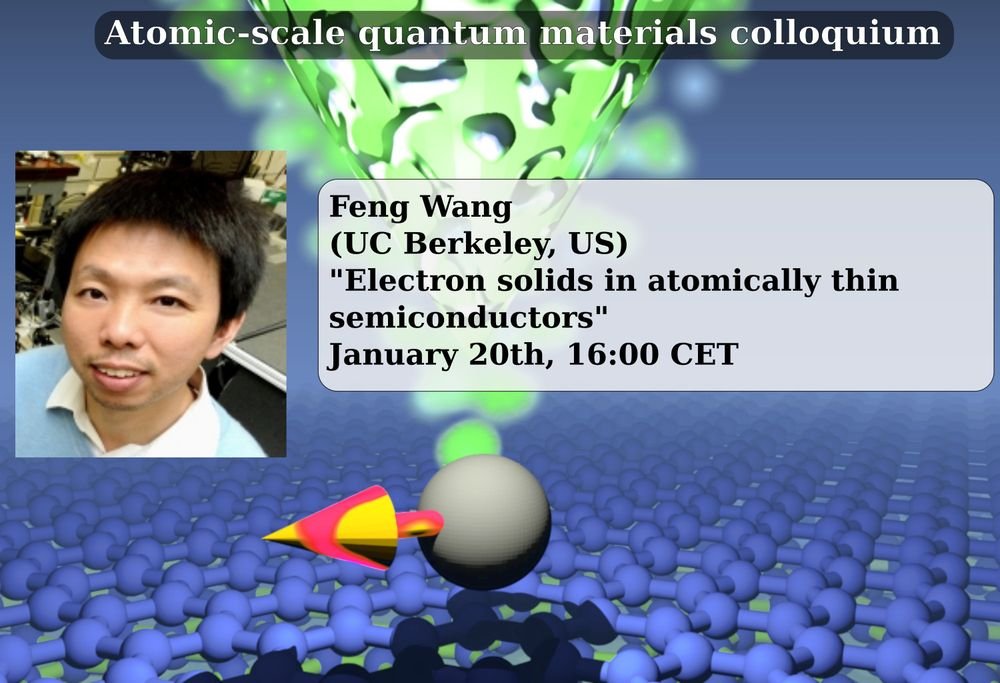
Join us for the 1st ASQM colloquium for 2025 on 20th January with Feng Wang (UC Berkeley, US) presenting "Electron solids in atomically thin semiconductors" at 16:00 CET. Image courtesy @JLado_Phys
To understand the electronic properties of quantum materials, one needs to probe the quantum geometric tensor. But this has been really tricky. A paper published in @NaturePhysics shows how to measure the dual components of the quantum geometric tensor. https://t.co/4wWedSFJJp
Stable manipulation of polar skyrmions is challenging. This work published in @NaturePhysics shows that thermal excitation can be an effective way to control such topological states.
https://t.co/9HlK2RN9AO
Along with my colleagues @Giulia_Pacc and Daniel McNally, we have put together a Nature Conference on quantum materials that will take place next March at Yale.
Full details here:
https://t.co/DiCz9A7EAt
We have space for a number of contributed talks, so please apply!
This is a nice News & Views article published in @NaturePhysics explaining how chirality and topology can produce orbital monopole.
Lee, HW., Rappoport, T.G. Chirality and topology team up to produce orbital monopole. Nat. Phys. (2024). https://t.co/m88ucMvndq
Manipulation of the electron’s orbital contribution to transport experiments is important for potential orbitronics device applications. Now the long-range dynamic orbital response is shown to be controlled by the arrangement of the atoms in ferromagnets.
https://t.co/aLZOGWJn6M
Chiral topological materials have been predicted to host orbital angular momentum monopoles, which can be useful for orbitronics application. Now, such monopoles have been imaged in chiral topological semimetals. Read the full article published in Nat Phys
https://t.co/lWTiC16Kin
🚨🚨 Nature Physics is hiring (again) 🚨🚨
In addition to the condensed-matter physics role (deadline Aug 9th!), we are also hiring someone to take care of our optics and photonics brief.
Locations are US and Germany, deadline is Aug 23rd
Advert is here:
https://t.co/7Bz7aTZkY9
The pseudogap state is believed to be a precursor to high temperature superconductivity in doped cupreates. Now doping dependent study on non-superconducting Mott insulator Sr2IrO4 reveals that it rather is generic to doped Mott insulators.
The detection of dark states — quantum states that do not interact with photons — in real materials may help to address many unsolved issues in condensed matter physics. Now, they have been identified in palladium diselenide.
Read: https://t.co/XxpZM9iALq
This month @NaturePhysics editorial celebrates hundredth anniversary of Satyendra Nath Bose’s paper that stimulated the study of quantum statistics and bosons.
'Wherever you look it is difficult to avoid bosons.'
https://t.co/1ZToHbgMwq
Nature is looking to hire a new optics and photonics editor! Join our editorial team and be responsible for showcasing some of the best research in the field.
Apply: https://t.co/UIXKkyyKd1, closing 24th July. DM me for questions. @Nature
Excited to attend the International Conference on Magnetism in Bologna, Italy! Looking forward to discussing all things physics. Fellow attendees, feel free to reach out—let's connect and share ideas! #ICM2024#Physics#Bologna#Networking
Quantum geometry and electron-phonon coupling are two fundamental concepts in condensed matter physics that govern many correlated ground states. Now, a generalized theory published in @NaturePhysics connects these two ideas.
Read: https://t.co/I4r61s1OpY
This article published in @NaturePhysics demonstrates flexible control of the quantum metric structure in a topological chiral antiferromagnet at room temperature.
https://t.co/mT00AOcDta