Marco Rubio said there was zero support among Gulf countries for a Strait of Hormuz toll, adding that they also shared other serious concerns as he wrapped up his Middle East trip following the US-Iran interim deal https://t.co/M2g6Xu4jl6
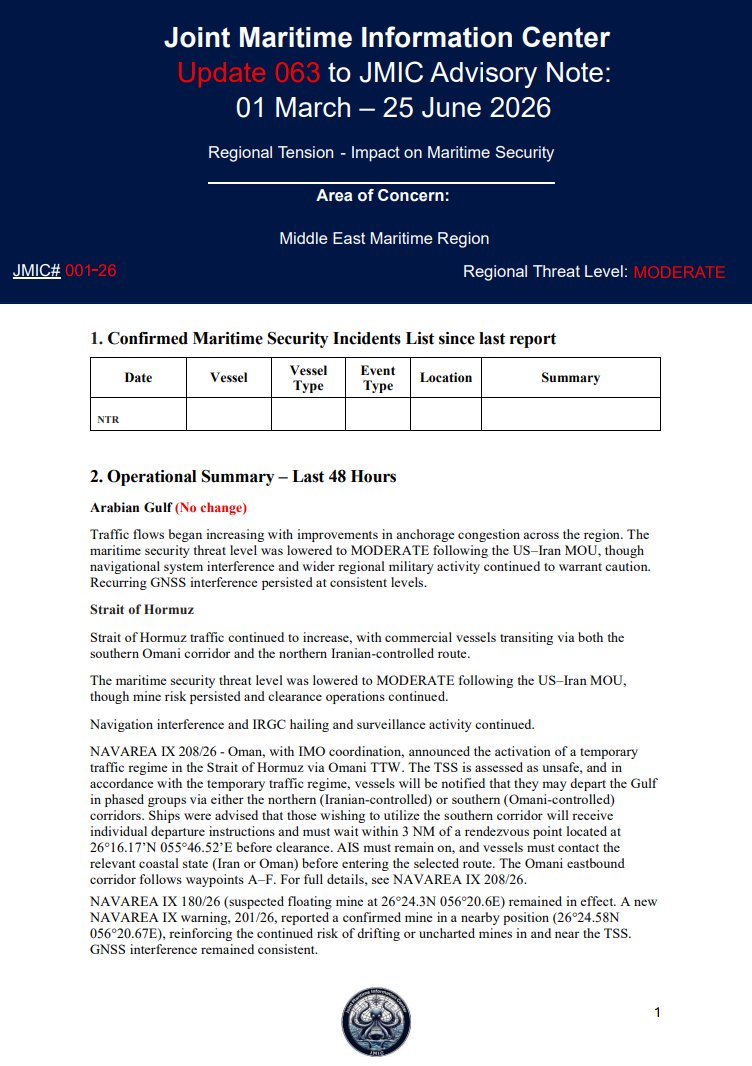
PGSA advises that vessels passage outside designated routes are not covered by the Safe Passage Guarantee, insurance, or related liabilities. Any consequences arising from unauthorized routing shall be the sole responsibility of the vessel owner, charterer, and master.
In a new report, a UN commission of inquiry credibly sets out Israel’s responsibility for atrocities against Palestinian children and even identifies military units apparently responsible.
The US and other governments should immediately suspend weapons transfers to Israel.
IMO pauses evacuation plan.
"I have been informed of an attack today in the Gulf of Oman. Seafarer safety remains paramount. To ensure coordinated approach & navigational safety, the IMO evacuation plan will be paused until further clarity."
- @IMOSecGen
https://t.co/UtvKjTtG5N
The discussion sparked by a recent statement on Passport Seva Divas has generated more heat than light.
The Ministry of External Affairs stated that a passport is a travel document, not a document of citizenship. Legally, that is correct. A passport is issued under the Passports Act, while citizenship is governed by the Citizenship Act, 1955. One law regulates the document; the other regulates the legal status.
But law and public understanding are not always the same.
For most Indians, the passport is the most authoritative document the Republic issues. It bears the name of the Republic of India, carries the holder’s identity, and is accepted around the world because foreign governments trust that India has verified the bearer’s nationality before issuing it. It is therefore entirely understandable that many people asked: if a passport is not proof of citizenship, then what is?
The answer requires some nuance.
A passport does not create citizenship. Nor is it the legal instrument that finally determines citizenship if that status is challenged before a court. Like many democracies, India distinguishes between citizenship law and passport law. In rare cases involving fraud, disputed parentage or illegal acquisition, citizenship may have to be established through the provisions of the Citizenship Act and supporting evidence. That is why a passport is not regarded in law as conclusive proof in every conceivable circumstance.
But that should not be confused with its practical significance.
A passport is issued only after the Government has satisfied itself that the applicant is entitled to one. In everyday life, and in international travel, it is the strongest evidence of Indian nationality that most citizens will ever possess. Nothing said by the MEA changes that. No immigration officer abroad will suddenly regard an Indian passport with suspicion because of a legal clarification made in New Delhi.
The episode does, however, remind us of a larger challenge.
India’s systems of civil registration developed unevenly over many decades. Millions of older Indians were born when birth registration was incomplete. Names were recorded differently across school certificates, land records and electoral rolls. The painful experience of the Assam NRC showed how documentary inconsistencies can create profound hardship when citizenship itself becomes the subject of legal scrutiny.
The lesson, therefore, is not that passports have somehow lost their value. It is that India needs stronger and more comprehensive civil registration, universal birth registration and reliable archival records so that citizenship can never become hostage to missing or inconsistent paperwork.
Sometimes a legally precise statement can create unnecessary public anxiety if it is not accompanied by explanation. A better way of putting it might have been this:
A passport is issued only after the Government has verified that the applicant is an Indian citizen. While citizenship itself is governed by the Citizenship Act, the passport remains the Republic’s most trusted document for international travel and, in ordinary life, the clearest evidence of Indian nationality.
That is both legally accurate and reassuring. The law need not be diluted, but neither should public confidence in one of the Republic’s most important documents.
To distil the argument:
A passport is issued because the Government has satisfied itself that you are an Indian citizen. It is therefore powerful evidence of citizenship in ordinary life and in international travel. But in a legal dispute over citizenship itself, the governing law remains the Citizenship Act, and a passport is not conclusive proof that overrides all other evidence
@_mrchaturvedi@MEAIndia Citizenship not governed by MEA. its MHA. MEA overseas under passport act. MHA citzen ship act. Passport along with another document as per citizenship act will be a citizenship document.
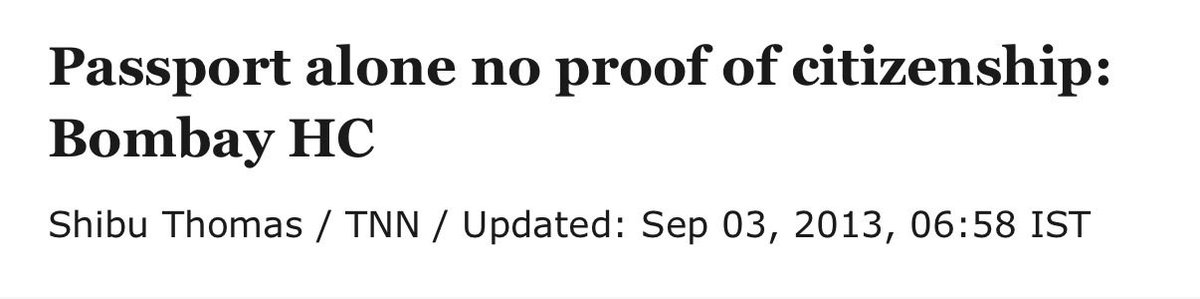
Govt clarifies, 'Passport never been proof of citizenship'; cites Passports Act 1967, Bombay HC 2013 ruling
Read @ANI Story | https://t.co/Ch7YdFCyW8
#Passport#India#Citizenship#MEA
For the “kagaz nahin dikhayenge” brigade outraging over the Ministry of External Affairs��� statement that a passport is not proof of citizenship, here is a reality check.
The MEA has not announced a new policy. It has merely reiterated a settled legal position.
Indian courts have repeatedly held that a passport is not conclusive proof of citizenship. The Bombay High Court made this clear in 2013 and reaffirmed the principle subsequently: citizenship is determined under the Citizenship Act, 1955, based on eligibility and supporting evidence, not by the mere possession of a single document.
In India, citizenship is established through a combination of records, including birth certificates, parents’ citizenship records (where relevant), school records, electoral roll entries, government service records, land and residence records, passports, and other contemporaneous official documents.
The statutory position is equally clear. Under the Passports Act, 1967, the Central Government has the power in specified circumstances to issue a passport or travel document even to a non-citizen. The law itself therefore recognises that possession of a passport cannot, by definition, be treated as conclusive proof of citizenship.
This distinction is neither unusual nor controversial. A passport is an important identity and travel document. It is evidence that may support a claim of citizenship. But citizenship itself flows from the Constitution and the Citizenship Act, not from the possession of any single government-issued document.
The outrage is not over a new rule. It is over a legal position that has long been settled by both statute and the courts.
Seafarers keep the world connected.
From food & fuel to medicine & humanitarian aid, their work underpins global trade & everyday life.
On Thursday's #DayOfTheSeafarer, we join @IMOHQ in recognizing their vital contributions & the sacrifices they make. https://t.co/sS8kNrOs99
A passport can get an Indian across international borders, secure consular protection in a foreign country and establish nationality before immigration authorities worldwide. Yet, according to officials of the external affairs ministry, it is not a proof of citizenship
Read the details here ➡️
https://t.co/xiy7gQUIKj
(✍️@utkarsh_aanand)
🗞️ For in-depth reporting:
https://t.co/69GygmATRR
📩 Subscribe now: https://t.co/OmqU1vhh45
Analyst Charles Kupchan tells Al Jazeera that a US-Iran deal is unlikely within 60 days, warning that talks may drag on with no final deal even by the end of the Trump administration.
@bigbasket_com your bbdaily contact number does not work. And you have without any prior information migrated my account to bb. How do now I take out my money in bbdaily wallet?