If you are building what you claim is a "revolutionary agentic AI" or #AiFirst software development tool, and you aren't using that tool to build itself, you've got to stop and ask yourself if what you are building is truly revolutionary, or just another prompt-based FrontPage.
Being a founder is waking up with a to-do list and realizing most of it won’t change the outcome.
You check things off. You stay busy. But the only thing that really matters is whether your next move shifts the curve.
Not the curve in your deck. The curve in reality. The one that separates what compounds from what disappears.
You’re not managing the business. You’re managing the fallout if the bet doesn’t land.
And the hardest part isn’t the risk. It’s not knowing whether the thing you’re pouring your time into is a multiplier or just a month you’ll never get back.
The longer you do this, the more you realize the work isn’t in the building. It’s in choosing what to build next, knowing you might be wrong, and doing it anyway.
That’s what separates the ones who last from the ones who don’t.
@d4m1n@datacatalyst_uk I think that now we could identify 2 classes of roles:
1) Product Makers, prototyping quickly with the user in mind (augmented designer/product owner roles).
2) Product Engineering/Scaling, making sure that the products are suitable for production and can sustainably grow/scale
Many of the (several dozen) complex prompts that make up our e2e Software Factory explicitly draw upon this intellectual tradition (as well as the canon of SWE itself) to help AI Agents categorise, sort, analyse, pattern, manipulate, prioritise, decide, and more.
100%. We build ours on Azure Functions and Durable Functions. Serverless, optional stateful/less, scalable, economical, fully distributed. We use linear Durable workflows and non-linear messaging-based flows with Event Grid.
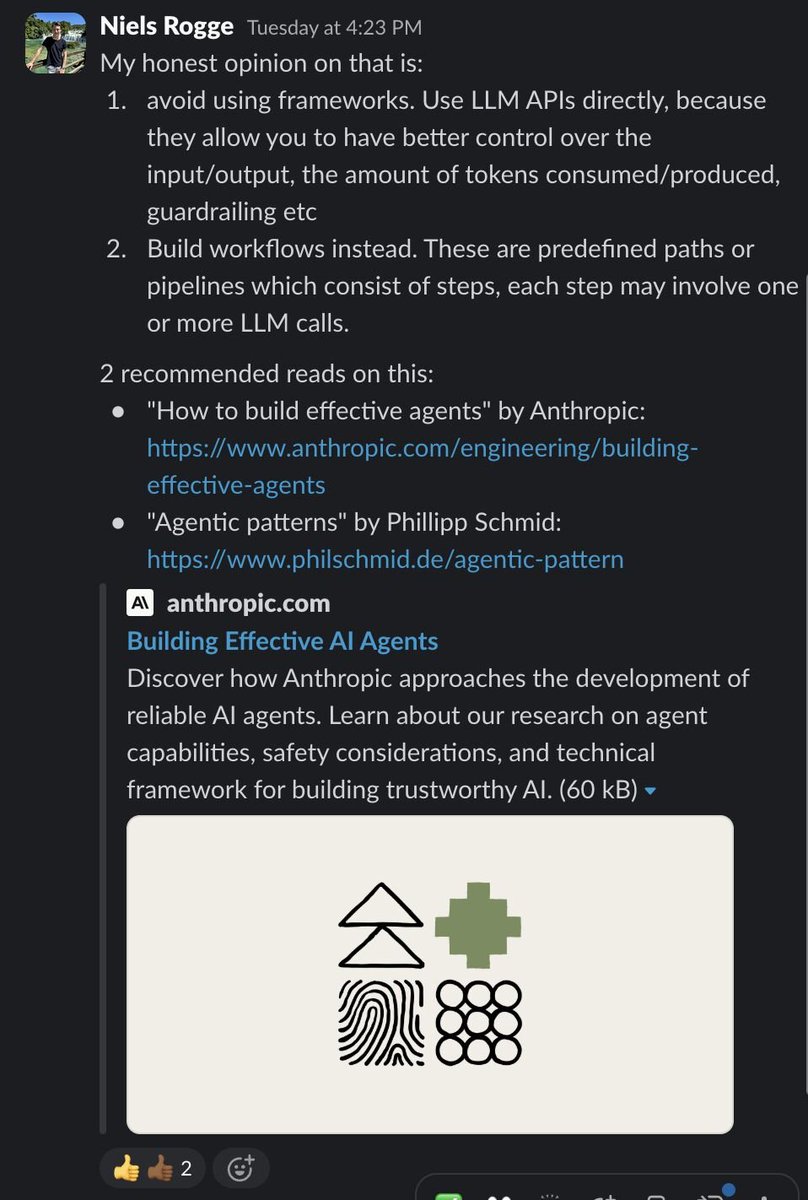
When people ask me:
"Which framework should I use for developing AI agents? Should I use @OpenAI Agent SDK? Google's Agent Development Kit? LangGraph or @pydantic Agent framework?"
Here's my honest answer:
If you are building what you claim is a "revolutionary agentic AI" or #AiFirst software development tool, and you aren't using that tool to build itself, you've got to stop and ask yourself if what you are building is truly revolutionary, or just another prompt-based FrontPage.
@hnshah We do design canvases, documents, graph explorers, enhanced where useful with conversational input. The requirements phase alone of Prizm, our e2e #AI software factory, => a 100-page SRS.
It's not sth you chat into being (any more than you use Siri to dictate your annual report)
Part of our thesis for Prizm is that chat works for small prototypes, but that like trying to write your corporate report with Siri, it's not suitable for robust enterprise software development. UI is needed.
Production-ready software, crafted by AI. https://t.co/TuiIG29Le5
I was curious who’s building AI interfaces that aren’t chat.
So I asked.
The responses were thoughtful, wide-ranging, and honestly a bit ahead of where I expected things to be.
Here’s what I learned:
1. Auto-Built UIs - AI creates the interface you need on the fly. Instead of fixed screens, it builds buttons, inputs, and views based on your request.
2. Task-Driven Workflows - You don’t chat, you complete a task. AI walks you through it, like a guide. Think of a coding assistant or step-by-step form filler.
3. Canvas Interfaces - You work on an infinite board. Drop images, text, or video anywhere. AI helps you organize, create, and iterate visually (like @tldraw or Flora).
4. Flow-Based Builders - AI nodes link together on a flowchart. You can see how your thoughts connect. This UI is great for brainstorming or product planning.
5. Custom Tools for Specific Jobs - No more one-size-fits-all chat. If you’re a teacher or a marketer, you get a tool designed for you, not just a generic chatbot.
6. Command Line AI - For technical users, AI works in the terminal. It feels like coding with a superpowered teammate helping you write commands.
7. Beyond Prompts - Some teams are rethinking how you even start talking to AI. Less typing. More showing, choosing, or nudging your way through a task.
8. Surprise Drops Incoming - Some teams are teasing new interfaces. We don’t know what they look like yet but the space is moving fast.
It’s clear we’re just getting started.
If you’re working on something in this space, I’d love to see it.
I’ll keep adding to the list.
i get the sense the people most bullish on vibe coding are people who have spent their careers talking to SWEs over 15-30min calls and haven’t quite grasped how many hundreds of daily decisions are hidden from them out of respect for time
For those who haven't already spent most of today Ghibli-ing their photo collection, a new highly-important research discovery:
If you give Amazon Polly's French voice models English text to speak, you can create your own episode of 'Allo 'Allo in minutes.
(You're welcome.)
For those who haven't already spent most of today Ghibli-ing their photo collection, a new highly-important research discovery:
If you give Amazon Polly's French voice models English text to speak, you can create your own episode of 'Allo 'Allo in minutes.
(You're welcome.)