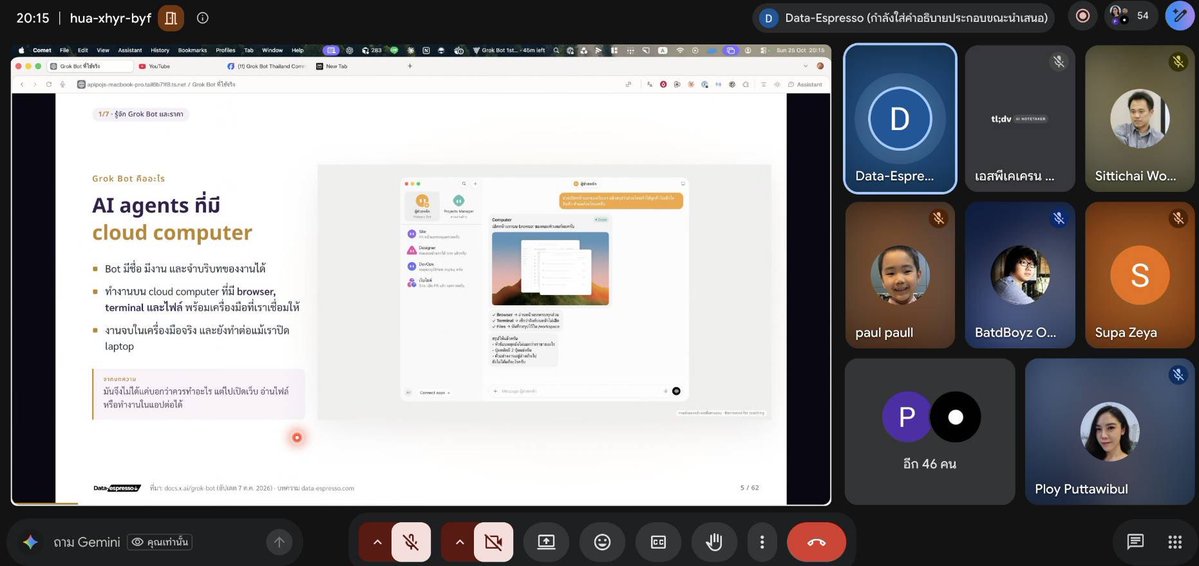
Your Grok Bot routines could be doing unnecessary work, even when they run perfectly.
A new feature could remove a workaround, replace a manual step or make an existing routine more reliable.
Give this prompt to your Chief of Staff to check every week which new features could improve the setup you already have:
"Once a week, check whether new Grok Bot features could make my setup simpler, cheaper or more reliable.
1: Find what's new.
Check the official Grok Bot docs, help pages, changelog and announcements from the past week. List each new or changed feature with its source link. Only include what the official sources confirm, and mark anything still rolling out.
2: Map my current setup.
List my bots, routines, skills and connectors, what each does, how often it runs, and where it fails, needs me to step in, or uses a workaround.
3: Match features to real problems.
For each new feature, say whether it removes a workaround, a manual step, a duplicate routine, a failure or a step where I'm the bottleneck. Skip features that don't solve something real in my setup.
4: Propose specific changes.
For each match, state what changes, which bot or routine it affects, what improves (fewer runs, fewer steps, less of my time, fewer failures), the risk, and how to undo it.
5: Test before switching.
Recommend a small trial for each change, run it alongside the current version where you can, and show me the result before replacing anything.
6: Change nothing without my yes.
Report proposals only. Don't edit, pause or delete any routine, bot or skill until I approve it.
7: Keep a log.
Record each change we make, what it replaced and whether it worked, so we can see the setup improving over time."
OpenAI models are now available on GCP.
Google is the first cloud provider where you can use Gemini, Claude, and GPT models. OMG!
There are 3 models:
GPT-6 Astra (top tier)
GPT-6.1 Sol (close in quality but cheaper)
GPT-6 Luna (fast and economical)
You can buy them through Google Cloud Marketplace. You get a single invoice, and the cost counts against your cloud commitment.
Your data stays inside the customer's data perimeter and isn't used to train models.
It's currently a private preview for selected enterprise customers.
You can now connect Codex CLI/Desktop to the Gemini platform. It's coming soon to Gemini for business and Antigravity.
https://t.co/1YJtpqSj1G
there's something really cool about asking your agent to draw a statechart (hypothetical example in this image), then using the /create-formal-verification-skill you made with pstack to find bugs through something like TLA+. you can both understand your code better and how the user flow should work, and fix issues users would otherwise see
Rejoice single DGX Spark owners!
You can now run Qwen3.8 Flash Next on TensorFold with the new Nvidia FP4 QAD quant 🔥
- 1.1M total FP8 KV cache
- 256k context, 5 concurrent users
- 46-55 tok/s on prose, single stream
- 132 tok/s on prose, 5 concurrent steams
- Prefill 2000-2300 tok/s
Qwen3.8 Flash Next is still the BEST model to run on one DGX Spark, bare none!
You can choose what to run: FP4 QAD for quality, or int4 for speed. Details on what is QAD below.
Get it here:
https://t.co/ElQiyWOMdQ
how do you trust your agents' work more? copy this post/link and give it to your @bot or agent!
1. codebase improvements: this is just good software engineering - better architecture, stronger types and invariants, clear boundaries. agents love to copy what exists and take the shortest path, so make the easy thing the right thing. categorically eliminate problems through code and you won't need to think about it again.
2. static analysis: lint rules, tests, CI, verification (eg TLA+). very token efficient ways to catch issues ahead of time.
3. prose: comments, rules, AGENTS.md, skills - anything that can't be enforced and requires agent judgment. use it minimally, but do use /create-verification-skill.
4. human review: the hardest to scale. at the rate agents land code, it's pretty much impossible to thoroughly review every PR, so spend that effort on the highest leverage point, designing an environment where agents do the right thing by default.
this forms an inverse pyramid: you want most of your effort at the top, least at the bottom. codebase improvements are deterministic, making it more token efficient, and lets you sleep more soundly at night.
install https://t.co/u9xIlN3eN0 and create a new Project:
1. look through my slack/chat messages and code review comments where i've given feedback on PRs, code, architecture
2. use /recall on my past transcripts to learn how i steer agents
3. /poteto-mode use /correct and /architect on past commits to find the most common pitfalls agents fall into, then propose a plan to rearchitect the code i own so it's more agent friendly. answer open questions with prototyping rather than defer to me, and back the plan with real data.
4. before you begin, use /sharpen + /in-your-own-words and confirm this prompt with me