Ghost Circuits… Machines That Think Without Code.
What if intelligence doesn’t come from code at all?
Computing comes from the tunability of materials and geometries.
I sit down with @thrishlab to share his journey of writing Ghost Circuits, it took him five years.
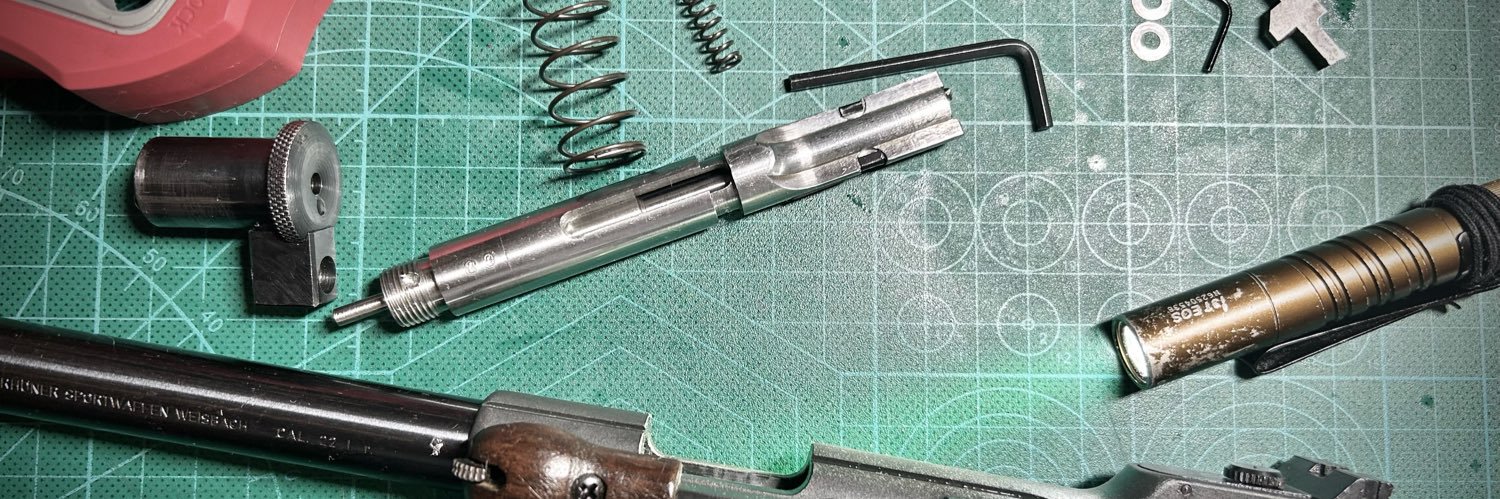
No to dla dodatkowej motywacji dodam jeszcze, że fajnie działa do treningu bezstrzałowego z laserowymi wkładkami aktywowanymi akustycznie bo spust fajnie klika. Nie ćwiczy się co prawda na prawdziwym ciężarze spustu i nie ma szarpnięcia gdy zamek spada ale można ćwiczyć pewne elementy dynamiczne na apkach typu Laser Academy. Ale nawet bez apki feedback z pojawiającej się laserowej kropki jest MEGA motywujący do częstszych treningów w domu co szybko przekłada się na lepsze wyniki na osi.
Just do it. Add Omnis Arma mod for better front grip and the ability to mount a red dot (and add one) and it will be your favourite gun. I’ve tested this configuration with many people and everyone loves it. Not just like it but love it - “oh man, this is so fun and easy to shoot!”. Also - the gun doesn’t take much space in your range bag, the mags are super cheap and are very efficient to store.
A LINUX KERNEL DEVELOPER PROVED THE THING YOU PUSH CODE TO IS SECRETLY A DATABASE THAT CAN VERSION ALMOST ANYTHING AND THAT MOST DEVS HAVE ONLY EVER TOUCHED A TENTH OF IT
42 minutes from Josh Triplett -- a longtime Linux kernel and Debian developer -- showing that Git is a general-purpose, tamper-evident versioning engine that just happens to be famous for code.
-> The moment it clicks, Git stops being "Where my code lives" and becomes what it really is underneath: a content-addressable store that can version almost anything -- your configs, your notes, your servers' state, entire datasets.
People run whole wikis on it. They version their entire machine's configuration with it. They ship websites by pushing to it. They track data too big to email. None of it is a hack -- it's the same handful of objects you already use for code, pointed somewhere new.
Treating Git as a code-only tool was never the ceiling -> it's a versioning engine for anything, and the people who see that automate what the rest of the team still does by hand. And as AI agents start spitting out not just code but configs, docs and data, the one system that can version and audit all of it at once is already sitting on your machine.
You learned five commands to survive. This is the talk that shows you were standing on top of a database the whole time.
It changes what you think the tool is even for.
Bookmark & Watch it today ↓
@sudoingX Yeah, I agree. Even if other models dense or MoE are faster "on paper" in raw prefill/generation TPS the 3.6 27B one wins in "effective speed" at which your agent will deliver its objective. It's output quality is also more uniform/predictable than MoE models.
@enterpilot I was talking about prompt_token_details.cached_tokens (OpenAI) or its equivalent. This is critical knowledge for cost management and context optimization.
🚨 Good news for your AI agents. We're slashing our May plans.
TinyFish Search & Fetch: $15/mo → $0
Web Agent Starter: $15 → $13/mo
Web Agent Pro: $150 → $132/mo
Try it → https://t.co/P7xSDWMOJy
Build agents that search the web, fetch any page, and act on it, all on one platform
@julien_c@ClementDelangue yep… I’ve tested it with my agent and it provided +50% tps unlike dflash which provided the boost only for simple / non agentic tasks. Can’t wait for the official support and for more models with MTP.
We just released something new: Luce PFlash
Long-context prefill is a silent killer for throughput speed. llama.cpp takes ~257 seconds to prefill 128K tokens of Qwen3.6-27B on a single RTX 3090. So we tried to solve the problem.
A small Qwen3-0.6B drafter loads in-process, scores token importance across the whole prompt, and the heavy 27B target only prefills the spans that matter. 128K prompt in 24.8 seconds, ~10.4x faster TTFT, NIAH retrieval preserved at every measured context.
It is a clean C++/CUDA port of FlashPrefill wired through Block-Sparse Attention, with a custom Qwen3-0.6B BF16 forward so drafter and target share one ggml allocator. The whole thing is a single daemon command (compress) in front of the existing dflash spec-decode stack.
More details here: https://t.co/DLIrzbomN2
🚀 Introducing FlashQLA: high-performance linear attention kernels built on TileLang.
⚡ 2–3× forward speedup. 2× backward speedup.
💻 Purpose-built for agentic AI on your personal devices.
💡Key insights:
1. Gate-driven automatic intra-card CP.
2. Hardware-friendly algebraic reformulation.
3. TileLang fused warp-specialized kernels.
FlashQLA boosts SM utilization via automatic intra-device CP. The gains are especially pronounced for TP setups, small models, and long-context workloads.
Instead of fusing the entire GDN flow into a single kernel, we split it into two kernels optimized for CP and backward efficiency. At large batch sizes this incurs extra memory I/O overhead vs. a fully fused approach, but it delivers better real-world performance on edge devices and long-context workloads.
The backward pass was the hardest part: we built a 16-stage warp-specialized pipeline under extremely tight on-chip memory constraints, ultimately achieving 2×+ kernel-level speedups.
We hope this is useful to the community!🫶🫶
Learn more:
📖 Blog: https://t.co/HF6opiR4yf
💻 Code: https://t.co/G3oaf5L1AZ
Nanobot is BY FAR my favourite async agent! The new release (0.1.5) fixed problems I had with post5 so I was able to finally upgrade my PROD environment. I ❤️ the new version. It’s fast, more reliable and less noisy. Excellent work!
🐈 nanobot v0.1.5.post2 release 🚀
👉 Windows support - nanobot now runs much more smoothly on Windows, with Python 3.14 support and CI coverage to back it up. Native Windows usage is no longer an afterthought.
👉 read_file now understands Office docs - DOCX, XLSX, and PPTX are now readable directly by the agent. Real-world files go in without manual conversion.
👉 OpenAI-compatible SSE streaming - the API now streams with proper SSE for /v1/chat/completions. If your app already works with OpenAI-style clients, plugging into nanobot gets much easier.
👉 More integrations - Microsoft Teams support lands, LM Studio works with nullable API keys, MiniMax gets thinking-mode support, and MyTool gives safer runtime self-inspection.
👉 Reliability upgrades across the stack - session files are safer, memory recovery is tougher, cron is quieter, provider fallbacks are sturdier, and Telegram/email handling is more polished. Less weirdness, more trust.
👉 WebUI is taking shape - a dedicated browser UI with WebSocket chat, i18n, typography polish, and dark mode is now in the repo. Still source-only for now, but it's coming together fast.
Try it out: pip install --upgrade nanobot-ai
Learn more in the v0.1.5.post2 release notes:
https://t.co/nuCI42MC15