8.82 lakh+ rooftop solar installations — and UP is now ahead of Gujarat and Maharashtra. ☀️
But this is just one part of a much bigger energy story unfolding across Uttar Pradesh.
We’re tracking the numbers behind UP’s changing economy, infrastructure and development at @datagiri_up.
Follow
https://t.co/6CByUeAfSy
The sun shines across India, but Uttar Pradesh is turning that sunlight into a serious clean-energy push.
In early October, UP overtook early solar leaders Gujarat and Maharashtra to take the #1 spot in cumulative rooftop solar installations under PM Surya Ghar.
UP — 8,82,867
Gujarat — 8,80,633
Maharashtra — 8,38,730
And the pace is just as striking.
In September, UP averaged 2,493 rooftop solar installations every single day.
That momentum is being backed by the state’s Solar Energy Policy, complementing the wider expansion of solar capacity — which has reached 4,123 MW in 2026.
So this isn’t just about putting panels on rooftops.
It’s about a state steadily turning more homes, more rooftops and more sunlight into energy.
UP didn’t just enter the rooftop-solar race.
It caught up with the early leaders — and moved ahead.
8.82 lakh+ installations.
2,493 a day.
4,123 MW of solar capacity.
A state as big as UP, moving 2,493 rooftops a day onto solar? That’s a shift you can’t miss.
#UttarPradesh #PMSuryaGhar #RooftopSolar #SolarEnergy #RenewableEnergy #CleanEnergy
8.82 lakh+ rooftop solar installations — and UP is now ahead of Gujarat and Maharashtra. ☀️
But this is just one part of a much bigger energy story unfolding across Uttar Pradesh.
We’re tracking the numbers behind UP’s changing economy, infrastructure and development at @datagiri_up.
Follow
https://t.co/6CByUezI30
The sun shines across India, but Uttar Pradesh is turning that sunlight into a serious clean-energy push.
In early October, UP overtook early solar leaders Gujarat and Maharashtra to take the #1 spot in cumulative rooftop solar installations under PM Surya Ghar.
UP — 8,82,867
Gujarat — 8,80,633
Maharashtra — 8,38,730
And the pace is just as striking.
In September, UP averaged 2,493 rooftop solar installations every single day.
That momentum is being backed by the state’s Solar Energy Policy, complementing the wider expansion of solar capacity — which has reached 4,123 MW in 2026.
So this isn’t just about putting panels on rooftops.
It’s about a state steadily turning more homes, more rooftops and more sunlight into energy.
UP didn’t just enter the rooftop-solar race.
It caught up with the early leaders — and moved ahead.
8.82 lakh+ installations.
2,493 a day.
4,123 MW of solar capacity.
A state as big as UP, moving 2,493 rooftops a day onto solar? That’s a shift you can’t miss.
#UttarPradesh #PMSuryaGhar #RooftopSolar #SolarEnergy #RenewableEnergy #CleanEnergy
8.82 lakh+ rooftop solar installations — and UP is now ahead of Gujarat and Maharashtra. ☀️
But this is just one part of a much bigger energy story unfolding across Uttar Pradesh.
We’re tracking the numbers behind UP’s changing economy, infrastructure and development at @datagiri_up.
Follow
https://t.co/6CByUeAfSy
The sun shines across India, but Uttar Pradesh is turning that sunlight into a serious clean-energy push.
In early October, UP overtook early solar leaders Gujarat and Maharashtra to take the #1 spot in cumulative rooftop solar installations under PM Surya Ghar.
UP — 8,82,867
Gujarat — 8,80,633
Maharashtra — 8,38,730
And the pace is just as striking.
In September, UP averaged 2,493 rooftop solar installations every single day.
That momentum is being backed by the state’s Solar Energy Policy, complementing the wider expansion of solar capacity — which has reached 4,123 MW in 2026.
So this isn’t just about putting panels on rooftops.
It’s about a state steadily turning more homes, more rooftops and more sunlight into energy.
UP didn’t just enter the rooftop-solar race.
It caught up with the early leaders — and moved ahead.
8.82 lakh+ installations.
2,493 a day.
4,123 MW of solar capacity.
A state as big as UP, moving 2,493 rooftops a day onto solar? That’s a shift you can’t miss.
#UttarPradesh #PMSuryaGhar #RooftopSolar #SolarEnergy #RenewableEnergy #CleanEnergy
8.82 lakh+ rooftop solar installations — and UP is now ahead of Gujarat and Maharashtra. ☀️
But this is just one part of a much bigger energy story unfolding across Uttar Pradesh.
We’re tracking the numbers behind UP’s changing economy, infrastructure and development at @datagiri_up.
Follow
https://t.co/6CByUeAfSy
The sun shines across India, but Uttar Pradesh is turning that sunlight into a serious clean-energy push.
In early October, UP overtook early solar leaders Gujarat and Maharashtra to take the #1 spot in cumulative rooftop solar installations under PM Surya Ghar.
UP — 8,82,867
Gujarat — 8,80,633
Maharashtra — 8,38,730
And the pace is just as striking.
In September, UP averaged 2,493 rooftop solar installations every single day.
That momentum is being backed by the state’s Solar Energy Policy, complementing the wider expansion of solar capacity — which has reached 4,123 MW in 2026.
So this isn’t just about putting panels on rooftops.
It’s about a state steadily turning more homes, more rooftops and more sunlight into energy.
UP didn’t just enter the rooftop-solar race.
It caught up with the early leaders — and moved ahead.
8.82 lakh+ installations.
2,493 a day.
4,123 MW of solar capacity.
A state as big as UP, moving 2,493 rooftops a day onto solar? That’s a shift you can’t miss.
#UttarPradesh #PMSuryaGhar #RooftopSolar #SolarEnergy #RenewableEnergy #CleanEnergy
8.82 lakh+ rooftop solar installations — and UP is now ahead of Gujarat and Maharashtra. ☀️
But this is just one part of a much bigger energy story unfolding across Uttar Pradesh.
We’re tracking the numbers behind UP’s changing economy, infrastructure and development at @datagiri_up.
Follow
https://t.co/6CByUeAfSy
The sun shines across India, but Uttar Pradesh is turning that sunlight into a serious clean-energy push.
In early October, UP overtook early solar leaders Gujarat and Maharashtra to take the #1 spot in cumulative rooftop solar installations under PM Surya Ghar.
UP — 8,82,867
Gujarat — 8,80,633
Maharashtra — 8,38,730
And the pace is just as striking.
In September, UP averaged 2,493 rooftop solar installations every single day.
That momentum is being backed by the state’s Solar Energy Policy, complementing the wider expansion of solar capacity — which has reached 4,123 MW in 2026.
So this isn’t just about putting panels on rooftops.
It’s about a state steadily turning more homes, more rooftops and more sunlight into energy.
UP didn’t just enter the rooftop-solar race.
It caught up with the early leaders — and moved ahead.
8.82 lakh+ installations.
2,493 a day.
4,123 MW of solar capacity.
A state as big as UP, moving 2,493 rooftops a day onto solar? That’s a shift you can’t miss.
#UttarPradesh #PMSuryaGhar #RooftopSolar #SolarEnergy #RenewableEnergy #CleanEnergy
8.82 lakh+ rooftop solar installations — and UP is now ahead of Gujarat and Maharashtra. ☀️
But this is just one part of a much bigger energy story unfolding across Uttar Pradesh.
We’re tracking the numbers behind UP’s changing economy, infrastructure and development at @datagiri_up.
Follow
https://t.co/6CByUeAfSy
The sun shines across India, but Uttar Pradesh is turning that sunlight into a serious clean-energy push.
In early October, UP overtook early solar leaders Gujarat and Maharashtra to take the #1 spot in cumulative rooftop solar installations under PM Surya Ghar.
UP — 8,82,867
Gujarat — 8,80,633
Maharashtra — 8,38,730
And the pace is just as striking.
In September, UP averaged 2,493 rooftop solar installations every single day.
That momentum is being backed by the state’s Solar Energy Policy, complementing the wider expansion of solar capacity — which has reached 4,123 MW in 2026.
So this isn’t just about putting panels on rooftops.
It’s about a state steadily turning more homes, more rooftops and more sunlight into energy.
UP didn’t just enter the rooftop-solar race.
It caught up with the early leaders — and moved ahead.
8.82 lakh+ installations.
2,493 a day.
4,123 MW of solar capacity.
A state as big as UP, moving 2,493 rooftops a day onto solar? That’s a shift you can’t miss.
#UttarPradesh #PMSuryaGhar #RooftopSolar #SolarEnergy #RenewableEnergy #CleanEnergy
8.82 lakh+ rooftop solar installations — and UP is now ahead of Gujarat and Maharashtra. ☀️
But this is just one part of a much bigger energy story unfolding across Uttar Pradesh.
We’re tracking the numbers behind UP’s changing economy, infrastructure and development at @datagiri_up.
Follow
https://t.co/6CByUeAfSy
The sun shines across India, but Uttar Pradesh is turning that sunlight into a serious clean-energy push.
In early October, UP overtook early solar leaders Gujarat and Maharashtra to take the #1 spot in cumulative rooftop solar installations under PM Surya Ghar.
UP — 8,82,867
Gujarat — 8,80,633
Maharashtra — 8,38,730
And the pace is just as striking.
In September, UP averaged 2,493 rooftop solar installations every single day.
That momentum is being backed by the state’s Solar Energy Policy, complementing the wider expansion of solar capacity — which has reached 4,123 MW in 2026.
So this isn’t just about putting panels on rooftops.
It’s about a state steadily turning more homes, more rooftops and more sunlight into energy.
UP didn’t just enter the rooftop-solar race.
It caught up with the early leaders — and moved ahead.
8.82 lakh+ installations.
2,493 a day.
4,123 MW of solar capacity.
A state as big as UP, moving 2,493 rooftops a day onto solar? That’s a shift you can’t miss.
#UttarPradesh #PMSuryaGhar #RooftopSolar #SolarEnergy #RenewableEnergy #CleanEnergy
8.82 lakh+ rooftop solar installations — and UP is now ahead of Gujarat and Maharashtra. ☀️
But this is just one part of a much bigger energy story unfolding across Uttar Pradesh.
We’re tracking the numbers behind UP’s changing economy, infrastructure and development at @datagiri_up.
Follow
https://t.co/6CByUeAfSy
The sun shines across India, but Uttar Pradesh is turning that sunlight into a serious clean-energy push.
In early October, UP overtook early solar leaders Gujarat and Maharashtra to take the #1 spot in cumulative rooftop solar installations under PM Surya Ghar.
UP — 8,82,867
Gujarat — 8,80,633
Maharashtra — 8,38,730
And the pace is just as striking.
In September, UP averaged 2,493 rooftop solar installations every single day.
That momentum is being backed by the state’s Solar Energy Policy, complementing the wider expansion of solar capacity — which has reached 4,123 MW in 2026.
So this isn’t just about putting panels on rooftops.
It’s about a state steadily turning more homes, more rooftops and more sunlight into energy.
UP didn’t just enter the rooftop-solar race.
It caught up with the early leaders — and moved ahead.
8.82 lakh+ installations.
2,493 a day.
4,123 MW of solar capacity.
A state as big as UP, moving 2,493 rooftops a day onto solar? That’s a shift you can’t miss.
#UttarPradesh #PMSuryaGhar #RooftopSolar #SolarEnergy #RenewableEnergy #CleanEnergy
8.82 lakh+ rooftop solar installations — and UP is now ahead of Gujarat and Maharashtra. ☀️
But this is just one part of a much bigger energy story unfolding across Uttar Pradesh.
We’re tracking the numbers behind UP’s changing economy, infrastructure and development at @datagiri_up.
Follow
https://t.co/6CByUeAfSy
The sun shines across India, but Uttar Pradesh is turning that sunlight into a serious clean-energy push.
In early October, UP overtook early solar leaders Gujarat and Maharashtra to take the #1 spot in cumulative rooftop solar installations under PM Surya Ghar.
UP — 8,82,867
Gujarat — 8,80,633
Maharashtra — 8,38,730
And the pace is just as striking.
In September, UP averaged 2,493 rooftop solar installations every single day.
That momentum is being backed by the state’s Solar Energy Policy, complementing the wider expansion of solar capacity — which has reached 4,123 MW in 2026.
So this isn’t just about putting panels on rooftops.
It’s about a state steadily turning more homes, more rooftops and more sunlight into energy.
UP didn’t just enter the rooftop-solar race.
It caught up with the early leaders — and moved ahead.
8.82 lakh+ installations.
2,493 a day.
4,123 MW of solar capacity.
A state as big as UP, moving 2,493 rooftops a day onto solar? That’s a shift you can’t miss.
#UttarPradesh #PMSuryaGhar #RooftopSolar #SolarEnergy #RenewableEnergy #CleanEnergy
8.82 lakh+ rooftop solar installations — and UP is now ahead of Gujarat and Maharashtra. ☀️
But this is just one part of a much bigger energy story unfolding across Uttar Pradesh.
We’re tracking the numbers behind UP’s changing economy, infrastructure and development at @datagiri_up.
Follow
https://t.co/6CByUeAfSy
The sun shines across India, but Uttar Pradesh is turning that sunlight into a serious clean-energy push.
In early October, UP overtook early solar leaders Gujarat and Maharashtra to take the #1 spot in cumulative rooftop solar installations under PM Surya Ghar.
UP — 8,82,867
Gujarat — 8,80,633
Maharashtra — 8,38,730
And the pace is just as striking.
In September, UP averaged 2,493 rooftop solar installations every single day.
That momentum is being backed by the state’s Solar Energy Policy, complementing the wider expansion of solar capacity — which has reached 4,123 MW in 2026.
So this isn’t just about putting panels on rooftops.
It’s about a state steadily turning more homes, more rooftops and more sunlight into energy.
UP didn’t just enter the rooftop-solar race.
It caught up with the early leaders — and moved ahead.
8.82 lakh+ installations.
2,493 a day.
4,123 MW of solar capacity.
A state as big as UP, moving 2,493 rooftops a day onto solar? That’s a shift you can’t miss.
#UttarPradesh #PMSuryaGhar #RooftopSolar #SolarEnergy #RenewableEnergy #CleanEnergy
Look closely at Uttar Pradesh’s industrial map — you’ll find a little bit of Japan there.
Not just one company.
Not just one factory.
Not just one sector.
Yamaha. Honda. DENSO. Kubota. Toyo Denso. Sekisui DLJM. Nissin. Nihon Kohden.
From automobiles and EV technology to tractors, construction equipment, medical technology and logistics, Japanese companies are becoming part of UP’s industrial landscape.
And the scale is getting harder to ignore.
But what does Japanese investment really signal?
Japanese companies are known for:
extensive market research
risk assessment
due diligence
before committing capital to a new market.
So when Japanese businesses choose to establish operations in Uttar Pradesh, it signals more than just a company-level investment.
It is also a signal that UP is increasingly being assessed by global investors as a place where long-term industrial investments can be made.
One Japanese company may be an investment.
But a growing Japanese corporate footprint can become a signal to the rest of the world:
Uttar Pradesh is increasingly on the global investment map.
Investors don’t just follow money. They follow confidence.
And Uttar Pradesh’s investment story shows what happens when the business environment starts changing.
From ₹194 crore → ₹2,126 crore in average annual FDI.
That’s nearly 11×.
But here’s the interesting part:
the change wasn’t only in the cheque. It was in the conditions around it.
After 2017, two things became increasingly important to the investment story:
Law & order:
When businesses feel safer about their people, property and operations, taking the UP bet becomes easier.
Less paperwork, more clicks:
With platforms like Nivesh Mitra, applications, approvals, NOCs, payments and tracking moved online — so doing business no longer had to mean doing rounds of offices.
And the numbers followed:
₹3,303 crore FDI in 17 years (2000–2017)
vs.
₹17,004 crore in under 8 years (2019–2025).
Plus, 150 MNCs by 2026.
Because “Ease of Doing Business” isn’t really about a rank on a chart.
It’s about whether a businessman sees UP and thinks:
“Let’s build here.”
And when that mindset changes, the investment numbers start telling the story.
#UttarPradesh #FDI #InvestInUP #EaseOfDoingBusiness #EconomicGrowth
The sun shines across India, but Uttar Pradesh is turning that sunlight into a serious clean-energy push.
In early October, UP overtook early solar leaders Gujarat and Maharashtra to take the #1 spot in cumulative rooftop solar installations under PM Surya Ghar.
UP — 8,82,867
Gujarat — 8,80,633
Maharashtra — 8,38,730
And the pace is just as striking.
In September, UP averaged 2,493 rooftop solar installations every single day.
That momentum is being backed by the state’s Solar Energy Policy, complementing the wider expansion of solar capacity — which has reached 4,123 MW in 2026.
So this isn’t just about putting panels on rooftops.
It’s about a state steadily turning more homes, more rooftops and more sunlight into energy.
UP didn’t just enter the rooftop-solar race.
It caught up with the early leaders — and moved ahead.
8.82 lakh+ installations.
2,493 a day.
4,123 MW of solar capacity.
A state as big as UP, moving 2,493 rooftops a day onto solar? That’s a shift you can’t miss.
#UttarPradesh #PMSuryaGhar #RooftopSolar #SolarEnergy #RenewableEnergy #CleanEnergy
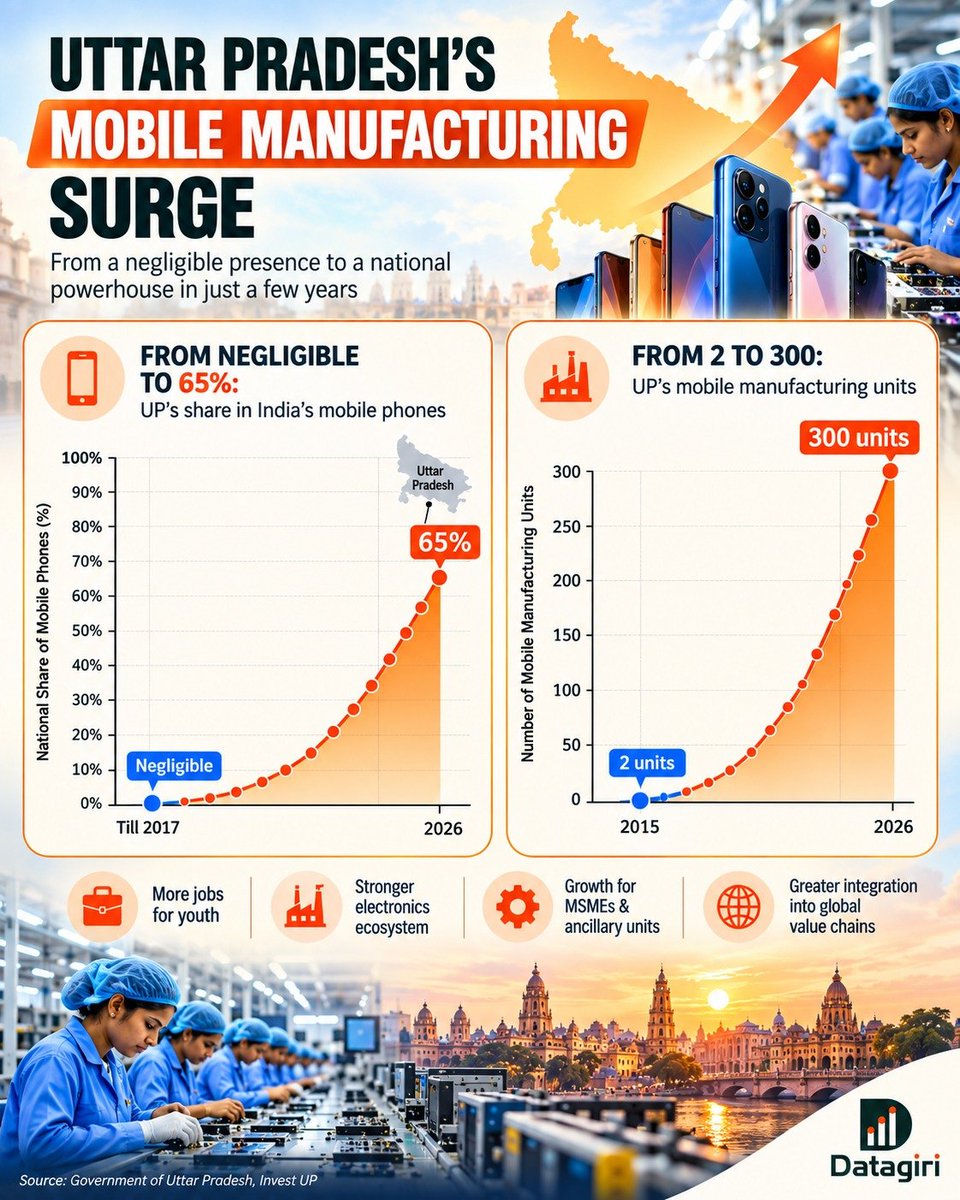
The phone in your hand may have been made in Uttar Pradesh.
That would have been hard to imagine before 2017.
2 mobile manufacturing units → ~300 today.
Negligible national share → ~65%.
But the real transformation goes beyond smartphones.
Factories. Jobs. Suppliers. Logistics. Investment. And an ecosystem capable of powering large-scale electronics manufacturing.
From 2 to 300. From negligible to 65%.
UP isn’t just participating in India’s electronics revolution anymore.
It is becoming one of its biggest engines.
#UttarPradesh #MobileManufacturing #Electronics #MakeInIndia #InvestInUP
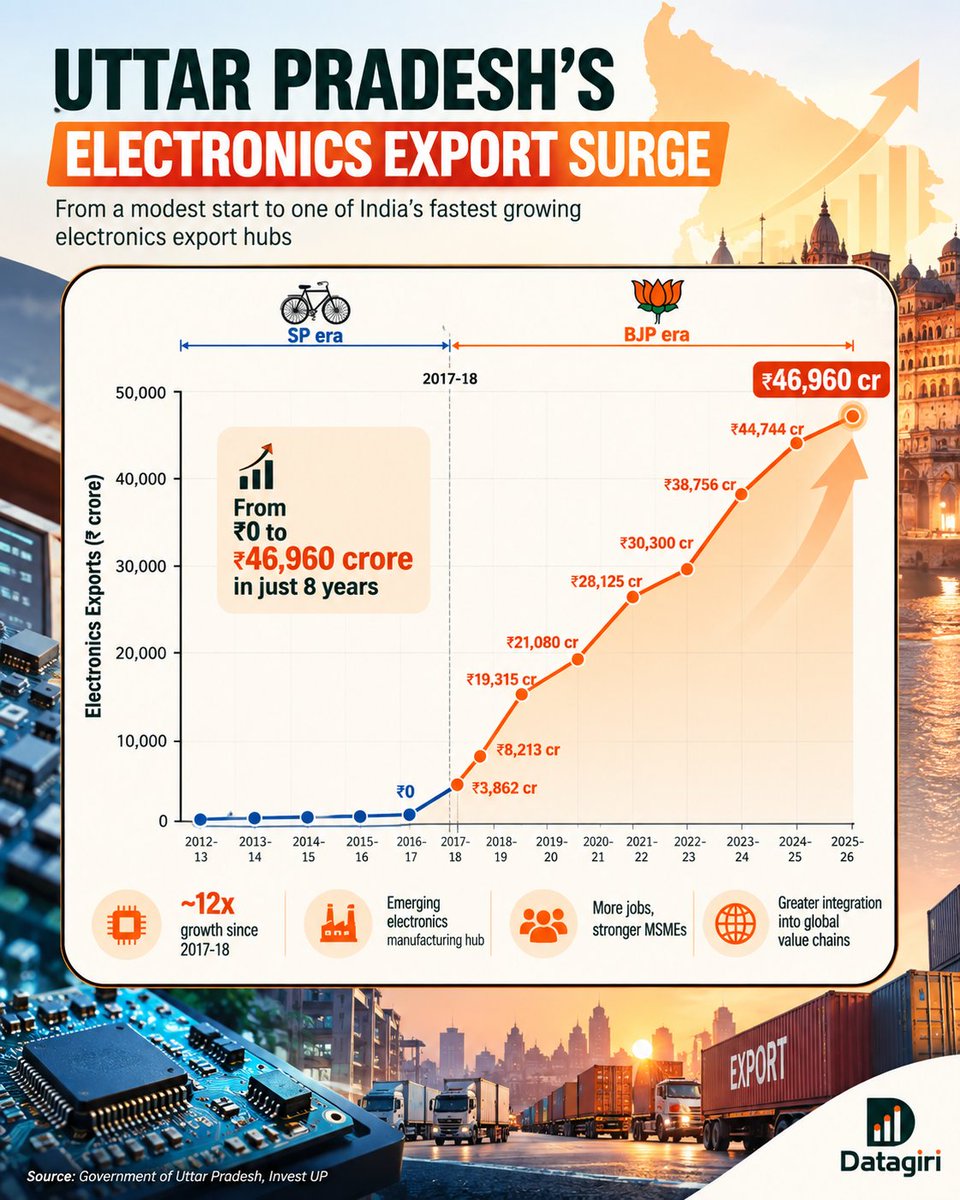
For years, Uttar Pradesh’s electronics export story was almost a blank page.
The graph tells a striking story.
From 2012–13 to 2016–17:
The line barely moves. Electronics exports remained negligible, reflecting UP’s limited presence in a rapidly growing global sector.
Then came 2017:
The trajectory changed completely.
What was once a near-flat line began moving upward, year after year.
What drove the change?
• Targeted Policies: Specialized electronics frameworks introduced aggressive capital and land incentives.
• Value-Chain Shift: Production matured from basic smartphone assembly to complex component manufacturing.
• Semiconductor Push: A dedicated state Semiconductor Policy complemented the national program.
• Mega Projects: Major wins include the ₹3,706 crore HCL–Foxconn OSAT facility at Jewar.
• Strategic Hubs: Noida, Greater Noida, and Jewar solidified as primary tech corridors.
• Digital Ecosystem: Hyperscale data center capacities expanded alongside heavy physical factories.
• Talent Pool: Growth in IT/ITeS employment, tech startups, and AI-skilling programs.
The result is visible in the curve.
From near-zero exports before 2017 to a sustained upward surge today, Uttar Pradesh has officially moved from the sidelines straight to the center of India’s electronics revolution.
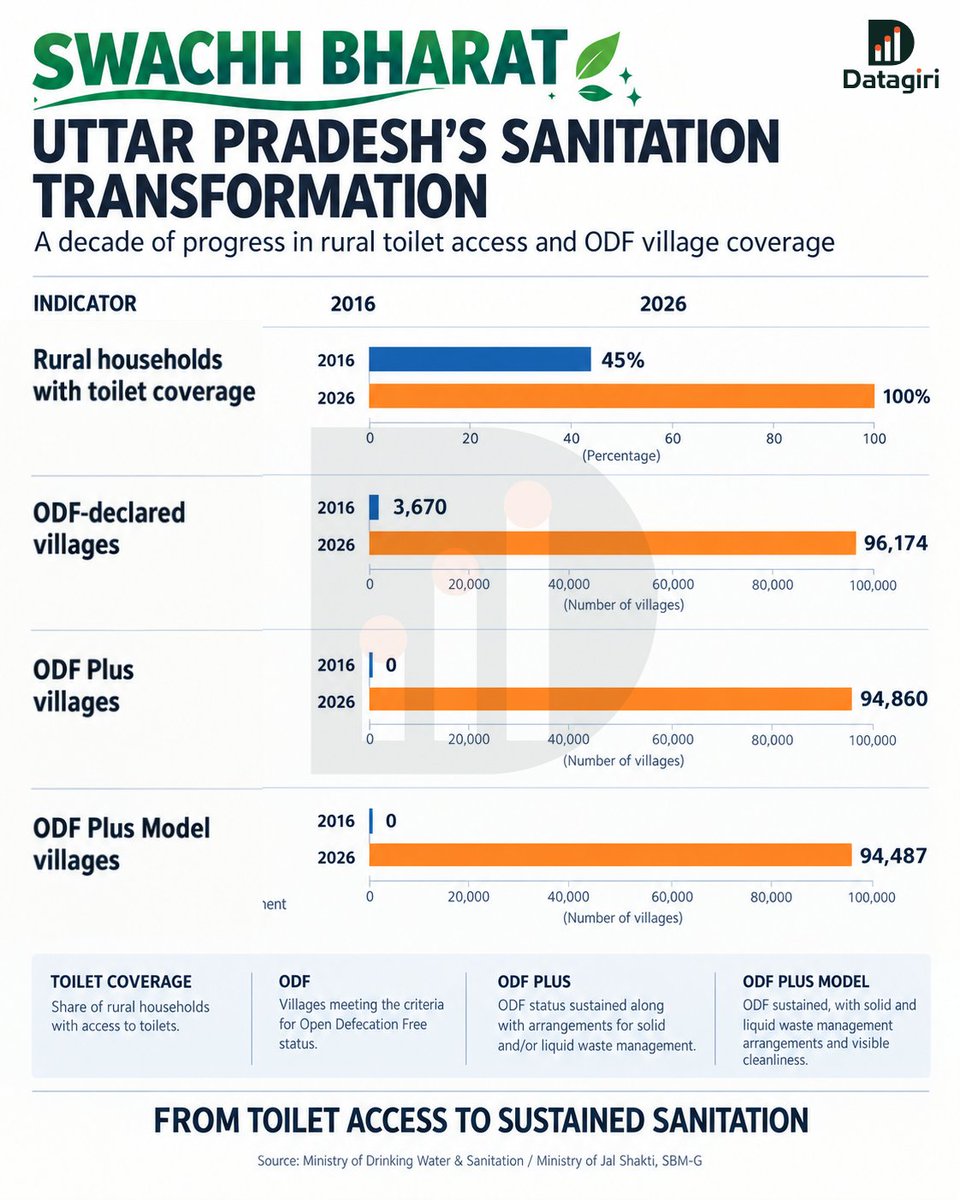
In 2016–17, Uttar Pradesh was among the worst-performing states in rural sanitation.
But sanitation is not just about toilets.
It is about dignity, safety, health and the quality of everyday life.
For millions of families, better sanitation can mean something deeply personal:
A woman not having to wait until dark for privacy.
Children growing up in cleaner surroundings.
Families facing less exposure to unhygienic conditions.
Villages moving from simply having toilets to managing waste and maintaining cleaner public spaces.
What began with toilet access has evolved into a broader transformation in rural sanitation, cleanliness and living conditions.
Because sanitation isn't just about what gets built.
It's about how people live.
#GandhiJayanti #MahatmaGandhi #SwachhBharat #SwachhataHiSeva #SHS2026 #SwachhataHiSeva2026 #SwachhBharatDiwas #SwachhIndia #CleanIndia #SwachhBharatMission #UttarPradesh #UP #RuralSanitation #ODF #ODFPlus #CleanVillages #WomenSafety #PublicHealth #RuralDevelopment #UPDevelopment #DataDriven #Development #India
UP's modernization isn't happening in one department or one sector.
Look at the vehicles now being deployed across the state.
Specialised vehicles that were largely absent from UP's public-service ecosystem before 2017 are becoming part of everyday governance.
AI-enabled interceptors — smarter traffic enforcement
Modern emergency vehicles— faster response
Mechanised sanitation vehicles — cleaner cities
Electric vehicles — greener mobility
Technology-integrated fleets — real-time monitoring and data-driven operations
The change isn't simply more vehicles.
It is more specialised vehicles + more technology + more automation + better environmental outcomes.
From policing to sanitation, emergency response to mobility, UP is upgrading the machinery behind public services.
Because development isn't just about building new infrastructure.
Sometimes, you can see it on the road.
For critics, the UP Police story often begins and ends with the bulldozer.
But beyond that political image, another transformation is underway: UP Police is modernising how it enforces the law.
To reduce road accidents and strengthen traffic enforcement, 87 new AI-enabled interceptor vehicles have been added to its fleet.
CM Yogi Adityanath flagged off 25 four-wheelers and 62 two-wheelers, taking the state's interceptor fleet to 172 — 35 four-wheelers and 137 two-wheelers.
These aren't just patrol vehicles. They bring technology into enforcement:
AI-powered speed detection
Real-time ANPR
Digital evidence & e-challans
Faster two-wheel response
In Lucknow's trial, the system reportedly generated 16,000 e-challans.
Alongside initiatives like PRAMAAN, which uses accident data to identify crash hotspots, UP Police is moving from conventional policing to technology-enabled enforcement.
The bulldozer may make the headlines. The modernisation is happening underneath.
Uttar Pradesh Is More Than the Taj Mahal
For decades, when the world looked at Uttar Pradesh through the lens of UNESCO World Heritage, three names dominated the picture:
Taj Mahal.
Agra Fort.
Fatehpur Sikri.
All three were inscribed in the 1980s and are monumental sites associated with the Mughal period.
They are unquestionably part of UP’s heritage.
But ask a bigger question:
Is Uttar Pradesh only its Mughal monuments?
A state shaped by Buddhism, Hindu traditions, ancient kingdoms, crafts, music, food, festivals, pilgrimage and living cultural traditions could never be represented by three monuments alone.
And over the past decade, the UNESCO story has started becoming broader.
2017 — Kumbh Mela
UNESCO inscribed Kumbh Mela on the Representative List of the Intangible Cultural Heritage of Humanity.
This was different from recognising a monument.
It recognised a living tradition — a massive religious and cultural gathering that has continued across generations.
2025 — Lucknow
Lucknow became a UNESCO Creative City of Gastronomy, bringing international recognition to its centuries-old culinary traditions and living food culture.
And this isn't even UP's first UNESCO recognition for a living cultural tradition.
Varanasi has been a UNESCO Creative City of Music since 2015, recognised for its deep musical heritage and Guru-Shishya tradition.
2026 — Sarnath
Then came perhaps the clearest expansion of the picture.
Ancient Buddhist Site of Sarnath, Varanasi was inscribed on the UNESCO World Heritage List in 2026.
Sarnath is associated with the Buddha's first sermon and developed over centuries through different periods of Indian history, including the pre-Mauryan, Kushana and Gupta periods.
So the UNESCO map of UP now tells a much wider story:
Mughal monuments.
Buddhist heritage.
Living religious traditions.
Music.
Gastronomy.
And the story doesn't stop with what has already been recognised.
The next layer is already being pursued.
UP's heritage pipeline now extends into places and traditions far beyond the three famous Agra monuments.
Salkhan Fossil Park, Sonbhadra was submitted to UNESCO's Tentative List in 2025.
Its geological record includes stromatolites dating back approximately 1.4 billion years.
Other UP heritage assets are also part of India's wider tentative-list and serial nomination landscape, spanning archaeological, architectural, cultural and natural heritage.
That means the conversation around UP's heritage is changing.
From monuments to traditions.
From medieval history to ancient civilisation.
From built heritage to living culture.
From famous destinations to lesser-known global heritage.
And this is where the role of government matters.
Projects such as the Kashi Vishwanath Corridor, improvements around major pilgrimage destinations and the large-scale organisation of events such as Kumbh have put greater administrative and tourism attention on heritage destinations.
But infrastructure alone does not create UNESCO recognition.
UNESCO recognition follows a formal national process involving documentation, nomination and evaluation.
What government can do is something more fundamental:
identify heritage, invest in its conservation and presentation, improve access and infrastructure, and build the institutional case for taking that heritage to the world.
And Uttar Pradesh has a very long list still waiting to be told.
Because the state's heritage isn't one monument.
It is thousands of years of civilisation — still living, still evolving, and still waiting to be discovered.
The next UNESCO story from Uttar Pradesh may not be another monument in Agra.
It could come from a fossil park in Sonbhadra, a Buddhist site in Varanasi, a weaving tradition, an ancient temple, a musical tradition, a historic city — or a living cultural practice.
UP's UNESCO story is getting bigger.
And more importantly, it is getting more representative of Uttar Pradesh itself.