Topos are mainly seen in pure mathematics and logic, but there is also an approach to physics in which topos are used!
So, if you're confident about your understanding of basic category theory, check out this 100 page primer titled ' An Introduction to Topos Physics' by Tsatos.
This is a very gentle introduction, well written and pedagogically sound.
If you need more material on topos along side this primer, check out Goldblatt's Topoi, the categorical analysis of logic and sheaves in geometry and logic by Mac Lane and Moerdijk.
🔗👇
This is a foundational publication which taught me how to optimize code for speed on modern computers. CPUs are bottlenecked by slow memory access most of the time. Optimize the code for memory access and get >10x performance improvements.
I've read this publication ~19 years ago at https://t.co/oT6plLunJu - https://t.co/TaAW7GRdre
Schroedinger's Message
In a distributed system, every message is both delivered and not delivered until you learn the outcome. Engineers must design protocols that stay correct in the superposition.
Retries collapse the wavefunction. Idempotency helps you survive the collapse
A fresh take on pretty printer design in Rust. 🦀
Trait-based instead of recursive enums. Each document construction becomes a type implementing the Doc trait. Lighter allocations, more flexible memory management.
Benchmarked against pretty, petty, and pye on real JSON formatting tasks, competitive across the board, with significant wins on several.
Solid read if you work on compilers, formatters, or DSLs in Rust.
By Jiayi Zhuang → https://t.co/t1t4kb0HOr
#Rust #RustLang #Compilers #OpenSource #SystemsProgramming
The new 𝚌𝚋𝚟 tactic in Lean 4.30.0 brings call-by-value evaluation into the proof layer.
"Call-by-value" is how most software runs: arguments are computed before being passed to a function. 𝚌𝚋𝚟 lets you use that same model to close proof goals, and is useful for software verification, formalized math, and domain-specific verification workflows alike.
Tactic reference: https://t.co/QbQJOnwZu7
#LeanLang #LeanProver #ProofAssistant #OpenSource #FormalVerification
🦀 Rust: Patterns & Engineering How-Tos
A practical guide from Microsoft on the patterns you actually need in production:
• type-state & newtypes
• PhantomData
• channels & concurrency
• async pitfalls
• testing with proptest
https://t.co/bK3mqnxL1I
#rust#rustlang
PSA: I now consider *all* of DeFi unsafe.
Coding agents are superhuman at finding vulnerabilities, and smart contract security is too asymmetric: defenders need to fix every bug while attackers need just one exploit to steal funds.
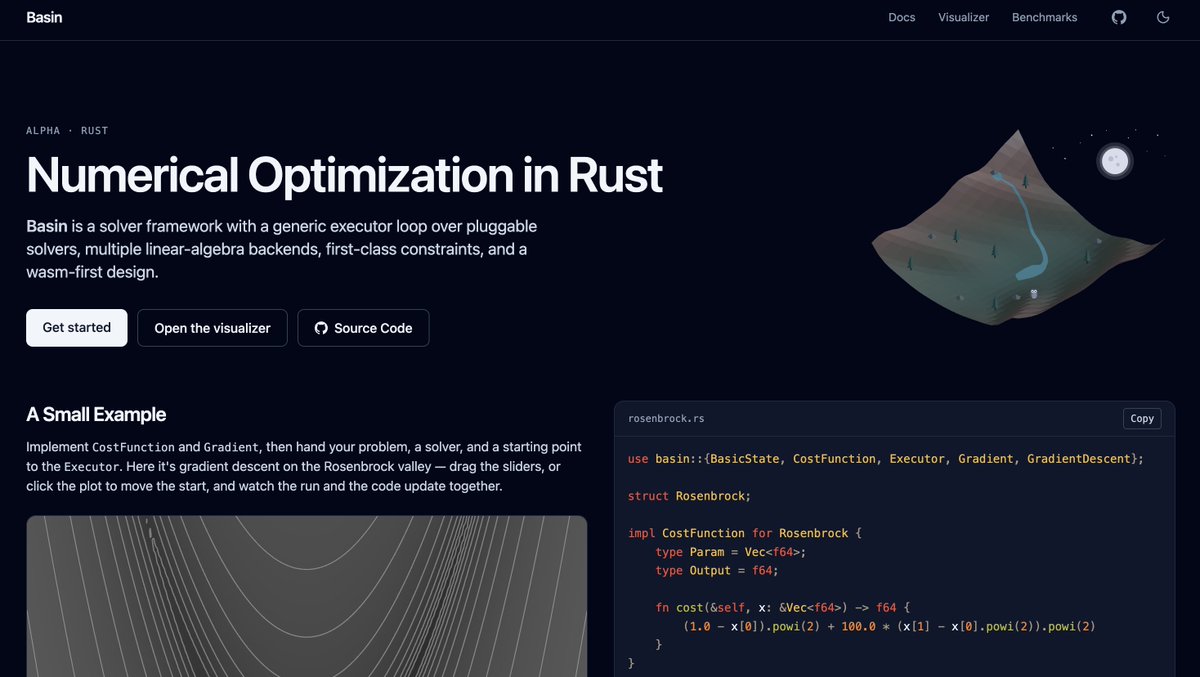
Came across a new Rust library worth sharing : basin. 🦀
A pure Rust library for numerical optimization. Pluggable linear-algebra backends (nalgebra, ndarray, faer). WASM-friendly by default, no BLAS, no threads required.
Covers a wide range of solvers:
→ First-order: gradient descent, BFGS, L-BFGS
→ Derivative-free: Nelder-Mead, Brent
→ Nonlinear least squares: Gauss-Newton, Levenberg-Marquardt
→ Global/stochastic: CMA-ES, genetic algorithms
→ Constrained: box bounds, log-barrier, augmented Lagrangian
Has an in-browser solver visualizer too. Early but actively shipping.
🔗 https://t.co/mTTx7YfmMq
#Rust #RustLang #NumericalOptimization #WASM #OpenSource #ScientificComputing
Rust promises zero-cost abstractions. But how well does it actually deliver? 🦀
Two researchers dug deep, studying the compiler, modifying it, and collecting real performance data for a talk at C++Russia 2026.
150+ slides covering Rust's performance trade-offs in a systematic, data-driven way. Possibly the most comprehensive treatment of the topic to date.
Slides + repo: 🔗 https://t.co/E0sOBakG3s
#Rust #RustLang #SystemsProgramming #Performance #Compilers #CPlusPlus
Go-to-Rust migration guide you've been waiting for. 🦀
Matthias Endler from https://t.co/G2Lare9iGl just published one of the most honest, practical guides on migrating backend services from Go to Rust.
No hype. Just real trade-offs:
✓ nil panics → Option<T>
✓ -race flags → compile-time Send/Sync
✓ if err != nil → Result + ?
✗ Goroutines → async coloring (the real pain point)
✗ Go compile times → Rust compile times (honest warning)
Also covers ecosystem mapping, integration strategies, and when to keep Go.
🔗 https://t.co/DrgUlUepiA
#Rust #RustLang #Go #Golang #BackendDevelopment
Rust + scoped errors = finally feels right. 🦀
scoped-error is a new crate that attaches context once per function, not at every call site. Clean error trees with file locations, tiny core, std-compatible.
A fresh take if anyhow/thiserror/snafu haven't fully clicked for you.
🔗 https://t.co/y1jGIoawu5
#Rust #RustLang #ErrorHandling #OpenSource
This guy is retarded (what the FUCK is "resistant to supply chains"? you mean "attacks on supply chains"?) and he is wrong. I am totally serious when I say this, I'd trust RedHat Linux more than NixOS for a server that has to run Linux. NixOS doesn't even have exhaustive working LSM support yet. Their model doesn't _even_ solve software that needs to be patched immediately (within minutes, or even seconds), and they are quite slow at building their patches and releasing them to cache as they do not have enough compute. The whole "build static system, roll it out atomically" model can't handle tiny incremental system patches well. (I still like it though, the bad part is that it is one single static layer)
The reason I use NixOS is because it is extremely moldable, great for tinkering and amazing if you want to build something completely custom. Anduril uses it for their drones' systems not because it claims to be more secure (it's a linux system without any security modules ffs, and kamikaze drones are famously being known for being internet-connected) but because it is an excellent builder for a Nix-free (but not /nix/store free) Linux system install.
Not because it's more secure than RedHat Enterprise Linux or whatever else. It isn't. Outside of the critical services, it barely even enables sandboxing for systemd units in official modules (hope modular services fixes this though)
I know for a fact that I'm not an important target, so I do not care that particularly much about acquiring patches for whatever software an hour or day late. If you do, you usually won't use NixOS. (Or if you do, you'd build basically your own distro on top of the NixOS module system or a slimmed down fork of nixpkgs and have your own build farm, requiring you to build vastly less software)
Also if you really want an ultra mega secure system you'd not be using Linux in the first place. It is a project that has historically chosen tiny gains in performance over any security gains. I'd not go as far as calling it "security hostile" myself, but a lot of the people working on it can be described as so. And no, I am not advocating for any of the BSDs.
‼️🚨 BREAKING: Another supply chain attack. 700+ GitHub repositories flagged, including PHP and Node.js projects. The malicious script was planted across all of them. When a developer installs the package, the script silently downloads a Linux file from GitHub, hides it under the name /tmp/.sshd (so it looks like a normal system file), and runs it in the background. It also skips security checks on the download and hides any error messages.
8 PHP packages on Packagist (the main PHP code library) were confirmed infected. The attacker hid the script inside a JavaScript config file (package.json) instead of the PHP one (composer.json), so PHP developers reviewing their code would not notice it. The biggest risk is to devdojo/wave (6,400 stars) and devdojo/genesis (9,100 installs), both popular Laravel project templates. Developers who use these templates run the bad script the moment they install dependencies.
The same payload was also dropped into GitHub Actions (automated build pipelines) under a fake step called "Dependency Cache Sync," meaning it could infect company build servers too. Packagist removed the bad packages, but the auto-updating versions (dev-main, dev-master, 3.x-dev) can quietly come back if the original repos stay infected.
IOCs:
GitHub account parikhpreyash4
repo systemd-network-helper-aa5c751f
drop path /tmp/.sshd
command fragments curl -skL and chmod +x /tmp/.sshd.
Oracle attacks are a reminder that clean code can still encode bad assumptions.
You can pass reviews, tests, and style checks -
and still fail adversarial reality.
The move is learning the attack *class*, not just memorizing one incident.
Patch Euler but miss the class behind it, and the same assumption takes down a different protocol.
https://t.co/nXtZCuNwGU
Inspired by this article, I spent some time this week in Turborepo:
1. Removing all .expect() and .unwrap() usage from implementation code
2. Fixing file system logical bugs
https://t.co/rQTKDzcNx0
Funding OSS is a hot topic today! I got to spend a lot of time over the last two years working on paying OSS maintainers at @Google.
We spent a few million dollars and funded some relatively high profile work, in addition to a lot of smaller projects.
A 🧵on problems I saw!