If you find yourself on Lake Como, our family’s favorite restaurant is Navedano, https://t.co/exbxgtFZnt a family-owned, beautiful restaurant set in spectacular gardens with superb food at reasonable prices.
You will love it.
The 2027 Ferrari 12Cilindri Manuale is the first car with a gated manual shifter to come out of Maranello since 2012. While the 12Cilindri lets the driver row their own gears, there is no physical connection to the powertrain, so the experience is actually a simulation. Ferrari will only build 1499 copies of the 12Cilindri Manuale, which each feature an 819-hp V-12 engine and will start at around $675,000.
Tommy Hunter, Canada’s Country Gentleman, has died.
He hosted The Tommy Hunter Show from 1960 to 1992 and gave many early country artists some of their first exposure including Garth Brooks and Shania Twain
Researchers are working urgently to identify a unique compound in a recently discovered wild mushroom that triggers remarkably consistent visions of miniature human figures.
Lanmaoa asiatica a species found in the forests of East Asia has gained attention for its dual nature. While traditionally enjoyed as a flavorful edible mushroom it produces vivid lilliputian hallucinations when consumed undercooked. Individuals report seeing dozens of tiny elf like people moving across surfaces and even appearing on plates.
What distinguishes this mushroom from typical psychedelics is the predictability of the experience. Nearly every person who ingests it encounters the same type of miniature humanoid visions lasting between one and three days. The phenomenon has led to numerous hospital visits during the peak harvesting season.
Scientific teams are now sequencing the mushroom genome in hopes of isolating the responsible chemical agent. Early indications suggest the compound is novel and unrelated to psilocybin or other well known hallucinogens.
Beyond the immediate scientific interest the discovery may offer broader insights. Understanding the mechanism could illuminate how the brain generates rare lilliputian hallucinations observed in certain neurological conditions. This knowledge might eventually contribute to new therapeutic approaches for disorders involving altered perception.
[Wang Y et al. Lanmaoa asiatica sp. nov. a new species from East Asia inducing lilliputian hallucinations. Mycologia or similar journal. DOI 10.1080 00275514 2025 1234567]
A rural Arkansas school district was hemorrhaging $250,000 a year and couldn't keep teachers. So residents voted to take out a $5.4 million bond, upgrade every building in the district, and install 1,400 solar panels.
Three years later, the deficit flipped to a $1.8 million surplus.
The project wasn't just solar. Energy efficiency upgrades across all six schools, new lighting, HVAC systems, windows, and thermostats cut energy consumption by 1.6 million kilowatts annually.
The panels, some installed as a canopy at the school entrance and some on unused district land, generated enough excess electricity that the district started selling it back to the grid. Monthly utility bills dropped from $17,000 to $4,000.
The school board voted to put the savings into paychecks. Teachers saw raises averaging $2,000 to $3,000 a year, with some receiving up to $15,000 depending on tenure.
Batesville went from one of the lowest-paying districts in Arkansas to one of the highest-paying in its county. Resignations slowed and applications went up.
Taxpayers funded the upfront cost through the bond. The savings paid it back and then some. "Batesville has reduced the checks they write to utilities," said the energy company that managed the project, "and increased the checks they write to teachers."
At least 20 nearby districts have since copied the model. Nine thousand schools across the US now run on solar. Batesville was the first to route the savings directly into teacher salaries.
On May 30, 1922, an elderly man in a dark coat stood at the foot of the Lincoln Memorial.
He was seventy-eight years old.
His hair was white.
His body was frail.
Two officers helped steady him as he prepared to climb the marble steps.
The monument behind him belonged to his father.
The weight he carried belonged to history.
His name was Robert Todd Lincoln, the last surviving son of Abraham Lincoln.
And that day, at the dedication of the Lincoln Memorial, he made his final public appearance.
President Warren G. Harding led the ceremony. Thousands gathered to honor the man who had guided the nation through civil war and given his life before the healing could truly begin.
But many eyes turned toward Robert.
He was not only a guest.
He was a living bridge.
A man whose childhood had touched the Lincoln home in Springfield and whose old age now stood before a national shrine.
Robert was born in 1843. He studied at Harvard, became a lawyer, and lived much of his life under a name that no private person could ever fully escape.
Being Abraham Lincoln’s son brought honor.
It also brought sorrow.
On April 14, 1865, when John Wilkes Booth shot President Lincoln at Ford’s Theatre, Robert was in Washington. He rushed to the Petersen House and sat through the night near his dying father.
He watched the president become a martyr.
He watched his father become memory.
Years later, tragedy found him again.
In 1881, Robert was serving as Secretary of War when President James Garfield was shot at a Washington railroad station. Robert was there, close enough to rush toward the wounded president as panic spread around him.
Garfield lingered for weeks before dying.
Then, in 1901, Robert arrived in Buffalo as President William McKinley was shot at the Pan-American Exposition. He was nearby when the news broke. McKinley survived for several days, then died from infection.
Three presidents.
Three assassinations.
Robert had been present or nearby for all of them.
The coincidence haunted him.
He once remarked that there seemed to be a certain fatality about presidential occasions when he was present.
His life held another strange thread.
As a young man, he once slipped between a moving train and the platform at a station in New Jersey. A stranger grabbed him by the collar and pulled him to safety.
The man who saved him was Edwin Booth, one of the most famous actors of his time.
He was also the brother of John Wilkes Booth.
History seemed to circle Robert Lincoln in ways almost too strange to believe.
Yet he was more than a witness to sorrow.
He served on General Ulysses S. Grant’s staff near the end of the Civil War.
He became a respected attorney in Chicago.
As Secretary of War, he helped oversee the army during a period of change.
Later, as minister to Great Britain, he represented the United States abroad with steadiness and restraint.
In business, he led the Pullman Palace Car Company through difficult years and remained one of the most prominent figures of his generation.
Still, he preferred privacy.
Perhaps he had seen too much of what public life could cost.
By the time he stood at the Lincoln Memorial in 1922, Robert was the last living child of Abraham and Mary Lincoln. His brothers had all died long before. His mother was gone. The world of the Civil War had faded into textbooks, monuments, and old men’s memories.
He alone still carried the family line back to the house in Springfield.
To the White House during war.
To the room where his father died.
Four years later, in 1926, Robert Todd Lincoln died in Vermont, just before his eighty-third birthday.
He had lived a life of privilege, service, grief, and restraint.
He had never sought to become a symbol.
But history made him one anyway.
In the photograph from the memorial dedication, he looks tired but composed, leaning on those beside him as he climbs.
Behind him is the seated figure of Abraham Lincoln carved in stone.
In front of him is a nation still trying to understand what that life had meant.
Robert Todd Lincoln was the last living link to the president who held the Union together.
And until the end, he carried that link quietly.
Tucson, Arizona changed the color of 20,000 streetlights, cut light pollution by 7%, prevented countless wildlife deaths, and saved taxpayers a boatload of money.
Most cities retrofitting streetlights to LED chose cool-white bulbs in the 4,000K range because they're bright and cheap. Cool-white light scatters upward and sideways at higher rates than the old sodium lamps, which is why light pollution has actually increased in many cities that switched to LED. Hundreds of millions of migrating songbirds navigate by stars and get pulled off course by that scatter every year, many of them fatally.
Tucson chose warm-white 3,000K LEDs instead, added full shielding so the light points down rather than up or sideways, and programmed adaptive dimming: 90% brightness from sunset to midnight, 60% after that until dawn. It was a win for wildlife and taxpayers: the whole thing costs less to run than what it replaced.
Philadelphia, LA, and Phoenix have all run LED retrofits that made skyglow worse. The technology to do it right exists and isn't expensive. It's a procurement decision, which means it's a political one. And political decisions are ones you can influence.
Your city council chose your streetlights. Most of them have never been asked about color temperature, shielding, or dimming schedules, not because those things don't matter, but because most people don't know to ask.
The night sky is habitat. The darkness migrating birds need to navigate is habitat. We've been treating it as a waste product of lighting decisions made by people who weren't thinking about birds.
Ask your council what color temperature your streetlights are. Most of them won't know the answer.
For most of modern history, a young family could look at a house and understand the math.
The Story Of Economic Autumn!
It was not easy.
It was never effortless.
But it was understandable.
A normal home costs about two to three times a household's income.
Three times the income was not a law.
It was not a slogan.
It was not nostalgia.
It was gravity.
At that price, a family could buy a home, pay the mortgage, raise children, save a little money, and still live a life outside the bank’s balance sheet.
Then something changed.
After 1980, the world entered a new financial era.
Interest rates began a 40-year decline.
Credit became easier.
Mortgage terms stretched.
Two incomes became the new underwriting base.
Banks discovered that housing was not just shelter; it was collateral.
Governments discovered that rising home prices made people feel wealthier.
Central banks discovered that rescuing asset prices was easier than rebuilding productive economies.
And gradually, without most people noticing, the question changed.
The old question was:
Can a household afford this home from its income?
The new question became:
How much debt can this household carry?
That was the turning point.
Housing stopped being priced mainly by wages and started being priced by leverage.
A home was no longer just a place to live.
It became a retirement plan.
A speculative asset.
A political promise.
A bank asset.
A government revenue source.
A national confidence trick.
And for a while, it worked.
Homeowners felt rich.
Banks grew larger.
Governments collected more revenue.
Developers made fortunes.
Real estate agents became national celebrities.
And young people were told:
Get in now, or you will be priced out forever.
So they stretched.
They borrowed more.
They delayed the children.
They took on longer mortgages.
They moved farther away.
They accepted smaller spaces.
They sacrificed savings.
They confused survival with success.
And the whole system called this prosperity.
But it was not prosperity.
It was financial exhaustion disguised as wealth.
Because shelter cannot permanently rise faster than the incomes of the people who must live in it.
That is not politics.
That is arithmetic.
For 40 years, falling rates hid the problem.
Every time housing became too expensive, the system found a new way to extend the cycle.
Lower rates.
Longer amortizations.
Easier credit.
More investors.
More foreign capital.
More government support.
More pressure on young buyers to take the risk.
But every cycle has a limit.
Eventually, the family reaches the edge.
The mortgage payment no longer fits.
The down payment becomes impossible.
The rent consumes the paycheque.
The commute destroys the day.
The second income does not create freedom; it merely services the debt.
And the dream that once built the middle class becomes a trap.
That is where many countries are now.
Canada.
Australia.
New Zealand.
China.
Parts of Europe.
Major U.S. cities.
The details differ, but the pattern is the same.
Housing detached from income.
Land became financialized.
Debt replaced productivity.
Governments protected asset prices while calling it stability.
And an entire generation was asked to fund the illusion.
This is why the three-times-income rule matters.
Not because every home must return to exactly that number.
Not because every city is the same.
Not because anyone should cheer for collapse.
But it reminds us that housing once had an economic anchor.
A normal home should be affordable on a normal income.
If that sounds radical today, it shows how distorted the system has become.
The painful truth is that no serious housing solution avoids pain.
If prices fall, existing owners feel poorer.
If land values fall, speculators lose.
If credit tightens, banks feel pressure.
If immigration is tied to housing capacity, politicians lose an easy growth model.
If zoning changes, neighbourhoods resist.
If taxes shift toward land speculation, powerful interests fight back.
That is why the system delays reform.
Every real solution takes something away from a concentrated group and gives a long-term benefit to everyone else.
So instead of fixing the model, governments try to stretch it.
They subsidize demand.
They protect prices.
They blame supply alone.
They promise affordability while defending unaffordability.
They tell young people help is coming, while preserving the very structure that priced them out.
But the market has its own memory.
Debt has its own discipline.
Cycles have their own justice.
In LongWave terms, this is what happens at the end of Financial Autumn.
The old model built wealth through leverage, asset inflation, and falling rates.
Economic Winter arrives when the debt-service math stops working.
The system can deny it.
Politicians can avoid it.
Banks can smooth it.
Central banks can delay it.
But they cannot repeal it.
The next Economic Spring will not come from protecting every inflated asset price.
It will come from rebuilding the real economy.
More homes.
More infrastructure.
More energy.
More productivity.
More real wages.
More small businesses.
More productive investment.
More families able to own shelter without becoming servants to debt.
That is the hopeful part.
The goal is not to destroy housing wealth.
The goal is to restore sanity to housing.
A healthy country does not measure success by how much debt young people must carry to buy a roof over their heads.
A healthy country measures success by whether ordinary families can build a life.
Own a home.
Raise children.
Start businesses.
Move for opportunity.
Save for the future.
And leave the next generation better off.
That was once normal.
It can be normal again.
But first, we have to tell the truth.
The three-times-income rule was not an accident.
It was the old affordability gravity.
And after 40 years of pretending debt could replace income, gravity is returning.
That is not the end of the story.
It is the beginning of a more honest one.
Driving on three wheels? No problem. Changing a tire without a jack? Also no problem.
With its hydraulic suspension, the Citroën DS could lift itself at the flip of a lever — space-age tech back in 1955.
[📹 classic_car_glo]
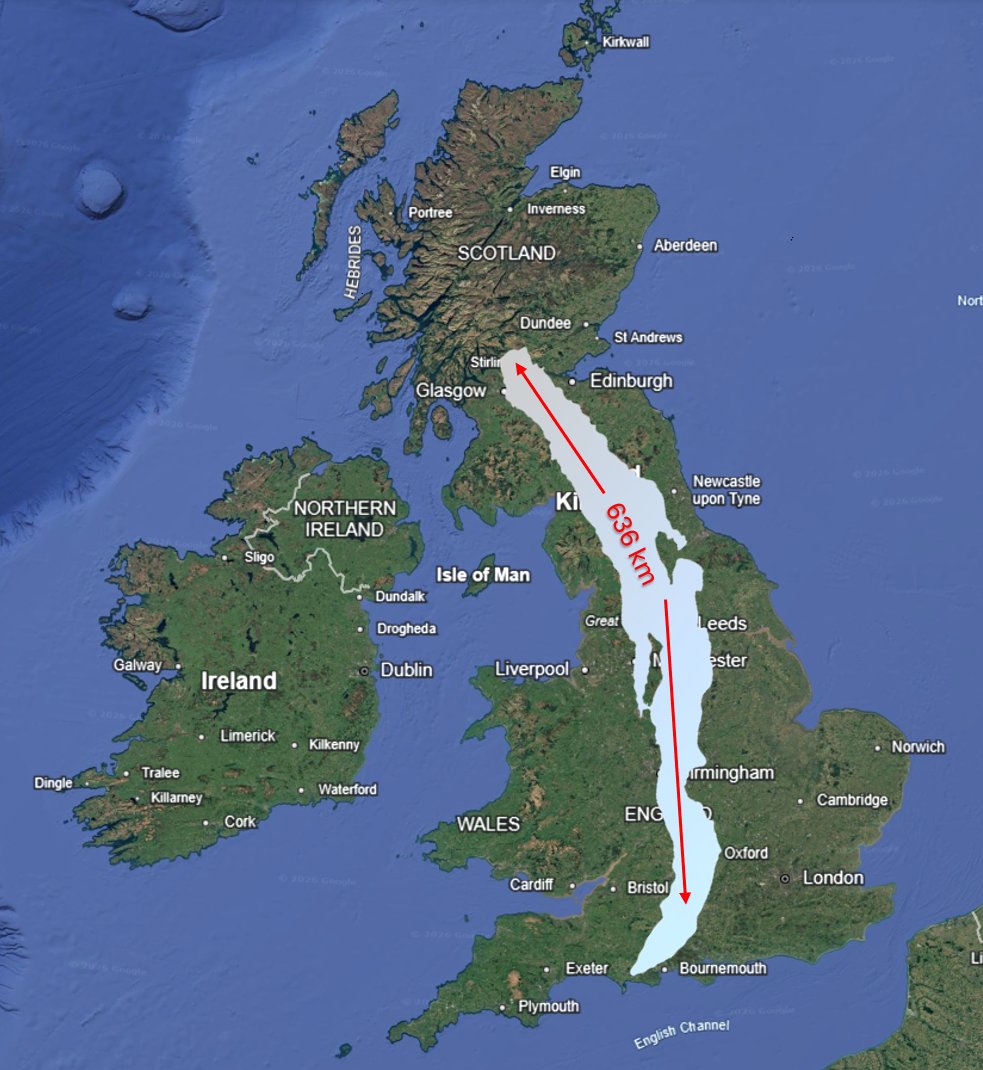
Lake Baikal in Russia is the world's largest freshwater lake by volume. Nothing else even comes close to it. The numbers attached to Baikal are staggering.
First of all is the maximum depth. At 1,640 metres (5,350 feet), it is the deepest freshwater lake in the world.
1/n
Fish in Utrecht had a problem. They were piling up against a 400-year-old canal lock every spring with nowhere to go. Predators found them. Many didn't make it.
Two ecologists fixed this with the Visdeurbe, or "fish doorbell."
They mounted an underwater camera on the Weerdsluis lock and built a website where anyone on Earth can watch the livestream and press a button when they see fish waiting at the gate. The lock keeper gets notified and opens it when enough people have rung in.
In 2024, over 20 million people tuned in. The doorbell was pressed 150,000 times by viewers in the Netherlands, Germany, the US, the UK, and dozens of other countries. Perch, bream, pike, rudd, catfish, and eels made it through to their spawning grounds upstream.
A centuries-old infrastructure problem was solved by a camera, a website, and strangers on the internet who wanted to help a fish get where it was going.
The site is visdeurbel dot nl. Migration season runs through spring. The fish doorbell season has come to an end for 2026, but they'll be back online March 1, 2027. See you next season!
In a recent YouTube video, Mark Carney had a confession to make: he will not meet Liberal emissions targets.
At least he was honest about that.
So, let's be honest about this: he pretends phasing out oil and gas was someone else's idea.
For a decade he was the worldwide CEO of the idea. He built his entire persona around Net Zero.
He claimed fossil-fuel-caused climate change was an "existential crisis", which in plain English means the world could end.
He was the UN's Special Envoy for Climate Action and Finance where he recommended 65% of oil and gas should stay in the ground.
As Trudeau's Economic Advisor, he advised bigger and broader carbon taxes than even Trudeau had imposed.
He founded a banking alliance with the mandate to starve oil and gas of investment.
At Brookfield, his job was to use his political influence to get government handouts for his "green" investments (heat pumps, pricey "green" aviation fuel, etc.).
He made fortunes off an agenda that inflated costs and killed jobs for the working class around the world.
He didn't inherit this ideology. He built it. He milked it.
Now, he claims he changed his mind. Really? So, it’s no longer an existential crisis? Was he wrong for last decade?
If so, why go on hiking the industrial carbon tax by 500%?
Why has he not scrapped a single Trudeau-era anti-development law?
Why are 500 projects still waiting for federal approval?
Why has he not used his unprecedented powers in Bill C-5 to approve a single project?
Because it is all an illusion.
It was always about enriching the club. And it still is.
He will sound the alarm on new crises. The solution will be the same: heavy-handed, top-down crony capitalism—taxes, inflation, and debt for you, and handouts, bailouts, and carve-outs for the Liberal club. All to save us from the latest crisis.
The only way to change any of this is with a party that has been saying the same thing all along: get the government out of the way; free our businesses from all carbon taxes, red tape, and subsidies to unlock abundant, affordable energy. For Canada. For you.
Peter Thiel just named the rule that decided if Elon Musk stayed or left. It has nothing to do with left or right.
Thiel: "I've known Elon since 2000. He was never doctrinaire, but for the first 20 years, he was left of center."
Tesla. Clean energy. Electric cars. About as left of center as it gets.
Then the terms changed.
Thiel: "This intellectual straitjacket where you're not allowed to have ideas. Even if you agree with 80%, it's never enough. You have to be 100%."
No idea on Earth requires 100% agreement. Only power does.
Thiel: "There's just no individuality left whatsoever."
Thiel: "The Democratic Party, it's like the Empire. They're all Imperial stormtroopers. We're the ragtag Rebel Alliance."
Not just him. Every institution that used to reward the odd ones now filters them out before they rise.
He didn't change. The room did.
Thiel: "It certainly seemed incredibly dangerous to me what he did, incredibly courageous."
Thiel: "Elon gave people a great deal of cover."
Not because he won the argument. Because he went first.
The straitjacket only holds you if you believe you need permission.
Everyone still wearing one is calling it a coat.
they did it. the mad lads actually did it.
i never talked about my time at DOGE last year because it was so controversial and contentious (remember that?)
early last year, @jgebbia recruited a handful of his most trusted early Airbnb engineers to embed at the Office of Personnel Management to solve the "retirement paper" problem.
processing a federal retirement took months, and in the extreme retirees could wait up to 6 months for their full pension to arrive. what was the holdup? paper. remember hearing Elon talk about "the mine" in Pennsylvania? we got to visit it. in deep underground caverns blasted out of limestone, there were literally acres of file cabinets, as far as the eye could see, storing files detailing federal employees' employment and paystub history. a simple "case" might be only a quarter or half inch thick, but really complex cases filled up whole filing cabinets. one famously took up a whole pallet.
each case was hand processed by case workers in cubicles deep underground. they checked calculations, made sure forms were filled out properly (many weren't), and handled a long tail of complex issues. we'd watch as they keyed data into a black and white terminal, transmitting to the COBOL mainframe built many decades ago.
since cases were processed by hand, there were multiple rounds of human review, and additional rounds for complex cases. case files were walked around between one worker's outbox and another's inbox. sometimes it would sit in one place for days, waiting to be picked up.
to OPM's credit, they'd done multiple rounds of "digital transformation" spanning decades, so some systems were newer than others. there was a big effort in the mid-90s. but the systems were disparate, and it was a total maze getting them to talk to each other. there was a big effort to build a web app where employees applying for retirement could digitally fill out the necessary forms — just to be mailed to the mine and stuffed into the paper file. and few federal agencies were even using it.
when we arrived, OPM was midway through a fresh attempt at digital transformation, delivered by a software contractor.
the blackpill was seeing the terrible quality of the software and interacting with the contractors. coming from silicon valley, i couldn't believe how low the talent and quality bar was for selling software to the government. it's clear, as the OG USDS people explained to me a decade ago, the primary skill these vendors have is securing government contracts. it's a huge moat. delivery of quality product be damned.
we fired the vendor and took over the project. they'd been working on it for more than a year, and there was another year before they were going to deliver it. at first we tried to bend it to our will, to actually connect all the various data sources and get to a decent UX for case workers in the mine to use, but we soon realized we were going to have to rebuild the whole stack from scratch.
it was around this time I had to go back to new york — i had a new job waiting for me, a four month old, and a wife whose patience was running out. but i got to watch from afar as the team cranked day and night, hitting early milestones. and now they've fully done it.
huge congrats to Joe and the team. @yatshitcray was the hero in the trenches. indefatigable, unrelentingly optimistic, and determined to see this project through. when i recruited him for "ok i can do two, maybe three months", he stuck it out over a year making this project a reality.
while the retirement project was under the DOGE banner, it operated different from what you heard from the breathless, negative media — we came in with the attitude of partnering with career OPM employees. we were team members determined to bring our software talents to bear on the problem they've been trying to fix for years, which they hadn't had the resources to solve before. they were wary at first, not sure about us, but they quickly saw how authentic and determined we were to work together toward the same goal. props to Joe for developing those relationships, setting the example of how to collaborate together.
what's the end result? lifelong federal employees, veterans, postal carriers get their full pension installments almost immediately. days instead of months. peace of mind for these people to devoted their careers to serving our country. massively streamlined operations inside of OPM. and NO MORE PAPER 🫡🇺🇸










![Rainmaker1973's tweet photo. Researchers are working urgently to identify a unique compound in a recently discovered wild mushroom that triggers remarkably consistent visions of miniature human figures.
Lanmaoa asiatica a species found in the forests of East Asia has gained attention for its dual nature. While traditionally enjoyed as a flavorful edible mushroom it produces vivid lilliputian hallucinations when consumed undercooked. Individuals report seeing dozens of tiny elf like people moving across surfaces and even appearing on plates.
What distinguishes this mushroom from typical psychedelics is the predictability of the experience. Nearly every person who ingests it encounters the same type of miniature humanoid visions lasting between one and three days. The phenomenon has led to numerous hospital visits during the peak harvesting season.
Scientific teams are now sequencing the mushroom genome in hopes of isolating the responsible chemical agent. Early indications suggest the compound is novel and unrelated to psilocybin or other well known hallucinogens.
Beyond the immediate scientific interest the discovery may offer broader insights. Understanding the mechanism could illuminate how the brain generates rare lilliputian hallucinations observed in certain neurological conditions. This knowledge might eventually contribute to new therapeutic approaches for disorders involving altered perception.
[Wang Y et al. Lanmaoa asiatica sp. nov. a new species from East Asia inducing lilliputian hallucinations. Mycologia or similar journal. DOI 10.1080 00275514 2025 1234567]](https://pbs.twimg.com/media/HMUPLYjXQAAAwua.jpg)