From my perspective, Miyazaki is a rather unique, yet extremely serious game developer.
His career did not begin in the game industry. In fact, he didn’t become a game developer until he was almost thirty years old.
Even among developers of my generation (those of us born in the 1970s), I think it’s remarkable that someone who wasn’t even a game developer during the dawn of the polygon era eventually became one of Japan’s most representative game creators. (In other words, compared to the rest of us from the same generation—including myself—his career path is exceptionally unusual. Most notably, unlike many of us, he was not working at one of the major development studios that held a significant technological advantage during the early polygon era. That, more than anything else, is what makes his path so unique.)
Next, regarding my impression of Dark Souls.
People often focus on its difficulty as a game, but I believe Miyazaki’s true creativity shines through in the world he created. (By the way, I personally think Dark Souls has fairly simple action mechanics, and I don’t actually consider it to be an especially difficult game.)
If you look into my own career, you’ll see that I was personally involved with the Dark Souls series and Elden Ring as the General Manager overseeing both production and marketing (Just to clarify, I wasn't part of the development team itself. My involvement was simply as the General Manager of the publisher-side department overseeing production and marketing). From that perspective, I can say that Dark Souls didn’t suddenly become a massive success overnight. It was the result of everything Miyazaki and his team had built up through their previous titles.
Today, he receives offers from all over the world, but when I think back to the days when he and his team were struggling the most, many of those offers seem like they’re coming from people who only know who they are today. Some of them almost feel like complete reversals in attitude. Well, that’s just my personal perspective.
Personally, I had grown tired of people who would simply compare games by saying things like, “That title cost X billion yen to make and sold Y million copies,” and then use nothing but those numbers to judge them against other games. There were so many people who couldn’t appreciate the journey or the growth of the developers themselves. Anyone can look at the current numbers—they’re available to everyone. Whenever I heard those kinds of opinions, I always thought, “That’s exactly what you’d expect from someone who’s never actually developed games.”
What surprised me even more was that, even if people couldn’t properly evaluate that journey, almost nobody even seemed interested in trying to understand the process of how those developers gradually reached where they are today.
(I'm NOT talking about the fan community).
Now, going back to Miyazaki, there are two things about him that have always stayed with me.
The first was back when I was developing Summer Lesson for VR, around the time it was generating a lot of buzz.
One day, he came to try an early build of Summer Lesson along with people from several other game companies.
While everyone else was laughing, chatting, and having fun with it, Miyazaki alone played it with incredible seriousness. Then, after everyone had finished and started discussing their impressions, he remained completely silent, staring intently at the preview monitor, deep in thought.
Everyone became curious and finally asked him, “Miyazaki, what are you thinking about?”
He suddenly smiled and said,
“Oh… I got completely absorbed in thinking about what I would do if I were making this, and what kind of game I’d create.”
What he talked about after that was, in the best possible sense, completely insane.
It was one of those rare moments when I caught a glimpse of what I’d call his “mad scientist” side—his deeply serious, obsessive approach to creativity.
The other thing that left a strong impression on me was that he generally dislikes video interviews (including live streaming).
I once asked him about it by email, and he replied with quite a long explanation. After reading it, I completely understood where he was coming from.
Simply put, he doesn’t like watching himself moving around on video. (Psychologically speaking, it’s actually a bit more complicated than that.)
But there was another reason.
According to him, there are naturally many people in this industry who know games far better than he does. Whenever he listens to those people speak, he realizes that his own understanding is still shallow, and it makes him feel that he’s not yet in a position to be the one talking about games.
I mean… it’s common for well-known developers to say, “I still have a long way to go.”
But whenever someone like him says that, my reaction is always,
“Come on… if you say you’re still not there yet, then the rest of us won’t feel qualified to talk about games at all.” (laugh)
Anyway, that’s one of the reasons why video interviews with Miyazaki are extremely rare. And conversations with him on camera—especially long-form discussions with another developer—are even rarer. They almost don’t exist at all.
By the way, the other game developer in that photo is Masahiro Sakurai.
If you ask me, he’s basically:
“A Saiyan who genuinely believes he’s just another ordinary human.”
Every now and then, when the rest of us are struggling with some problem, he’ll say something that sounds exactly like Goku saying,
“Well… why don’t you just fly?”
And I’ll reply,
“Because we humans can’t use Flight Technique.”
Then he just stares at me with a completely puzzled look.
To put it in terms of Demon Slayer, I’d describe him as:
"Like Muzan Kibutsuji casually showing up at a drinking party where all the Hashira have gathered, genuinely believing he's just another ordinary guest".
That’s the kind of person he is.
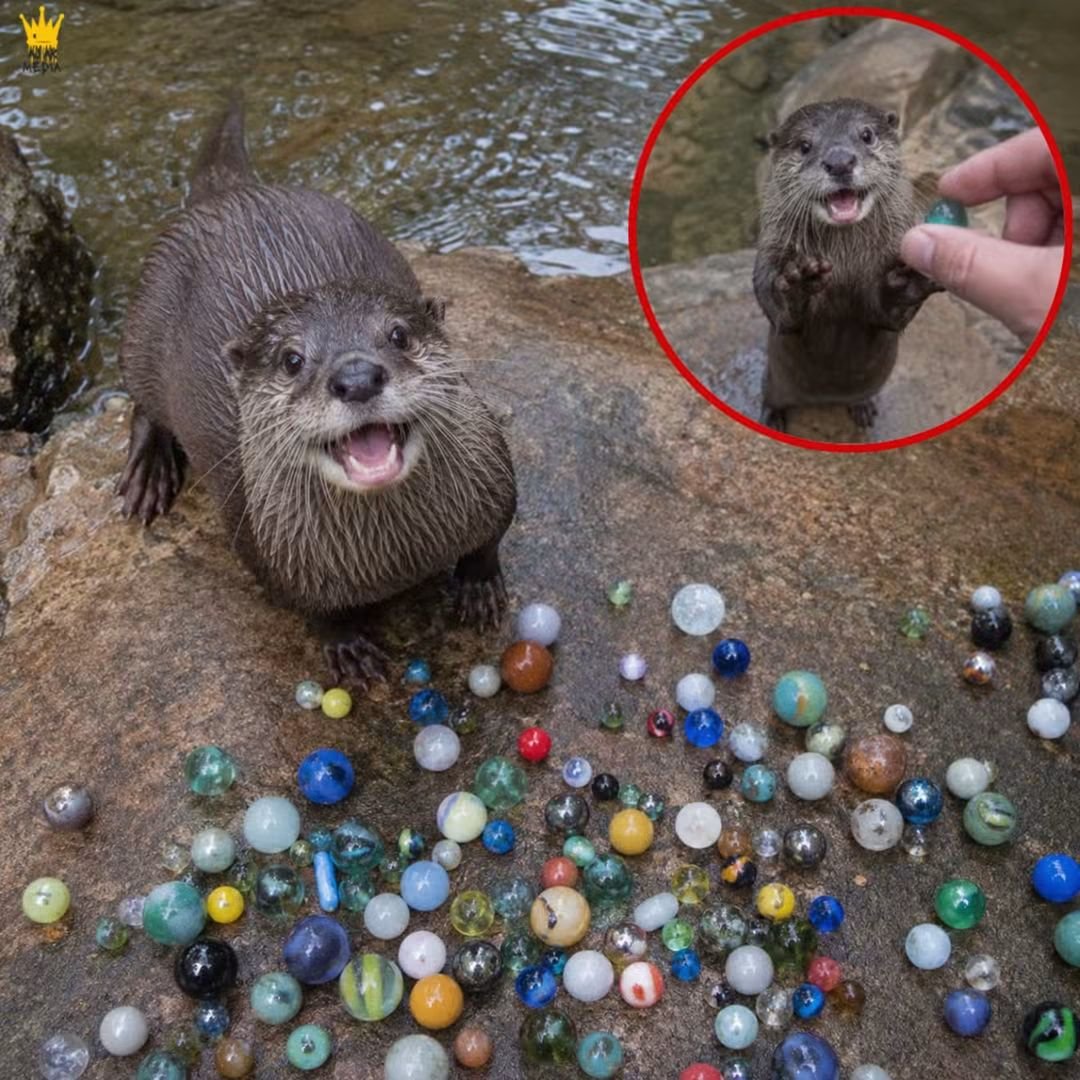
Otter at a local zoo is going viral after showing zookeepers her favorite marble collection.
At a local zoo, staff noticed one otter had a habit that was different from the rest.
Otters are known for using rocks to crack open shellfish, and some even keep their favorite stones because they work better than others. But this otter wasn’t saving rocks. She was saving marbles.
Zookeepers first noticed her hiding one shiny marble in the corner of her enclosure. Then another appeared. Then another.
Soon, staff realized she wasn’t just collecting them by accident. She was carefully keeping each one like it meant something.
The zookeepers thought it was so sweet that one by one, staff members started bringing her a different marble as a gift. Every time she received one, she would take it gently, inspect it, and add it to her little collection.
Now, whenever certain keepers visit, she gathers the marbles together as if she’s showing them off. Visitors say it looks like she knows exactly which marble came from which person.
🚨#BREAKING: A 28-year-old confirms he has spent the last 10 YEARS of his life interviewing World War II combat veterans to keep their stories alive...
...in fact, for the last 10 years, he has interviewed World War 2 veterans EVERY SINGLE DAY
He started as a teenager, ditching school to ride his BIKE to the local retirement home, walking up to the front desk and asking to, "meet some World War II heroes."
His name is Rishi Sharma.
He's crossed all 50 states and half the world.
He's slept in his car and lived on gas-station food to afford it.
He asks these men for hours of their memories, and then he hands the entire recording to their families...
...FOR FREE
So that 200 years from now, a great-great-grandchild will know not just their hero's name, but how he laughed, how he cried, and what he sacrificed.
Rishi has no military family, his parents immigrated here from India.
He does it out of pure gratitude.
In his words:
"My parents were given the opportunity to immigrate and raise a family because of veterans like these. It's a debt of love I'll spend my entire life trying to repay..."
As one 100-year-old Marine who stormed Iwo Jima told him, remembering the flag going up:
"The hair on my arms still stands up when I think about how beautiful it was."
THAT is America.
250 years of ordinary people doing extraordinary things...
God bless our veterans. 🇺🇸🇺🇸
🇯🇵🇺🇸 Happy Independence Day to our friends in the United States!
This song is very popular here in Japan and many artists often cover it. I particularly love this one.
In 1872, an eighteen-year-old girl arrived in a remote gold mining camp in Idaho. Legally, she was not even considered a human being. She did not have money, she did not speak a word of English.
She had been sold by her starving family in China during a famine, smuggled across the ocean, and bought by a wealthy Chinese saloon owner to work as a slave.
Her birth name was Lalu Nathoy, but the miners quickly gave her a simpler name: Polly.
The odds against Polly were overwhelming. Under American law at the time, she was invisible. The local government considered her presence illegal, and the men in the camp viewed her as property.
But Polly possessed a quiet determination that no one saw coming.
While she spent long, exhausting hours scrubbing heavy canvas pants on a washboard, she listened. She memorized every word spoken around her.
She learned English in complete silence, without anyone realizing it until it was too late to stop her.
Polly looked at the rugged miners around her and noticed something crucial.
They had gold in their pockets, but absolutely nothing else.
They had no one to feed them properly, no one to nurse them when they fell ill, and no one to make the brutal survival in the canyon bearable.
She saw a massive void in the market and decided to fill it.
She started cooking, sewing, and providing basic medical care. Every single coin she earned from these side jobs went straight into the dirt floor underneath her bed.
While the men squandered their fortunes on gambling and alcohol, Polly was buying something much more permanent: her independence.
Her life took a dramatic turn when a local saloon keeper named Charlie Bemis was shot in the face during a gambling dispute.
The camp doctor took one look at the horrific wound and declared him a dead man. Polly refused to accept that. She boiled water, sterilized a common crochet hook, and spent hours carefully extracting the bullet from Charlie’s skull.
Against all medical logic, Charlie lived.
Eventually, Polly and Charlie left the mining camp together and moved to Hells Canyon, the deepest river gorge in North America.
The Snake River cut through granite walls so steep that sunlight only hit the valley floor for a few hours a day. On a piece of land that seemed impossible to cultivate, Polly planted a fruit orchard.
She grew cherry and apple trees against the harsh rock cliffs.
When miners down the river got sick with fever or suffered terrible injuries, Polly took them in, becoming the ultimate healer of the canyon.
But her greatest battle was yet to come. In 1892, the U.S. government passed the Geary Act, a harsh law requiring all Chinese residents to carry certificates of residence or face immediate deportation. Polly had no papers.
A federal official traveled down into the canyon specifically to deport her. But when he arrived, he saw the thriving orchard, the vegetable gardens, and the sick men Polly was actively nursing back to health.
Realizing she was the backbone of the entire canyon community, the officer sat at her table, filled out the residence paperwork, and signed it as her witness instead of arresting her.
Polly Bemis lived in her canyon until her death in 1933 at the age of eighty. Today, her cabin is protected as a National Historic Site, and the cherry trees she planted still bear fruit.
Polly Bemis proved that when your spirit is strong enough, human law becomes nothing more than a suggestion.
She began her life in America with absolutely nothing, yet she chose to fill the harsh canyon with sweet fruit, warm meals, and a safe place for people who had no one else to care for them.
Enslaved, isolated, and stripped of every legal right, Polly faced a harsh wilderness and an even harsher society with absolutely no fear. She chose to fight back not with malice, but by building a life of profound purpose and protecting those around her.
The new Jackass is out and it’s really the finale of millennial youth.
To understand Jackass is to understand millennial men.
First and foremost, Jackass is outside and it’s doing dumb stuff. It happens in the real world. It is people doing things that come from a deep, deep sense of boredom. You don’t taser your friends nuts if you have a magic dopamine box in your pocket 24/7.
You couldn’t understand the anticipation of a friend doing something dumb in 2005. The monotony and nothingness of banal regular life being cut through instantly by your friend getting pushed in a shopping cart into the hedges of an Episcopalian church so they launch like a catapult.
This was our youth. These were our people. After the dot com boom and 9/11 and the war in Iraq, there was a nihilism and sadness in the country. Jackasss came in to fill that void. Fuck everything, they said, have fun with your homies. Terrorize corny people. Have fun with your homies.
You can see a tinge of sadness in all of their eyes. Even for them, the kings of risk, they know they can’t gamble with their bodies anymore.
But there’s something more than that. There’s a sense now that it also wouldn’t be worth it. I. 2003 if you punched your dwarf friend with a giant boxing glove, you made fifty million people laugh for years. Now maybe you get a few hours.
These are samurai that would do this to their death if we wanted them to. But the payoff now would be so fleeting, what is the point. They are not afraid, they are sad. Values have changed. They are shogun in a world that doesn’t need them.
And that’s ok. That’s getting old. And we always knew this was coming. Their theme song, the classic twang of a telecaster, is Corona by the band Minutemen. It’s a sad song about how greed and excess of America pillaged Latin America. And that was there all along, just below surface, ready to be some metaphor for the jackass journey; the sad clown is just sad when the show is over.
@stevesaylor This is a weird example because Star Fox allows you to use one of the joy-cons as a mouse for aiming. The side of the joy-cons have optical mouse sensors.
All of these artworks come from the 1996 Pokémon Encyclopedia, released only in Japan.
The artworks featured in the initial post are all from Benimaru Itoh (outside of the obvious Sugimori work). However, there’s lots of other concept art from the generation 1 games as well (picture 3)
@ArturKleys58697@SPUNJ Did you watch the Austin major? They talked about him constantly, the camera was on him constantly, the crowd cheered loud as hell for him. The people still clearly want to see him play, despite him not being the world's most friendly teammate.