@dhh Remember GDPR was supposed to be about stopping big tech harvesting your data. I said at the time they wouldn't stop (they haven't) and it's so broad a bad legislation that it'll be everyone else that suffers it needs a complete overhaul.
The US government, citing national security authorities, has issued an export control directive to suspend all access to Fable 5 and Mythos 5 by any foreign national, whether inside or outside the United States, including foreign national Anthropic employees.
The net effect of this order is that we must abruptly disable Fable 5 and Mythos 5 for all our customers to ensure compliance.
Access to all other Claude models is not affected.
We apologize for this disruption to our customers. We believe this is a misunderstanding and are working to restore access as soon as possible.
Read our full statement: https://t.co/bwn0sximKZ
A letter to my friends at Anthropic
I hate that I feel obligated to do this. I hate that I've had to be so harsh towards Anthropic for the past few months. I really, really don't want to. I know it might feel like I'm doing this for clicks or something, but I promise I'm not.
My pro-Anthropic content ALWAYS outperforms my anti-Anthropic content. I have cost myself a lot of money, opportunities, sponsors, and more.
I'm doing this because you work for an evil cult. I'm begging you to wake up.
Your CEO, Dario, does not respect engineers. This is obvious. He couldn't make it more obvious if he tried (and I think he's trying pretty hard)
You know this, but you don't want to acknowledge it. It has kept you up many nights. You know that bad code is shipping to users. You know that one bad tweet might get you fired. You fear for your vesting schedules. You're afraid.
Nobody deserves what you're going through right now. You go to work afraid, you leave work afraid, and you go to YouTube to keep up on the dev world, just to hear me yelling all about how evil your company is.
You deserve better. You might not feel like you do, but you know deep down that this isn't right.
I hope you know how deeply I feel for you. I'm sorry. I know I haven't helped you much individually, and I want to be better about this.
If you're ready to leave, please hit me up. I swear I'll never tell a soul. I have friends at every lab and most startups in the AI world. Most of them would be down to match your current vesting schedules, possibly even go beyond.
If you're staying for the money, I beg you to hit me up. We can make the money happen somewhere that hates you less.
I know I'm asking for a lot of trust here, and that you're scared after seeing how hard I've been on Anthropic. I can't blame you at all for that. I should have posted something like this months ago. That's my failure to own and I will own it to my best ability.
If you're willing to trust me in this moment, I can make it right. Let me help you escape. You deserve to work somewhere that you can have impact. Somewhere that listens when you feel something is wrong. Somewhere that won't fire you when you point out the things that hurt your users.
My DMs are always open to you. When you're ready, let me know. I promise to make it right.
@cryptopunk7213 All the Chinese models are soooo benchmaxed.
In real world they are not remotely close to Opus or GPT 5.4 xhigh. Anyone who works with them on hard problems knows there is no comparison. I hope that changes.
Also, Claude Code is an agent harness, not an AI model
In 2023, we spent $3,934,099 on AWS + other hosting. In 2026, our hosting + support bill is down to ~$1m/year due to the cloud exit. Even including all the hardware buying, we will already have saved ~$4m by the end of this year. And going forward, it's ~$3m/yr in savings 🤑
The problem with this view is it's only considering a very narrow section of the software engineering market.
The vast majority of software engineers do not make $200k per year.
Most software engineers are not in the USA and not being paid USA level salaries.
Even within the USA, according to Indeed the mean is $130,646.
And according to the US Bureau of Labor Statistics the median is 131,450*
* That was for 2024.
Tested OpenCode vs Claude Code:
Claude wrote better code, 2× faster, 30% cheaper
I asked both (Opus 4.5) to implement the same plan:
- Claude: 14 min, ~191k tokens
- OpenCode: 27 min, ~278k tokens
Quality was close (and good), Claude slightly better overall.
Some things could be improved both ways by adding rules, not a deal breaker, but Claude needed less corrections (except for tests: OC wrote more tests than CC which is better). Btw both had the same rules, tools, etc.
CC followed instructions better, which I like: I prefer spending time tuning (via rules) to achieve better results than a better OOTB experience with less room to improve. Some of the bad code CC wrote was actually caused by my rules asking for the bad pattern (OC ignored it which was "accidentally" better).
OpenCode wins on the UX though, it's MUCH nicer. But using Claude Code on the web, GitHub code reviews, integrating with Linear, etc is something missing from OpenCode AFAICT.
Btw migrating from Claude Code to OpenCode took me 3h, but I guess that depends on how advanced your setup is.
One thing I noticed was weird in OpenCode is that it kept failing to add imports in the code, thinking it had done so and facing test or lint errors. So every file edit or so, OpenCode had to do it in 3 steps (edit, something fails, realize the imports were not added and re-edit the file). It feels like there's a lot of room for improvement here (and maybe that's a big factor contributing to the speed and token difference).
Anyway that was just my experience yesterday and it's worth what it's worth, just sharing, test for yourself!
Event-Driven Architecture is great until you need to trace a transaction through 4 queues, 3 topics, and a lambda.
Sometimes a synchronous REST call is fine. Keep it boring.
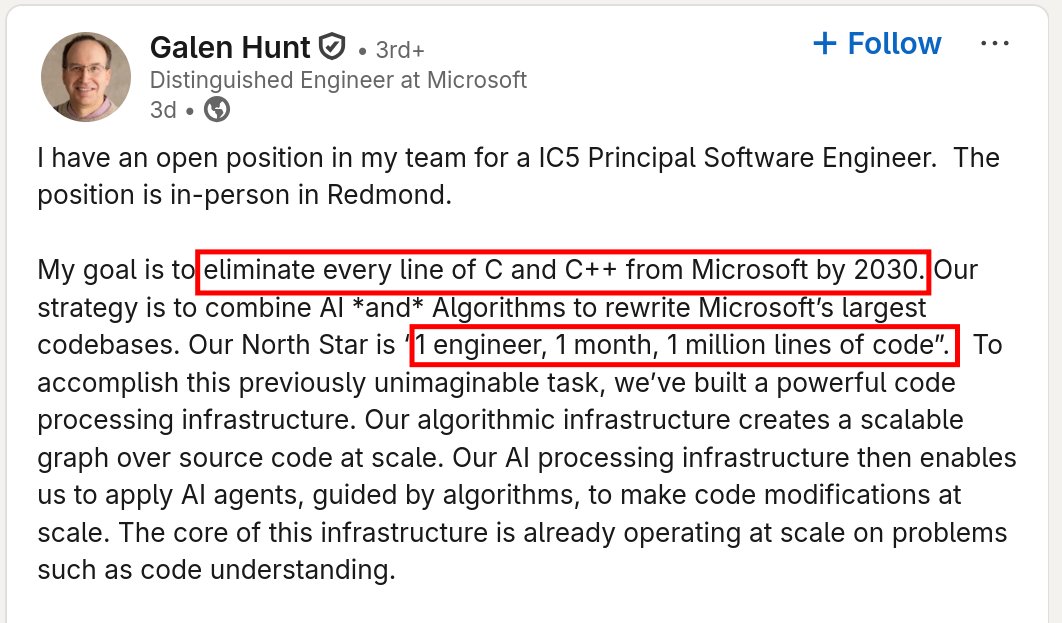
Man I'm so tired but Microsoft just can't stop losing.
This will be a colossal failure that they will most likely have to backtrack.
You can't even physically READ one million lines a month, let alone understand them.
And we all know how bad AI is at writing systems level code
Microservices is the software industry’s most successful confidence scam. It convinces small teams that they are “thinking big” while systematically destroying their ability to move at all. It flatters ambition by weaponizing insecurity: if you’re not running a constellation of services, are you even a real company? Never mind that this architecture was invented to cope with organizational dysfunction at planetary scale. Now it’s being prescribed to teams that still share a Slack channel and a lunch table.
Small teams run on shared context. That is their superpower. Everyone can reason end-to-end. Everyone can change anything. Microservices vaporize that advantage on contact. They replace shared understanding with distributed ignorance. No one owns the whole anymore. Everyone owns a shard. The system becomes something that merely happens to the team, rather than something the team actively understands. This isn’t sophistication. It’s abdication.
Then comes the operational farce. Each service demands its own pipeline, secrets, alerts, metrics, dashboards, permissions, backups, and rituals of appeasement. You don’t “deploy” anymore—you synchronize a fleet. One bug now requires a multi-service autopsy. A feature release becomes a coordination exercise across artificial borders you invented for no reason. You didn’t simplify your system. You shattered it and called the debris “architecture.”
Microservices also lock incompetence in amber. You are forced to define APIs before you understand your own business. Guesses become contracts. Bad ideas become permanent dependencies. Every early mistake metastasizes through the network. In a monolith, wrong thinking is corrected with a refactor. In microservices, wrong thinking becomes infrastructure. You don’t just regret it—you host it, version it, and monitor it.
The claim that monoliths don’t scale is one of the dumbest lies in modern engineering folklore. What doesn’t scale is chaos. What doesn’t scale is process cosplay. What doesn’t scale is pretending you’re Netflix while shipping a glorified CRUD app. Monoliths scale just fine when teams have discipline, tests, and restraint. But restraint isn’t fashionable, and boring doesn’t make conference talks.
Microservices for small teams is not a technical mistake—it is a philosophical failure. It announces, loudly, that the team does not trust itself to understand its own system. It replaces accountability with protocol and momentum with middleware. You don’t get “future proofing.” You get permanent drag. And by the time you finally earn the scale that might justify this circus, your speed, your clarity, and your product instincts will already be gone.
We are sorry to report that YouFibre has been subjected to a DDoS attack today (28.11.25). We are working very hard to resolve this. From a high level, a DDoS attack is a malicious attack that creates a flood of internet traffic affecting service performance. Please keep an eye out for updates in your inbox and on our network updates page here on X -@youfibre_status . We hope normal service will return quickly.
You're never getting me back into an office full time, but I'd also hate to work remotely without these fantastic semiannual meetups. Spending a week together in person is invaluable for charging trust batteries and connecting as humans. Highly recommend it for any remote team.
@ZacksJerryRig That is a separate screen he's not playing GTA on the main monitor. Which means he's somehow got it to think he's paying attention. I think that's why is rear view is covered is he's got a phone or something with a video of him driving to defeat the attention suffering.
I've never suffered so much loss of progress in such ridiculous ways in a challenge run, but we will find a way to make Mysticism in Oblivion work.
It continues at the top of the hour!