$TGTX So looks very likely indeed that every 3 month self-administered Briumvi via an autoinjector is going to work. They managed to get a high concentration of drug in a small volume (2ml) without it getting too viscous for an autoinjector - Ocrevus needed more than 10x that volume for their subq, which is why they required a pump.
So from a market perspective, they will have both an IV and subq where the patient can freely switch, and they will have only 4 injections per year instead of the Kesimpta 12 injections. Their IV with new dosing schedule will be way easier than Ocrevus for new patients. Their efficacy is likely a little better than both competitors.
$AXL.v CEO met with the president of Ecopetrol last week regarding the Tapir extension - "We're very positive about getting the extension". IMO the extension is the main thing holding the share price down.
https://t.co/QSXFw4zR8H
@Biomaven In contrast, buying secondary's which are offered at a discount to market is often a pretty safe short term trade, at least that's my experience but I only participate if I already know the company.
@Mark_IKN Interesting that 2001 and Clockwork were made very close to each other (my memory here) and 2001 had a huge budget and Clockwork a small one. 2001 looked dated soon after it came out but Clockwork seems timeless. Also agree that the book was excellent, at least the first part.
Wow. What a joke $TSLA full self driving seems to be. They're way behind competitors and yet the stock is in the stratosphere. The most over valued stock on the planet.
When Tesla announced an expansion of its robotaxis to Dallas and Houston last month, some investors touted momentum for CEO Elon Musk’s mission to transform the electric-vehicle maker into an AI-powered, driverless-tech giant. Reuters reporter Norihiko Shirouzu recently tested Tesla’s robotaxis in Dallas, however, and found them to still be in a beta-testing phase.
Last night we learned $NKTR is running a specific/separate phase 3 trying to become the *only* atopic dermatitis biologic with a biologic-refractory indication specified on the label.
Would be huge!
Search is full of ads and wrong answers. Every other email is an ad. Prime Video charges you and shows ads. Paramount? Ads. Peacock? YouTube? Hulu? Ads followed by more ads. Netflix full of ads. Meta and X, every other thing is an ad. Pinterest is nothing but ads. AI is in everything. AI finishes sentences incorrectly and won’t stop. AI reads your email and search history to target you with more ads. Every time you open an app or visit a site there’s an update making it worse. In a hurry? First, click here to agree to terms you don’t have time to read and must accept. You need an account to do that. Change your temporary password. Enter your 2FA code. Check your email and enter that code. Now use a passkey. Your password is too simple to remember. Change it. No, not like that. Now log on. Enter your 2FA code. Check your email for a code… Welcome back! We’ve updated our terms of service and privacy policy (you have none). Subscribe to the site. Subscribe to Netflix. Subscribe to toilet paper. Subscribe to these groceries. Pay a membership fee for the right to subscribe then tip your driver who delivers the subscriptions your membership lets you subscribe to. Time to work? We’ve got to update your laptop and will slow down everything you do until you agree to update. But first, click here to agree. Update installed — your laptop’s broken now. It doesn’t matter, since your boss just replaced you with AI. Go to your phone to complain on social media. Wait, your phone needs an update so we can add more AI. Click here. Oh sorry, your phone can’t handle this update. Now it’s useless. Go get the newest phone. Here’s a text from a friend, an email, a voice mail they left three days ago but you didn’t see until now because of sync problems with the cloud. It’s their GoFundMe. Their MLM. Their Patreon. Never mind, you didn’t respond to their text within 9 minutes and now you’re no longer friends. They blocked you. Make new friends. Download this app to find people in your area. In your neighborhood. On your street. Two doors down from you. Do you know this person yet, we think you’d get along. You need an account to use this app. That username is taken. Enter a password. Not that one, you used it on another site. You need to be connected to WiFi to download the app. Allow the app to connect to other devices on your network. Allow the app to access your contacts, know your precise location, store your credit card details. Oops, sorry, we got hacked now all that info is available on the web. There’s a class action suit. You can join. It’ll take a decade to get your $3.73 share of the ten billion settlement. We’ll send it via PayPal or deposit it to your bank, just tell us those details. Oh no, another hack. That info is circulating now, too. Here’s a spam call, a spam email, a spam text. Why are you angry? Why are you talking about getting rid of your phone? Why don’t you like AI, it lets us make all of this easier? Do you know how ridiculous that sounds? This is progress. You’ll be left behind. Do you want to be left behind? Do you???
Good that they're slashing those high costs but can they not move a little quicker now that oil prices are mooning? This picture is from their April presentation 🙁. $TAL.TO $PTAL #PTAL
I would bet that bloomberg is using AI to generate these articles. It's nice when it happens to a stock where you've done deep DD and can act quickly (not me in this particular case).
Anyone wondering what that >10% flash crash was for $ABVX at close? Bloomberg published a blurb saying that their P2 ulcerative colitis trial has been delayed by 2+ years.
The issue? That trial already read out 4 years ago 🤣
Clearly spooked someone who spooked some algos who spooked some more algos.
It has all recovered back to closing price ~$112 already obviously. Was in the high $90s for a couple minutes!
Shoutout to @KevinLMak who brought this to my attention so quickly that I was actually able to grab a few cheapies 😅
These valuations are completely ridiculous but just like in the dot com bubble, the floats will be small allowing continual short squeezes. A lot of retail suckers and fund holders will eventually get slaughtered when the bubble bursts. 🍿
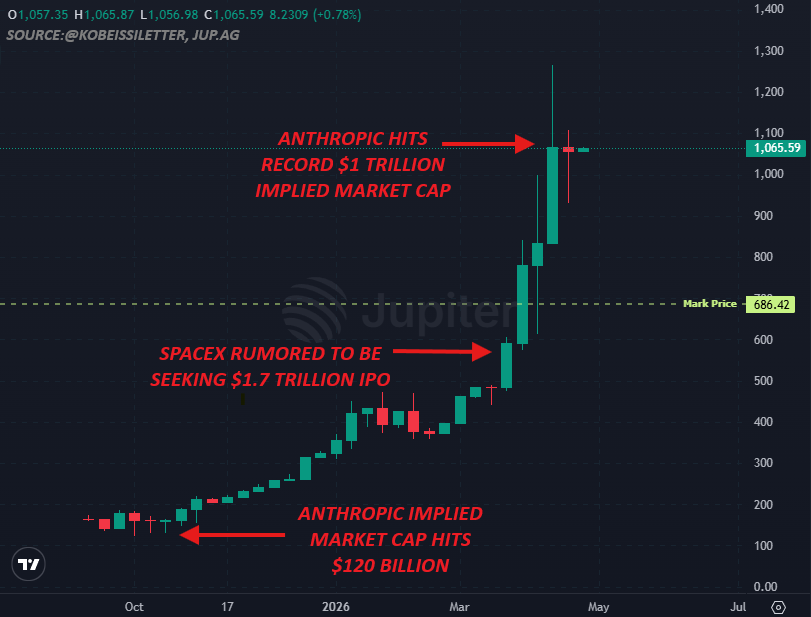
BREAKING: Anthropic's pre-IPO valuation has officially hit a record $1 trillion.
Anthropic's implied valuation is now up +733% since October 2025, per onchain pre-IPO trading data.
Pre-IPO instruments trading onchain, backed 1:1 by SPV exposure on Jupiter, are providing a real-time proxy for the company’s implied IPO valuation.
Anthropic has now become the third company to exceed $1 trillion in implied valuation, joining OpenAI and SpaceX.
The implied market cap of these 3 companies alone is now up to $3.7 TRILLION.
We are about to witness a historic IPO run.
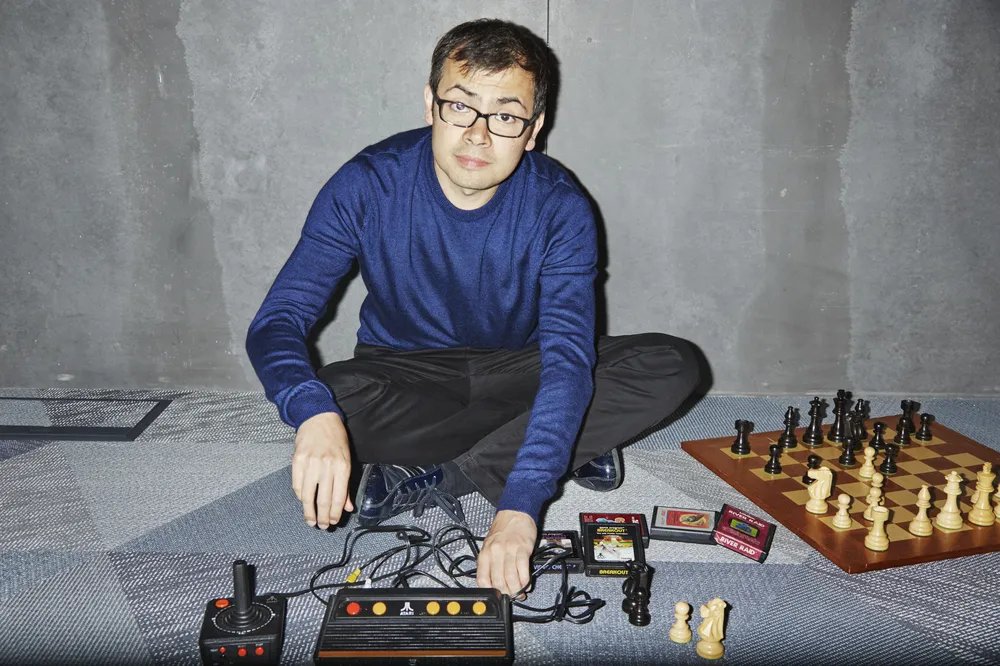
A British kid became a chess master at 13, then a bestselling video game designer at 17, then a PhD neuroscientist at 33, then the CEO of the AI lab that won the 2024 Nobel Prize in Chemistry.
People called him unfocused for twenty years. He was running the most deliberate career plan in modern science.
His name is Demis Hassabis, and the thing almost nobody understood while he was doing it was that every single step was feeding the same underlying obsession.
Here is the thread that connects the whole career, and why it matters for how anyone should think about building toward a hard goal.
The chess came first. He was born in London in 1976 and started playing at age four. By eight, he was the London champion for his age group. By thirteen, he had an international master rating that put him in the top fifty players in the world under his age bracket. He was on a track that would have made him a professional player for the rest of his life.
He walked away.
The reason he gave later, in interview after interview, is the part most people miss. He said chess forced him to think constantly about thinking itself. Every move required him to simulate what his opponent was simulating about him. He became fascinated not with winning the game, but with the process the human brain was running in order to play it. He decided chess was too small a container for the real question he wanted to answer, which was how intelligence actually works.
The video games came next. He used the money he won from chess tournaments to buy a ZX Spectrum. He taught himself to code. By seventeen, he was a lead programmer on a game called Theme Park that sold millions of copies. He could have stayed in that industry and built a career as one of the top game designers in Britain.
He walked away from that too.
He went to Cambridge, did a double first in computer science, and then made the move that looked like the strangest pivot of his life. He enrolled in a PhD in cognitive neuroscience at University College London. He was thirty. His peers from Cambridge were already running companies. He went back to graduate school to study how the human hippocampus builds memories and imagines future scenarios.
His 2007 paper on the link between memory and imagination was named one of the top ten scientific breakthroughs of the year by Science magazine. But the paper was never the point. The point was that he had spent three decades quietly building the exact combination of skills nobody else in the world had put together.
Deep intuition for how intelligent agents behave in complex systems, from a lifetime of chess. Hands-on engineering fluency, from years of shipping commercial software. And a rigorous scientific understanding of how biological brains actually produce cognition, from a PhD in neuroscience.
In 2010, he used that combination to co-found DeepMind with Shane Legg and Mustafa Suleyman. The mission statement he wrote was two sentences long and sounded absurd to most people who heard it. Solve intelligence. Then use it to solve everything else.
For the first six years, DeepMind worked almost entirely on games. Atari. StarCraft. Go. People outside the field could not understand why a lab that claimed to be building artificial general intelligence was spending hundreds of millions of dollars teaching computers to play Pong.
Hassabis kept explaining the reason in interviews and almost nobody was listening. Games were not the goal. Games were a controlled environment where you could iterate on general-purpose learning algorithms fast, measure their progress precisely, and prove to yourself that you had built something that could transfer between domains.
In 2016, AlphaGo beat Lee Sedol, the world champion at Go, in a match that had been considered decades away. And the day after that match ended, Hassabis sat down with his team lead David Silver and asked what they should do next.
The answer was the thing he had been working toward his entire life.
They turned the same deep reinforcement learning approach at a problem biology had been stuck on for fifty years. Protein folding. Given an amino acid sequence, predict the three-dimensional shape the protein would fold into. Every drug discovery effort in the world depended on it. The best computational methods could only solve a small fraction of proteins. Experimental methods took years per structure and millions of dollars per protein.
AlphaFold2 was released in 2020. Within a year, it had predicted the structure of almost every protein known to science. Two hundred million structures. Made freely available to the entire research community. More than two million researchers from a hundred and ninety countries have used it since.
In October 2024, Demis Hassabis and John Jumper were awarded the Nobel Prize in Chemistry for that work.
The line almost nobody quotes from his speeches is the one that explains the whole career. He has said, many times, that he did not build AlphaFold to solve protein folding. He built AlphaFold to prove that the approach he had been developing for thirty years could actually work on a real scientific problem. Protein folding was the demonstration. AGI was always the goal.
The chess taught him how to think about adversarial systems. The games taught him how to ship software. The neuroscience taught him how the only existing example of general intelligence actually worked. DeepMind used all three to build a method that could transfer between domains the way the human brain does. And the moment the method was ready, he pointed it at the single most important unsolved problem he could find in a domain where a breakthrough would save millions of lives.
Most people looking at his career from the outside, at any point before 2016, would have called it scattered. A chess prodigy who gave up chess. A video game designer who walked away from a gaming career. A computer scientist who detoured through neuroscience. A startup founder who burned six years on board games.
From the inside, it was the most focused career in modern science. Every step was quietly answering the same question. How does intelligence actually work, and what would it take to build one that could solve problems humans have not been able to solve alone.
The people who change a field are almost never the ones who looked focused along the way.
They are the ones who were obsessed with a single question so deep and so long that the path they took to answer it looked like chaos from the outside and like a straight line from the inside.
And they almost never get credit for the plan until decades later, when the Nobel Committee calls.