Artlist invited me to New York, what I saw blew my mind.
In the past couple of years, I've seen a lot of creative tools, some good some bad, and some that makes you stop in your tracks.
This was one of the latter.
Let's dig in.
The Time Has Come for Robots.
I build AI Agents to replace office workers, but these demos convince me! All physical labor will be gone to robots, too. (even the world's oldest profession).
Just watch it if you disagree. The biggest robot thread ever (50 demos):
@ArendJanKamp Hoi Arend Jan, geweldige foto. Vind je het goed als wij deze gebruiken bij de Telegraaf? Als je mij volgt kan ik ff DM sturen. Alvast dank!
@bysl Can $ORGN explain this pivot shift one time again? What is the new strategy? Where are the licensing deals for your orderbook? Was this an overnight shift as it feels so? What after o2? is there proof of scaling the business?
In 1985, Nike held a 24-hour shoe design contest.
Nike was struggling. Their stock dropped 50%. They had to lay off people. Adidas, Converse, & Reebok were all selling more shoes.
So in a panicked attempt to find creative talent, Nike held a shoe design contest.
The winner was
A corporate architect named Tinker Hatfield.
"Two days after the competition," he said, "I wasn't even asked—I was told that I was now a footwear designer for Nike."
As he got to work on his first official shoe design, he thought about a building he had studied in architecture school: The Centre Pompidou in Paris.
The Centre Pompidou is an inside-out building, meaning that the structural, mechanical, and circulation systems are all exposed.
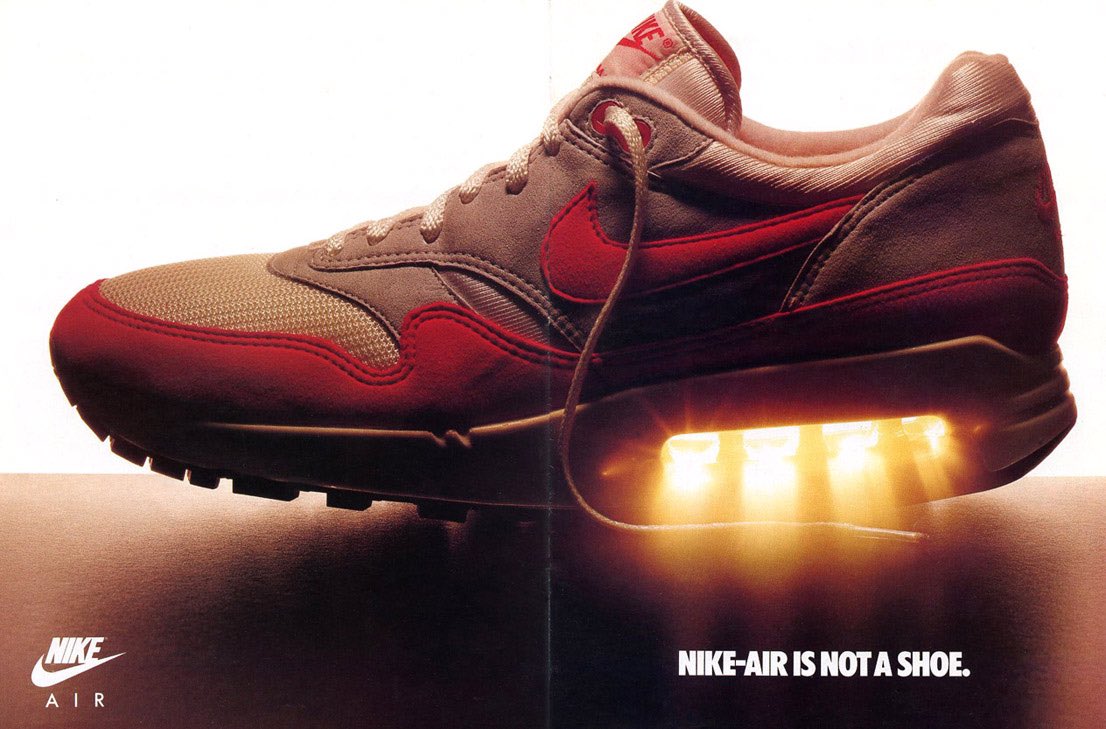
“That building,” Tinker said, “was describing what it was to the people of Paris. And I thought, ‘Well why not do that with a shoe? Let’s cut a hole in the side and show what’s in the shoe.’”
So Tinker designed an inside-out shoe:
The Air Max 1.
The Air Max 1 was a massive success, and it steered Nike's design direction from then on.
"To this day," Tinker says, "Phil Knight says I saved Nike."
Takeaway 1:
Had he not studied that building in Paris, Tinker says, he couldn’t have created the Air Max.
Creativity, he says, is a function of the “library in your head."
“When you sit down to create something...what you create is a culmination of everything you’ve seen and done previous to that point.”
Takeaway 2:
Tinker Hatfield went to architecture school and then he was a corporate architect for 4.5 years. Then, literally overnight, he became one of the best shoe designers in the world.
This makes me think of a counter-intuitive discovery made by psychologist Charles Spearman in 1904.
Before Spearman, the natural assumption was that the more you specialize in one thing, the worse you’ll be at other things.
Instead, Spearman discovered "the positive manifold" phenomenon.
He found that different abilities tend to be positively correlated. That the expertise gained through specialization is transferrable. That the cognitive and creative abilities cultivated as an architect could positively correlate with being a shoe designer.
- - -
"Creativity is a function of the previous work you put in." — Robert Greene
Follow @bpoppenheimer for more content like this!
James Cameron has written & directed 3 of the top 4 highest-grossing movies of all time (Avatar, Avatar: The Way of Water, and Titanic).
Before he made movies, Cameron was a truck driver.
He didn't go to film school.
Instead, on the weekends, he would go to the library and..
"I'd pull any thesis that [University of Southern California] graduate students had written [on] anything that related to film technology," Cameron explained.
"And for the cost of xeroxing (photocopying), I [got] all these doctoral dissertations [and] build up these big binders on how everything was done."
"So I literally gave myself a full graduate course on film technology for about $120.
I didn’t have to enroll in school because it was all there in the library. I’d set it up to go in like I was on a tactical mission, find out what I needed to know, and take it all home."
Takeaway 1:
When asked what motivated him to read those big binders full of information on filmmaking, Cameron said he was just following what excited him.
"People seek out the information and knowledge they need," he said. "It's like a divining rod."
The mythologist Joseph Campbell similarly talked about how reading is like "a divining rod," a way to find what you are uniquely attracted to and meant to do.
"You’ve got to read," Campbell said. "Find [what] excites you. And if it doesn’t excite you…It’s not yours.”
Takeaway 2:
Of course, at some point, Cameron had to put the binders down and pick up a camera.
When he eventually attempted to make his first movie, Cameron said, “It was a bit like a doctor doing his first appendectomy after having only read about it."
The bestselling author and learning expert, Scott Young, has a great article with a great title, "Do The Real Thing."
"When you examine case studies of people who have had major accomplishments," Scott writes, "you expect there to be some trick or shortcut...More often, however, the strategy used is dead simple: doing the real thing."
Takeaway 3:
Leonardo da Vinci used to sign off his letters, “Leonardo da Vinci, disscepolo della sperientia” ("disciple of experience").
He used to believe that one learns best by solely "doing the real thing."
Over time, however, he evolved out of this belief and, biographer Walter Isaacson writes, "became a disciple of both experience and received wisdom."
When you examine case studies of people who have mastered their craft, you usually find they are "disciples of both experience and received wisdom."
Like Cameron, they read the library and they do the real thing.
- - -
“Those who are in love with practice without theoretical knowledge are like the sailor who goes onto a ship without rudder or compass and who never can be certain whither he is going.” — Leonardo da Vinci
Follow @bpoppenheimer for more content like this!








![bpoppenheimer's tweet photo. James Cameron has written & directed 3 of the top 4 highest-grossing movies of all time (Avatar, Avatar: The Way of Water, and Titanic).
Before he made movies, Cameron was a truck driver.
He didn't go to film school.
Instead, on the weekends, he would go to the library and..
"I'd pull any thesis that [University of Southern California] graduate students had written [on] anything that related to film technology," Cameron explained.
"And for the cost of xeroxing (photocopying), I [got] all these doctoral dissertations [and] build up these big binders on how everything was done."
"So I literally gave myself a full graduate course on film technology for about $120.
I didn’t have to enroll in school because it was all there in the library. I’d set it up to go in like I was on a tactical mission, find out what I needed to know, and take it all home."
Takeaway 1:
When asked what motivated him to read those big binders full of information on filmmaking, Cameron said he was just following what excited him.
"People seek out the information and knowledge they need," he said. "It's like a divining rod."
The mythologist Joseph Campbell similarly talked about how reading is like "a divining rod," a way to find what you are uniquely attracted to and meant to do.
"You’ve got to read," Campbell said. "Find [what] excites you. And if it doesn’t excite you…It’s not yours.”
Takeaway 2:
Of course, at some point, Cameron had to put the binders down and pick up a camera.
When he eventually attempted to make his first movie, Cameron said, “It was a bit like a doctor doing his first appendectomy after having only read about it."
The bestselling author and learning expert, Scott Young, has a great article with a great title, "Do The Real Thing."
"When you examine case studies of people who have had major accomplishments," Scott writes, "you expect there to be some trick or shortcut...More often, however, the strategy used is dead simple: doing the real thing."
Takeaway 3:
Leonardo da Vinci used to sign off his letters, “Leonardo da Vinci, disscepolo della sperientia” ("disciple of experience").
He used to believe that one learns best by solely "doing the real thing."
Over time, however, he evolved out of this belief and, biographer Walter Isaacson writes, "became a disciple of both experience and received wisdom."
When you examine case studies of people who have mastered their craft, you usually find they are "disciples of both experience and received wisdom."
Like Cameron, they read the library and they do the real thing.
- - -
“Those who are in love with practice without theoretical knowledge are like the sailor who goes onto a ship without rudder or compass and who never can be certain whither he is going.” — Leonardo da Vinci
Follow @bpoppenheimer for more content like this!](https://pbs.twimg.com/media/FyDsJLPXsAIX5UE.jpg)


