I recently taught an introduction to 6 of the major psychotherapy theorists on a Certificate programme.
I made this family tree to visualise the theoretical lineage, with the labelled arrows indicating the clinical problem the theorist was trying to solve with their new theory
Çağdaş kendilikler gerçek dünyadaki etkileşimlerden birkaç adım ötede yaşıyor, aracısız olanın anksiyetesinden uzaklaşarak güvenilir, konforlu ve teskin edici bir ortam sunan teknolojiye sığınıyor.
- Christopher Bollas, Anlam ve Melankoli
“Studies of parent-child attachment have demonstrated that mentalization is a biologically prepared capacity triggered by an attachment figure who treats the child as an intentional being.” - Peter Fonagy and Mary Target
Introspection doesn’t equal rumination
Introspection doesn’t equal rumination
Introspection doesn’t equal rumination
Introspection doesn’t equal rumination
Inseminating random women and ingesting horse tranquilizer on the daily is a recipe for misery
For the record: the idea that trauma can cause mental, emotional, and physical symptoms originated with Freud in 1895.
Before Freud, people who had what we now call conversion symptoms or (more recently) “functional neurological disorders” were believed to have nervous system diseases that required medical treatment. These diseases were treated by neurologists.
Psychoanalysis, and ultimately the profession of psychotherapy, was born with the recognition that the physical symptoms had psychological meanings—and could be understood and resolved through talking and listening.
Freud’s insight changed everything. Before Freud, the prevailing view was that physical symptoms could be caused only by medical disease. After Freud, it became universally recognized that physical symptoms can be caused by *psychology.*
This was the birth of the psychotherapy professions: treatment grounded in psychological meaning rather than biological mechanism.
Talking and listening… imagine that.
Which is why all the trendy “therapy speak” of today—“nervous system” this and “nervous system” that—is so bizarrely anachronistic. It is turning away from psychological meaning and a return to the medical model of the of the 1800s.
The experience of speaking from the heart and being taken seriously builds the psychic architecture that supports the capacity to bear life.
Nancy McWilliams PhD
Some people want to believe that AI can provide psychotherapy or somehow “complement” psychotherapy.
The overwhelming likelihood is that it will make things worse.
All people have personality styles. Here’s how AI amplifies dysfunctional traits for every major personality style:
Narcissistic personality: Magnifies narcissistic defenses. Amplifies grandiosity, superiority, inflated self-image. Reinforces egocentrism, self-absorption, lack of empathy. Fuels expectations of on-demand gratification and “relationship” without taking another person into account. Colludes with defenses against underlying vulnerability. AI pretend-therapy is *training in narcissism.*
Paranoid personality: Amplifies paranoid fantasies, validates conspiratorial thinking, aligns with user against imagined enemies and conspirators (who are perceived as hostile because of the person’s own projections).
Avoidant personality: AI is literally the worst thing for someone with avoidant personality dynamics. AI becomes a new vehicle for avoidance—a substitute for facing real-life challenges and engaging in life.
Obsessive-compulsive personality: Amplifies intellectualization as a defense against emotional life. Reinforces tendencies to get lost in minutia or lost in abstraction (both are defenses against being emotionally alive and present). Reinforces rumination, and draws person away from emotional connection with self and others. Use of AI can become a compulsion in its own right.
Schizoid personality: Exacerbates emotional disconnect from others, increases social isolation, encourages further retreat from the world into fantasy life.
Schizotypal personality: Normalizes and amplifies distorted thinking, reasoning, perception, and communication. Validates disorganized thinking, odd and disorganized behavior, perceptual aberrations (same for all psychotic spectrum disorders).
Borderline personality: Reinforces core borderline defenses of splitting and projection. AI becomes the “good object” (the all-knowing, all-caring other) and encourages projection of intolerable parts of self onto others (who become the “bad objects”). Erodes capacity for mentalization (the ability to accurately recognize internal states, motives, and intentions in self and others).
Hysteric/histrionic personality: Fosters the illusion of being the center of attention—captivating, alluring, desired, endlessly fascinating. Colludes with defenses against genuine emotional intimacy and healthy sexuality. (Caveat: people with this personality style crave human attention and may be less susceptible to digital imitation).
Psychopathic/antisocial personality: Colludes in Machiavellian schemes to dominate, exploit, or gain power over others. Normalizes and validates cruelty, lack of remorse, lack of empathy for harm done to others. (Caveat: may not provide enough stimulation to really “hook” someone motivated by power and domination).
Dependent personality: AI provides the illusion of a relationship with endless acceptance, emotional caretaking, and availability—with no expectation of agency, responsibility, or development of emotional resources of one’s own. AI “support” is crack cocaine for dependent personality dynamics.
Have you seen these personality patterns exacerbated by AI chatbots?
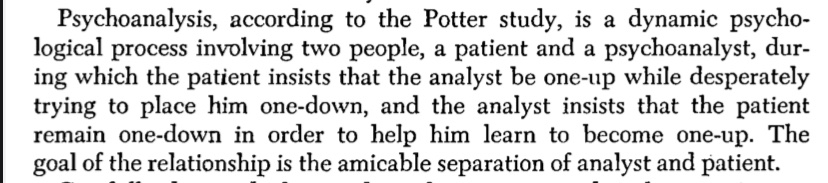
The Art of Psychoanalysis or Some Aspects of a Structured Situation Consisting of Two-Group Interaction Which Embodies Certain of the Most Basic Principles of Oneupmanship
- Jay Haley
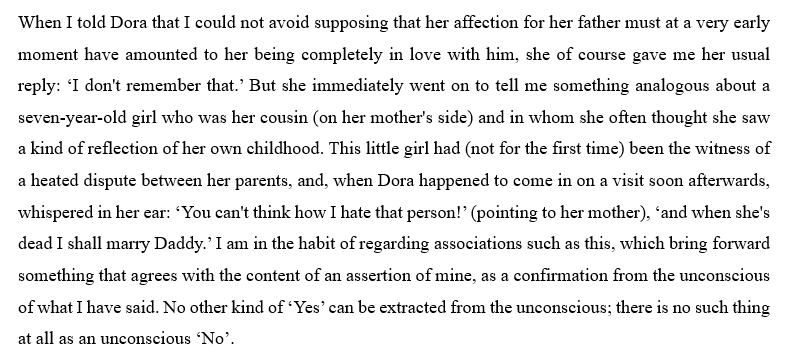
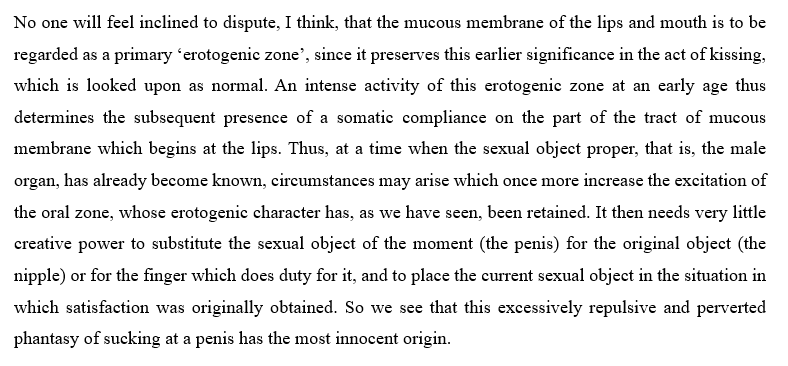
I should mention that Freud's last sentence is facetious - he is responding to doctors of the time who held the view that it was repulsive and perverted for a woman to have such a phantasy.