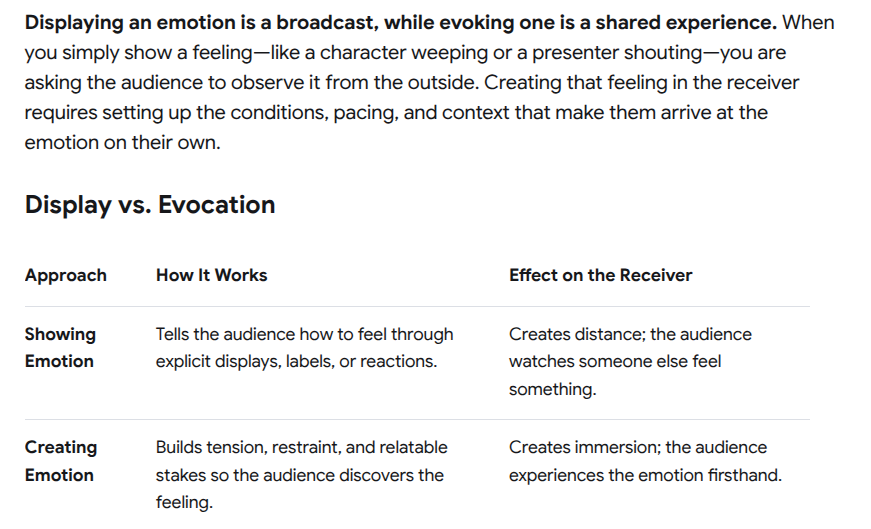
.@davetrott: "What this misses is that creating an emotion in the receiver isn’t the same as simply showing them an emotion" https://t.co/X76fV5eQMT
GoogleAI: "Displaying an emotion is a broadcast, while evoking one is a shared experience"
In 1906, the scientist Francis Galton visited a livestock fair in Plymouth and accidentally stumbled on something that explains why central planning fails.
Around 800 visitors had paid sixpence each to guess the weight of a slaughtered ox. Galton collected the tickets and analysed them, expecting the crowd to do badly. Individual guesses were all over the place, but their average was 1,197 pounds - the ox weighed 1,198. While supposed experts - butchers and farmers - guessed poorly on their won, taken together, ordinary fairgoers had come within a pound of the truth.
Nearly a century later, in 2004, the journalist James Surowiecki popularised this effect in The Wisdom of Crowds. His argument was that in large, diverse and independent groups, individual errors cancel each other out, and the collective estimate moves towards the truth.
This helps explain why government bureaucracies so rarely match the efficiency of free markets. Friedrich Hayek called this the “knowledge problem.” The information an economy runs on is scattered across millions of people, each knowing their own circumstances, preferences and opportunities. No planner can gather it all. Markets don’t need to: through prices, they condense that dispersed knowledge into a single number that anyone can act on. The result is what Hayek called “spontaneous order”, complex coordination that no one designed.
Markets condense dispersed information into a market price. When planners abolish markets and try to design an economy and fix prices, they replace the judgement of millions with the guesses of a small group working from incomplete information. As Galton’s ox shows, no committee of experts, however clever, knows as much as all of us together. Central planning fails because bureaucrats fail to guess what the market could have told them.
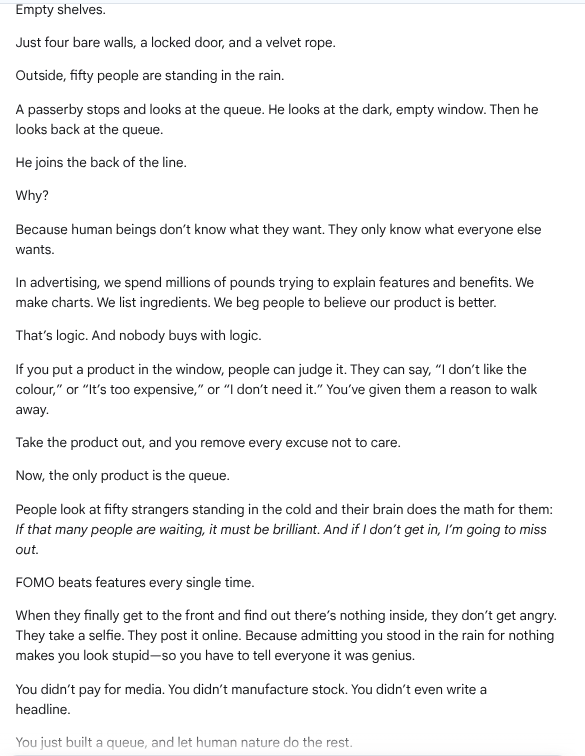
.@davetrott wrote about this event in Campaign. Article entitled "What influences the influencers?" As Dave writes, "Payless got fantastic advertising for next to nothing." More here: https://t.co/QTtI9ogicu
“Don't Mess with Texas” sounds like something a Texan would actually say. “Please Don't Mess with Texas” sounds like something a delusional government committee would like Texans to say.