A senior litigator was telling me about his career last week. Thirty-five years in. Civil litigation. Big firm and now solo. We were talking about what actually changed in the practice.
He said the thing nobody talks about is what disappeared after 2020.
Not the trials. Those had been declining for years. Not the case-management conferences - Zoom handled those fine. What disappeared was the hallway BS.
The conversation in the courthouse cafeteria after a hearing. The walk down to Fred's office two doors down: "What do you think damages might be on this one - am I missing anything?" The drink after a deposition. The half-sentence over coffee that became the argument that won the case.
For fifty years, that was the actual mechanism that built legal competence. Not CLEs. Not firm trainings. The informal "let me bounce one off you" conversation in physical proximity to other lawyers who knew the work.
Zoom killed it. Remote work finished it.
The senior litigator I was talking to gets to retire with the skill he built in the hallway. The junior litigator coming up in 2026 will never have that. She will get her Zoom CLE, her case-management software, her billing platform. She will not have a Fred down the hall.
Here is what most legal-AI vendors are missing.
The most valuable thing AI can do for lawyers is not draft the brief faster.
It is be the Fred down the hall.
The "let me bounce one off you." The "am I missing something." The "what would you argue if you were on the other side." Those are not productivity tasks. Those are competence-building tasks. They are exactly what disappeared in 2020 and exactly what nothing has replaced.
This is the actual case for AI in legal. Not faster work. Sharper lawyers. The informal sharpening conversation, on demand, every day, no scheduling required.
The 35-year litigator gets to retire with the skill he built in the hallway.
The 35-year-old litigator coming up now will only get to that skill if she builds her own Fred.
That is the work.
I’m excited to announce my memoir, Out of the Shadows, will be published by HarperCollins in North America on October 13, 2026. In the book, I break my silence to reveal everything I legally can about my investigations of UAP and non-human intelligent life on behalf of the U.S Government and the profound impact my work had on me and my family. We are at a turning point in human history and I am proud to play a role in opening the public’s eyes to the truth and bringing about long overdue disclosure.
Después de filtraciones de datos en entidades públicas y privadas, los atacantes pueden construir mensajes cada vez más creíbles: nombre de marca, montos bajos, urgencia de pago, suspensión del servicio y formularios que piden datos personales.
El phishing ya es sistematizado.
Me llegó un correo de phishing usando la imagen de Claro con una supuesta factura pendiente y botón de pago.
Esto es una señal de un problema mayor: datos expuestos + ingeniería social + reputación digital.
Being a lawyer is saying "I just need to get through this hearing/deposition/other appointment this week and then things will calm down" for forty years and before you know it you are 70 years old telling people that you have been practicing law for 40 years with no Bar Grievances filed, and finally your reward arrives in the form of a heart attack or a stroke out at your work desk and the state Bar finally takes an action on your status but it's just to mark you "deceased."
12 señales de un abogado de calidad:
-No promete resultados.
-Escucha al cliente.
-No convierte cada caso en un espectáculo.
-Es claro y te dice la verdad aunque sea incomoda.
-Trabaja con provisión de fondos.
-No habla mal de otros abogados ni clientes.
-No presume de dinero ni de contactos.
-Tiene buena presencia y va arreglado.
-Te mantiene informado.
-No crea conflictos innecesarios.
-Es puntual.
-Busca una solución por encima de tener la razón.
No busca parecer brillante.
Busca ser efectivo.
Por eso cuesta encontrarlos y no son baratos.
El tema ProGen tiene seguimiento de prácticamente todos los medios del país. En todas partes se publican crónicas, reportajes y análisis. Los detalles que se van haciendo públicos dejan claro que la Fiscalía no está acusando a todos los que son. Quienquiera que sea el gran poder intentado bloquear la verdad, va a fracasar pues la atención pública es máxima. El escrutinio es enorme. Lo único que le conviene al gobierno o a fiscalía es actuar con decencia: dar con las cabezas del atraco y ejercer justicia, sin contemplaciones ni cálculos. Cualquier otro camino pulverizaría la anémica confianza del país en las instituciones y tendría costos políticos, judiciales y sociales gigantescos.
La gravedad de esto no puede medirse únicamente en términos económicos. Esto es grotesco, de una carga moral y simbólica gigantescas. Es escupirle a la cara a todos los ecuatorianos. La ÚNICA salida digna para el gobierno es que lleguen a caer los responsables en la parte superior de la pirámide, quienquiera que sean.
-El cliente consulta en ChatGpt y cree que sabe más que tu.
-Recibir audios de 7 minutos a las 23:48.
-Todo el mundo conoce a un abogado.
-Tu apenas conoces a otros abogados de tantos que hay.
-Clientes que desaparecen cuando toca pagar.
-Ya no te respetan ni en el Juzgado.
-Gente que por ver TikToks se piensan que le han convalidad la carrera de derecho.
-Clientes que se piensan que su juicio son como los de la tele.
-Hacer de psicólogo en temas matrimoniales.
-Alguno se piensa que la vida es como Suits.
-Responder mensajes un domingo porque "es urgente".
-Acabar deseando trabajar de panadero por paz mental.
¡Cuidado con lo que le dices o le preguntas a la Inteligencias Artificial!
Un juzgado federal en Nueva York acaba de dictar sentencia en el caso "United States vs. Heppner" en el que, desde mi perspectiva, acaba de generar un precedente judicial peligroso sobre Inteligencia Artificial.
1. Contexto del asunto.
El señor Bradley Heppner se encontraba sujeto a una investigación penal federal. Decidió utilizar la IA "Claude" para redactar estrategias de defensa, analizar su situación legal y compartirle dicha información generada a su abogado. Pensó que como sería información que utilizaría su abogado, la misma estaría protegida.
2. La decisión judicial.
Este asunto presentó una cuestión jurídica novedosa en el derecho estadounidense (y también para cualquier otro país, como México): ¿La información que genera una persona sujeta a investgación criminal a través de una IA pública está protegidas por las doctrinas conocidas como "privilegio entre cliente/abogado" y "producto de trabajo" (work product)? El juez Rakoff determinó que no.
Los argumentos, en esencia, son:
- La IA no es un abogado. Las comunicaciones generadas entre la IA y el acusado Heppner no son comunicaciones entre cliente/abogado.
- La información generada por la IA no es confidencial, ya que los usuarios, al consentir los acuerdos de confidencialidad de Claude (política de privacidad) y compartir datos con terceros, se pierde la calidad de información "privada".
- La trampa de la doctrina del "Work Product". El argumento de defensa de Heppner fue que dicha información generada se trataba de "material de trabajo" para el juicio. Sin embargo, el juez Rakoff consideró infundado tal argumento, pues, a su consideración, las preguntas e información obtenida por Heppner no fue generada bajo la dirección y supervisión de su abogado. El juez determinó que si el abogado lo hubiere hecho como parte de estrategia de litigio, tal vez la decisión judicial adoptada hubiese sido distinta.
3. Efectos de la sentencia.
Heppner tuvo que entregar a la autoridad investigadora la información que Claude le generó.
4. Moraleja.
Este precedente genera ciertas reglas en las que, estimo, hay que poner atención:
* Si estás sujeto a investigación no consultes a la IA sin supervisión de tu abogado porque puede ser utilizada en tu contra. La IA puede ser lista, pero no es tu confidente legal.
* Tal vez obliga a los abogados a revisar y rehacer acuerdos de confidencialidad, contratos de servicios legales con clientes y modificar sus programas de cumplimiento normativo en relación con la IA como instrumento de apoyo en el trabajo cotidiano jurídico.
El mensaje final del juez Rakoff es relevante, al señalar, en esencia que el uso de la IA no debe apartarse de principios legales, como aquellos que rigen el privilegio entre "cliente/abogado" y la doctrina del "work product".
Aquí la sentencia por si la quieren consultar: https://t.co/w3Lcjgzwoj
Adverbs sometimes destroy the arguments they’re meant to strengthen and protect. I call them badverbs.
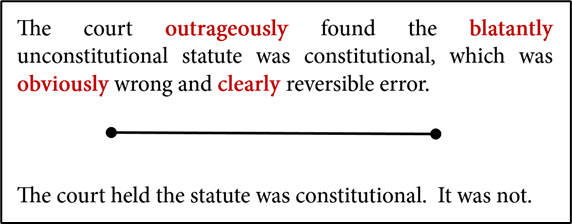
1. Intensifier adverbs: Used to pump up weak arguments (“Clearly,” “Obviously,” “Outrageously”).
2. Hedge adverbs: Used to cushion shaky arguments (“Arguably,” “Apparently,” “Fairly strongly”).
Researchers studied U.S. Supreme Court briefs and found something striking: the more intensifiers a brief used, the more often the party lost. Example below.
Appellate judges do it too — but for a different reason. We reach for them in dissents, when the issue is a closer call.
Judges check page length before reading a word.
• Long brief? We read faster and with less attention.
• Short brief? We slow down and pay closer attention.
Brevity signals confidence. Most lawyers have it backwards.
Winston Churchill fought his depression with bricks. He'd lay them for hours at his country home in Kent. He joined the bricklayers' union. And in 1921 he wrote about why it worked. It took psychology another 75 years to catch up.
He called his depression the "Black Dog." It followed him for decades. His method for fighting it back was as basic as it sounds: laying brick after brick, hour after hour.
Churchill spelled out his theory in a long essay for The Strand Magazine. People who think for a living, he wrote, can't fix a tired brain just by resting it. They have to use a different part of themselves. The part that moves the eyes and the hands. Woodworking, chemistry, bookbinding, bricklaying, painting. Anything that drags the body into a problem the mind can't solve by itself.
Modern psychology now calls this behavioral activation. It's one of the most-studied depression treatments out there. Depression sets a behavior trap. You feel bad, so you stop doing things, and doing less means less to feel good about. Feeling worse makes you do even less. The loop tightens until you can't breathe inside it.
Behavioral activation breaks the loop from the action side. You schedule the activity first, even when every part of you doesn't want to. Doing it produces small rewards: a wall gets straighter, a painting fills in, a messy room gets clean. Those small rewards slowly rewire the brain. Action comes first, and the feeling follows.
Researchers at the University of Washington put this to the test in 2006. They studied 241 adults with major depression and compared three treatments: behavioral activation, regular talk therapy, and antidepressants. For the people who were most severely depressed, behavioral activation matched the drugs. It beat the talk therapy. A 2014 review of more than 1,500 patients across 26 trials backed up the result.
Physical work like bricklaying does something extra on top of this. It crowds out rumination, the looping bad thoughts that grind people down during the worst stretches of depression. Bricklaying needs both hands and gives feedback brick by brick: each one is straight or crooked. After an hour you can see exactly how much wall you built. No room left for the mental chewing.
The line George Mack used in his post, "depression hates a moving target," is good poetry. The science behind it is sharper. Depression hates a brain that has somewhere else to be.
Mayo Empezó Fuerte, Noticias de Filtraciones de la ANT, Banco de Machala, Cooperativa en Pastaza, RanSomware a Una Mayorista, Defacement a una Universidad en Ecuador y lo que faltaba filtraron todos los cromos el Álbum del Mundial.
Cual será el siguiente golpe?