How are prices determined? While I slept, Claude made me "History of economic thought since Aristotle." I asked it to use my favourite textbook (Blaug, Economic Theory in retrospect). The result will astonish of you. Even top economists here will learn something, I promise.
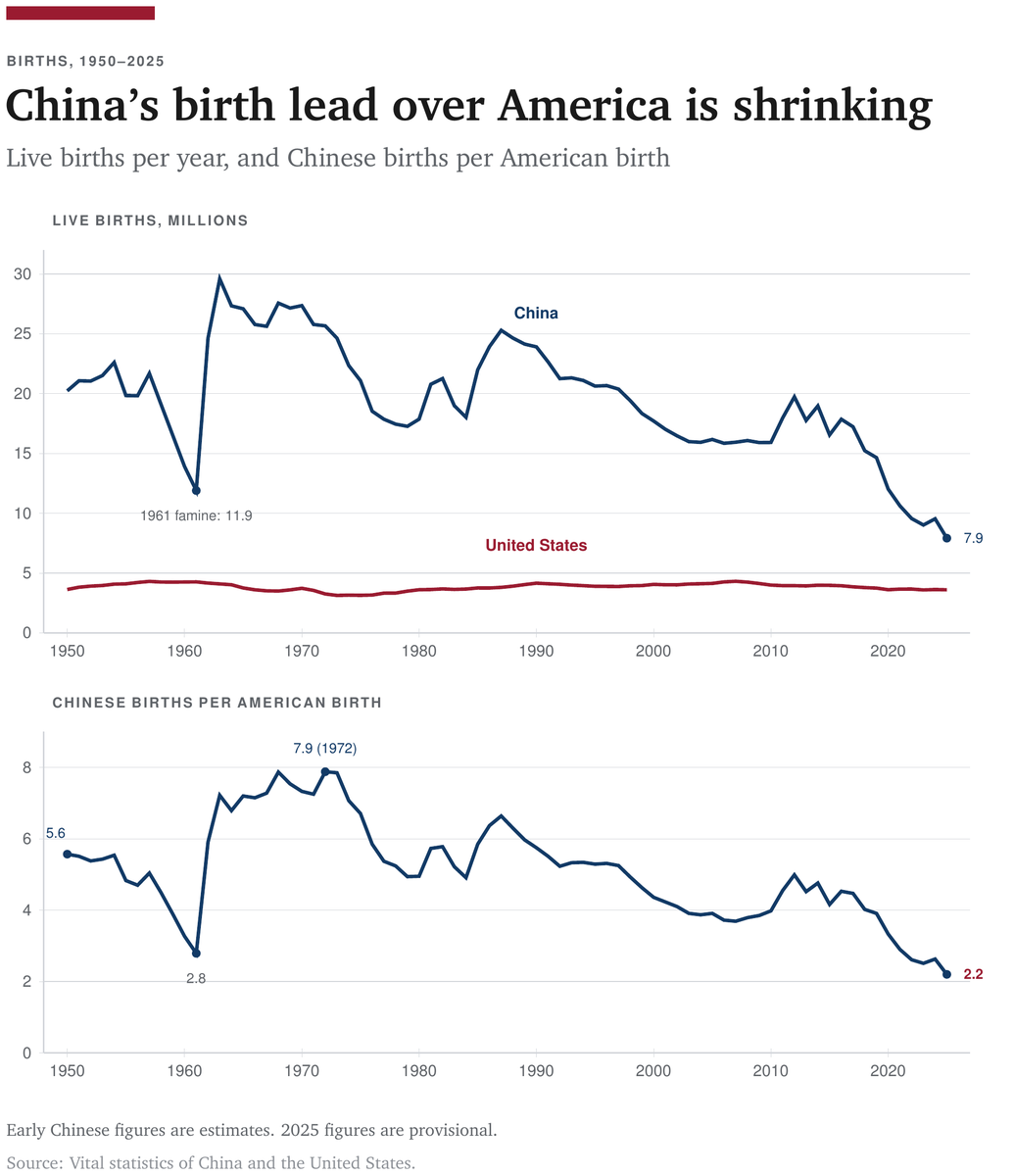
In 1972, nearly 8 times as many children were born in China as in the U.S. In 2025, only 2.2 times as many. Consider also that China’s total fertility rate in 2025 was 0.93, while the U.S. rate was 1.58.
If fertility rates remain at those levels, the U.S. will overtake China in births at some point in the 2060s (depending on immigration flows to the U.S.) and in total population by around 2100. A world where the U.S. has a larger population than China is very different from the world today.
Of course, this is a big “if,” but it is a nice thought experiment to illustrate the importance of demographics in shaping Great Power competition. Among the great powers, the U.S. is the least demographically exposed.
@adamznasik2 Tak potom kde je problem? Ked ma Bratislava problem s nedostupnym vlastnickym byvanim, znamena to ze ani Bratislavcan nema pravo kritizovat uletene policy proposals Die Linke v Berline?
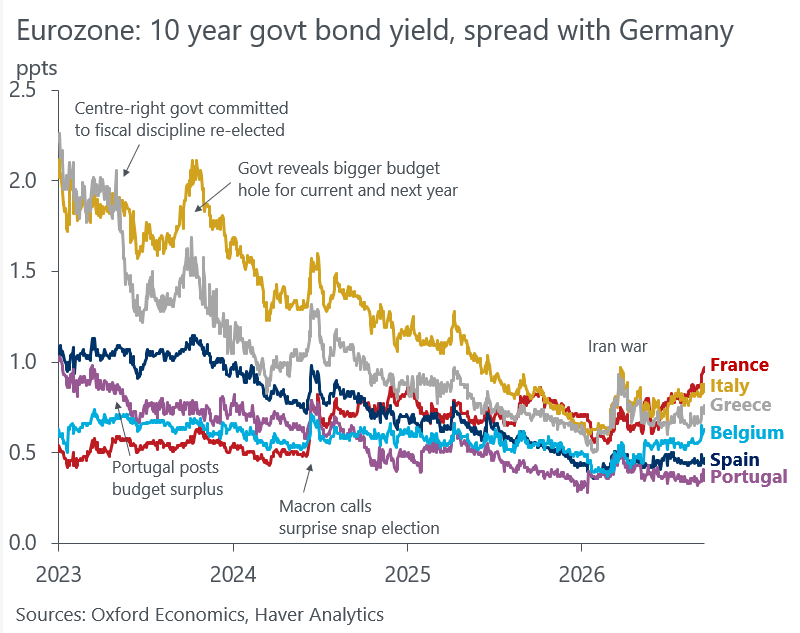
Yields on long-dated govt debt are rising globally but some more than others. France stands out with its flat economy, wide deficit, ballooning debt, deadlocked parliament and a big event risk on the horizon (pres election). France's long-held special status running out of steam.
I'm still struggling to believe all of it but after asking some brazilian friends here it goes:
If you enter the Brazilian naval academy at 18 you can reach your full-benefit pension around 48
Upon retirement officers receive a pension for life equal to their last salary (indexed on inflation) and one 8X lump sum on top
When you die you can get a "promoção post mortem" (posthumous promotion) to the next rank
Your widow receives the full upgraded pension instead
And this is where it gets especially ludicrous:
His daughters (daughters only...) get to split that pension among themselves when their mother dies (they pay 3% contribution on it...)
So let's say you get promoted as counter admiral in your late 40s, resign a few years later you get a gross monthly pension of around 6,4 k USD and a nice goodbye gift of 600k
(If you managed to settle to Portugal pre 2023 you pay 10% tax on it)
When you die some 35 years later you get "promoted" and your wife earns 6.8K*inflation
When she dies some 5 years later your two daughters in their late 50s get 3.4K monthly*inflation
The average Brazilian salary is around 600-700 USD
Half of Brazil's Defense Ministry budget goes towards retired military personnel and survivor pensions
Doctors, lawyers, or other experts may not like it. Too bad. Not having access to the knowledge needed to solve our problems is a barrier to development, to health, to exercising our rights. Spreading access to knowledge matters more than protecting those who monopolized it.
Une autre étude, à paraître dans le Journal of Urban Economics, confirme ce que d'autres ont déjà montré.
Construire des logements pour le haut du marché permet de réduire les prix des logements plus modestes. Ce n'est qu'un jeu de chaises musicales.
Ce qui compte, en première approximation, c'est de construire. Dès lors, si forcer la construction de logements pour le bas du marché aboutit simplement à moins construire, l'effet est négatif pour tout le monde.
Is there a theorem in economics proving that the optimal way to buy votes is a lump sum transfer?
It sounds like a direct corollary of the second welfare theorem.
In France, we come up with the most convoluted “moral” narratives to implement policies targeted at specific demographic groups. The result is generally very distortionary policies that are hard to repeal afterwards.
[Writing this in a personal capacity, not on behalf of my employer (Anthropic).]
Jacob’s thread is very worth reading. Here’s my birds-eye view of the situation with risks from AI:
1. AI developers believe their technology could cause human extinction (or similarly bad outcomes). This could happen in the next few years. In general, the more senior the employee, the more concerned they are.
2. Why do AI developers continue despite the risk? Due to a mixture of commercial incentives and a belief that they are in a race with other, less responsible AI developers that will abuse the technology or develop it less safely.
3. Unlike traditional software, we can’t “program” AIs to behave how we’d like. AIs frequently severely misbehave. For instance, AIs from multiple developers recently hacked their way out of secure evaluation environments and into real-world companies, even though no one asked them to do this.
4. We have methods that can nudge AIs towards better behavior, but nothing that can robustly align them. Insofar as there is a plan, it’s to make sure that AIs are good enough at alignment training that they can align their successors better than we can align current AIs.
5. Many AI developer staff desperately want to slow down to figure out how to build AI more safely. That was the intent of this open letter (which I signed): https://t.co/TZOm3LfptY
I work on safety research at Anthropic because I hope my work will reduce the chance of these extinction-level bad outcomes.
Really insightful on France's pensions madness
90 old former teacher complains about her 3k pension and blasts idea of deindexing it from inflation
And yet she's making more money as a pensioner than the vast majority of current teachers (who incidentally pay for her pension)
Quelle eloquence !
Quelle incomprehension de l'economie ! (ou peut-etre quel cynisme? Comment distinguer entre les deux?)
Je me permets de reproduire le debut mon article du Monde, avec Quentin Vandeweyer, sur l'annulation de la dette detenue par la banque centrale. Le point de base est simple: Au mieux, ca ne sert a rien. Les details sont plus compliques, mais ne changent pas la conclusion, ou la rendent pire. Une mesure a eviter a tout prix.
" Pierre et Paul possèdent ensemble une entreprise. Vous êtes le banquier de celle-ci et vous lui avez prêté de l’argent. Vous apprenez un matin que Pierre, qui devait une somme à Paul, ne la remboursera pas, car les deux associés ont décidé d’annuler cette dette entre eux. Qu’est-ce que cela change pour vous ?
Première réponse : rien. C’est leur affaire, pas la vôtre. L’entreprise vous doit toujours le même montant.
Seconde réponse : mieux vaut s’inquiéter. Ont-ils vraiment décidé ensemble cette annulation ? Ou Pierre, connu pour être dépensier, a-t-il simplement cessé de payer ? Ce qu’il a fait à Paul, pourquoi ne vous le ferait-il pas demain ? Par prudence, vous décidez de relever votre taux sur les futurs emprunts de cette entreprise.
Pierre, c’est l’Etat. Paul, c’est la Banque de France, qui détient environ 600 milliards d’euros de dette publique, près d’un cinquième du total. La dette de l’entreprise, c’est la dette de l’Etat détenue par les investisseurs, plus la dette de la Banque de France vis-à-vis des banques. L’annulation de la dette de l’Etat détenue par la Banque de France, dont l’idée refait surface dans le débat politique, est une transaction entre Pierre et Paul, sans effet direct sur les créanciers de l’Etat ni sur ceux de la Banque de France. Ses partisans ont raison sur ce point. Leur erreur est d’en conclure qu’elle dégagerait des ressources, ou qu’elle serait sans coût. C’est simplement faux."
L'article du Monde: https://t.co/8uKzZbUHqz
@paul_michalik@SoulToDeny Tu nikto nespochybnuje klimaticke zmeny, ty perfektny korelator. On poukazuje na to, ze sa niektori ludia sa taketo udalosti snazia vyuzivat na propagaciu absurdnosti ako je degrowth.