It's 2026 and we are still murdering animals for their fur. Bears slaughtered for what? These hats?! When faux fur would do nicely and look virtually the same. It's madness and it's wrong.
Labour in opposition said they would end the use of bear fur for ceremonial hats for the British Army in Government, they have increased the trade. This is a national disgrace @PETAUK@BornFreeFDN
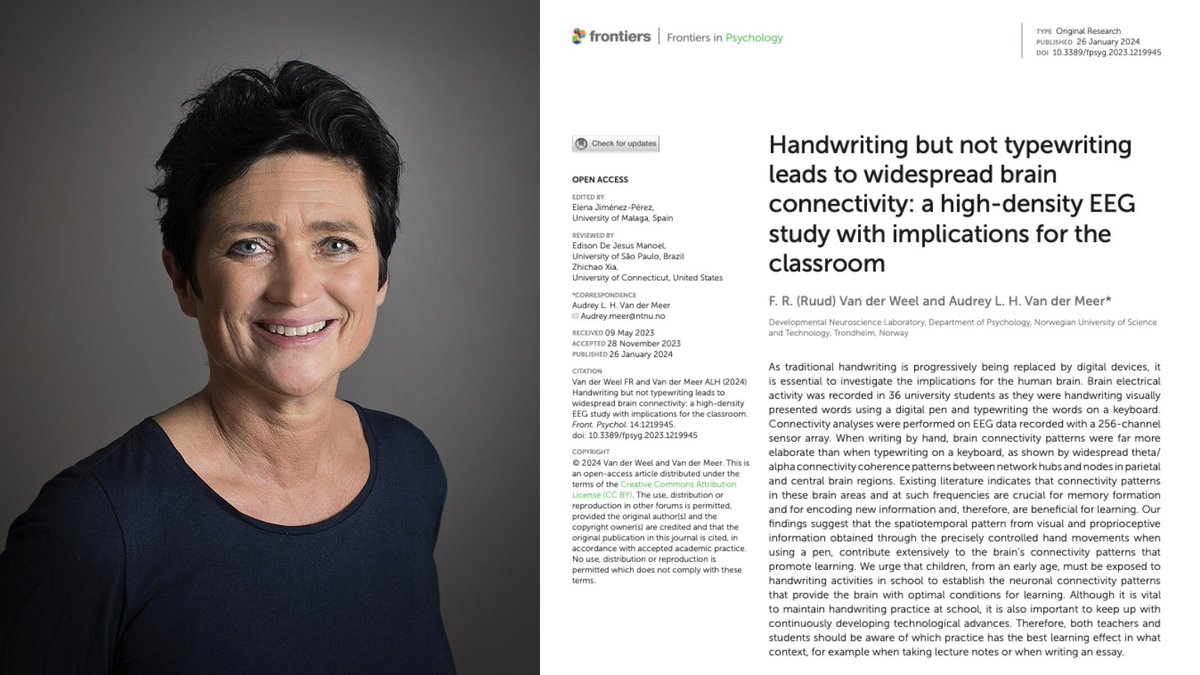
A Norwegian neuroscientist spent 20 years proving that the act of writing by hand changes the human brain in ways typing physically cannot, and almost nobody outside her field has read the paper.
Her name is Audrey van der Meer.
She runs a brain research lab in Trondheim, and the paper that closed the argument was published in 2024 in a journal called Frontiers in Psychology. The finding is brutal enough that it should have changed every classroom on Earth.
The experiment was simple. She recruited 36 university students and put each one in a cap with 256 sensors pressed against their scalp to record brain activity. Words flashed on a screen one at a time.
Sometimes the students wrote the word by hand on a touchscreen using a digital pen, and sometimes they typed the same word on a keyboard. Every neural response was recorded for the full five seconds the word stayed on screen.
Then her team looked at the part of the data most researchers had ignored for years, which is how different parts of the brain were communicating with each other during the task.
When the students wrote by hand, the brain lit up everywhere at once.
The regions responsible for memory, sensory integration, and the encoding of new information were all firing together in a coordinated pattern that spread across the entire cortex. The whole network was awake and connected.
When the same students typed the same word, that pattern collapsed almost completely.
Most of the brain went quiet, and the connections between regions that had been alive seconds earlier were nowhere to be found on the EEG.
Same word, same brain, same person, and two completely different neurological events.
The reason turned out to be something nobody had really paid attention to before her work. Writing by hand is not one motion but a sequence of thousands of tiny micro-movements coordinated with your eyes in real time, where each letter is a different shape that requires the brain to solve a slightly different spatial problem.
Your fingers, wrist, vision, and the parts of your brain that track position in space are all working together to produce one letter, then the next, then the next.
Typing throws all of that away. Every key on a keyboard requires the exact same finger motion regardless of which letter you are pressing, which means the brain has almost nothing to integrate and almost no problem to solve.
Van der Meer said it plainly in her interviews.
Pressing the same key with the same finger over and over does not stimulate the brain in any meaningful way, and she pointed out something that should scare every parent who handed their kid an iPad.
Children who learn to read and write on tablets often cannot tell letters like b and d apart, because they have never physically felt with their bodies what it takes to actually produce those letters on a page.
A decade before her, two researchers at Princeton ran the same fight using a completely different method and ended up at the same answer. Pam Mueller and Daniel Oppenheimer tested 327 students across three experiments, where half took notes on laptops with the internet disabled and half took notes by hand, before testing everyone on what they actually understood from the lectures they had watched.
The handwriting group won by a wide margin on every question that required real understanding rather than surface recall.
The reason was hiding in the transcripts of what the two groups had actually written down.
The laptop students typed almost word for word, capturing more total content but processing almost none of it as they went, while the handwriting students physically could not write fast enough to transcribe a lecture in real time, which forced them to listen carefully, decide what actually mattered, and put it in their own words on the page.
That single act of choosing what to keep was the learning itself, and the keyboard had quietly skipped the choosing and skipped the learning along with it.
Two studies. Two countries. Same answer.
Handwriting makes the brain work. Typing lets it coast.
Every note you have ever typed instead of written went into your brain through a thinner pipe. Every meeting, every book highlight, every idea you captured on your phone instead of on paper was processed at half depth.
You did not forget those things because your memory is bad. You forgot them because typing never woke the part of the brain that would have made them stick.
The fix is the thing your grandmother already knew.
Pick up a pen. Write the thing down. The slower road is the faster one.
The "Settlers" are terrorists. The genocidal and apartheid Israeli regime is a terrorist/criminal organization. The US government is complicit.
We are witnesses.
‘Leave or we’ll kill you’: Settler’s warn Palestinians in Jerusalem’s Ol... https://t.co/0lGXYx5r87 via @YouTube
🇩🇪 🇮🇱 "German citizen:
You keep saying that Iran will build an atomic bomb within two weeks; but why don't you mention Israel's possession of 200 nuclear warheads?!"
With fertilizer, this planet feeds 8.5 billion people.
Without it, we can feed around 2 billion.
We have just disrupted 30% of global fertilizer supply through the Strait of Hormuz. And people are still talking about this as if it is an oil story.
It is not an oil story. It is a food story. And the numbers do not care about politics.
Watch the full breakdown: https://t.co/uoO29ao98F
#FoodSecurity #Fertilizer #StraitOfHormuz #GlobalFoodCrisis #SteveKeen #Economics
Remember all of the talk of Trump becoming "a dictator" if elected to a 2nd term?
I scoffed at the notion.
We have "checks and balances" and "rule of law" I said.
Fast forward to today.
When the Guardrails Fail: Trump’s Assault on Checks and Balances https://t.co/w8VYE6a7KI
The American buffalo—those ornery, hairy prairie beasts that reign as the official mammal of the United States—have joined wind turbines, electric cars, and climate researchers in the crosshairs of the Trump administration. https://t.co/7Iq8zfPnPc
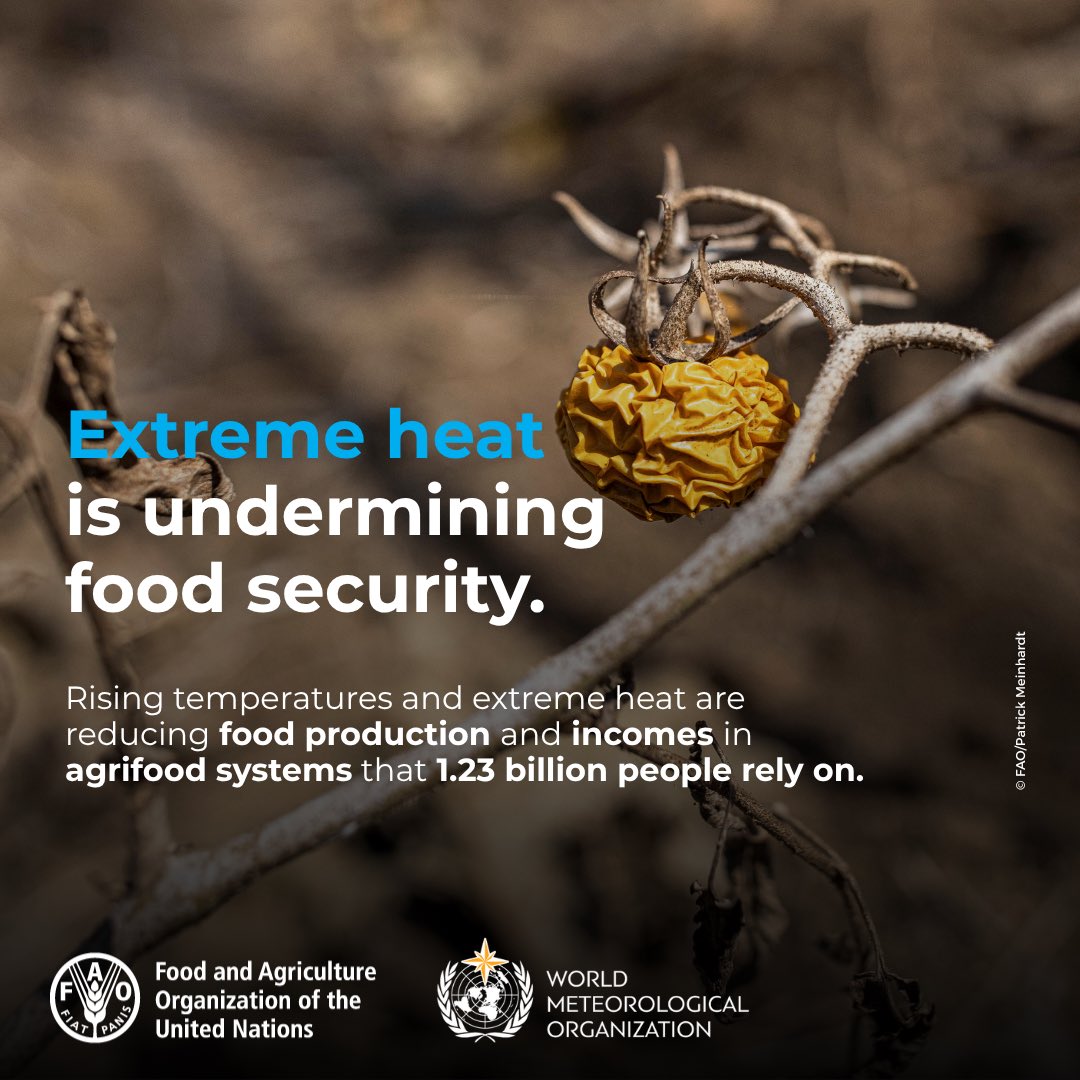
Extreme heat is pushing agrifood systems to the brink.
A new @FAO /WMO report finds that rising temperatures are putting crops, livestock, fisheries, forests, farmers, and workers at growing risk, as well as identifies adaptation options.
Read ➡️ https://t.co/DkcTokpMVu
This spring, federal agencies plan to spray glyphosate—the world's most controversial and widely-debated weedkiller—across thousands and thousands of acres of public land. Land where families camp, hikers explore, hunters pursue game, and children swim in mountain streams. And almost no one knows it's happening, reports @natethecurious.
Glyphosate, introduced by agri-giant Monsanto in 1974, has been classified as a probable carcinogen by the World Health Organization. Bayer, the multinational conglomerate that acquired Monsanto in 2018, is now on the hook for over $12 billion in legal settlements and payouts to thousands of people who claim Roundup gave them cancer and other serious illnesses. Scientists have also linked the chemical to decimated Monarch butterfly populations, mass frog die-offs, and widespread ecological damage.
And yet in February, President Trump signed an executive order declaring glyphosate critical to national security, invoking the Defense Production Act to guarantee its continued use and shielding its producers from legal liability.
So why is one of the most litigated chemicals in American history being quietly sprayed across our national forests?
To get to the bottom of it, my colleague Melissa Lewis and I pulled California pesticide application records going back to 1995 and analyzed more than 5 million data points. What we uncovered was deeply troubling: glyphosate spraying in California forests has quintupled since 2005—the fastest-growing market for the chemical in the state—and the public has been left almost entirely in the dark.
This is the secret plan to cover the world in herbicide—that they don't want you to know about.
Find the full 22 minute documentary on our YouTube channel.
Scientists are increasingly worried that a key Atlantic current, which delivers warmth to northern Europe and shapes weather globally, is at risk of collapse.
Multiple lines of evidence suggest it may be nearing a tipping point.
https://t.co/qxiXJAO5F0
A reckoning is unfolding in the Amazon.
In my special issue for The Ecologist, I explore how Indigenous leaders, traditional communities and researchers are resisting development that could push this vital ecosystem past irreversible tipping points.
https://t.co/7TRNrl1Mpg
Global appetite for beef is driving Amazon deforestation, new study finds
EU new trade with Brazil and S America will only accelerate massive Amazon deforestation but they do not care
Profit before planet
https://t.co/4Y4fKSN1M8
@RCdeWinter I wouldn't limit that just to Republican presidents. They are right up there among the most decent of all of our presidents. This country desperately needs a Theodore Roosevelt type of president today. Unfortunately, I'm afraid he was one of a kind.