Science influenced by art. Introducing the Ellison Medical Institute Art Book: a limited-edition collection of original photographs curated by our Founding CEO, Dr. @DavidAgus. Showcasing works by renowned artists including Keith Haring, Damien Hirst, Robert Indiana, Jeff Koons, Pablo Picasso, Tim Rollins, and more, the collection reveals how extraordinary art helps shape the environment where groundbreaking science happens.
📸 Photography by Yoshihiro Makino
📚 Published in collaboration with Nazraeli Press
🔢 Only 1,000 copies available
🎗️ All proceeds fund cancer research & preventive medicine programs at EMI
Dedicated to our patients, who remain at the center of everything we do.
Order your copy today: https://t.co/8wgJbCUn5V
In medicine, we often keep doing things simply because “that’s how it’s done.” A large @bmj_latest review of 69 clinical trials including more than 159,000 patients found little to no benefit from calcium, vitamin D, or combined supplementation in preventing fractures or falls.
https://t.co/ewMSKNybww
I recently sat down with the incredible Bran Ferren, designer, technologist, inventor, and former President of R&D and Creative Technology at The Walt Disney Company, for his podcast, Conversations for Our Daughters. Together, we discussed the future of personalized medicine and how innovation is changing the way we prevent, detect, and treat cancer.
Watch the full conversation here: https://t.co/81xFVWMCXO
AI will transform medicine: from discovering new drugs to unlocking insights from data to handling routine administrative tasks. I didn’t go to medical school to spend my day in front of a computer. AI can help bring the focus back to patients and human connection. Exciting times ahead.
Loved this conversation with Kara Swisher:
https://t.co/NMbZkARNYa
NAD+ supplements marketed for anti-aging still haven’t shown meaningful benefits — and now even the premise that NAD levels inevitably decline with age is being questioned. Focus on what actually works: #EatRealFood#Exercise
https://t.co/WKoTORdqTj
Calcium and vitamin D are the most common individual supplements taken in the US, and there is little to no data showing a benefit on bone fx in this large review. Weight bearing exercise trumps all! https://t.co/6CLR1vmIUd
Artificial intelligence is rapidly making its way into the healthcare world. At 3:30pm East, @DrMarcSiegel talks about the changes and potential impact with Dr. David Agus @DavidAgus - Physician @emilosangeles. Stream live here: https://t.co/bw9glj09DU
Deeply honored to receive the Latchkey Award from @JohnsHopkinsDOM and @OslerResidency, alongside Drs. Redonda Miller and Suzanne Koven. Modeled after the key Osler gave select senior residents to his personal library, this award is especially meaningful. I will always treasure my time in training at Hopkins. @ChidaNatasha@NadiaHanselMD@drjmariomolina
Another study showing the remarkable benefit of the Shingles vaccine on dementia/Alzheimers - a 50% reduction - the impact of this on individuals, families, society and our economy are profound ---- if people actually take the vaccine! https://t.co/EI7DltvD0l
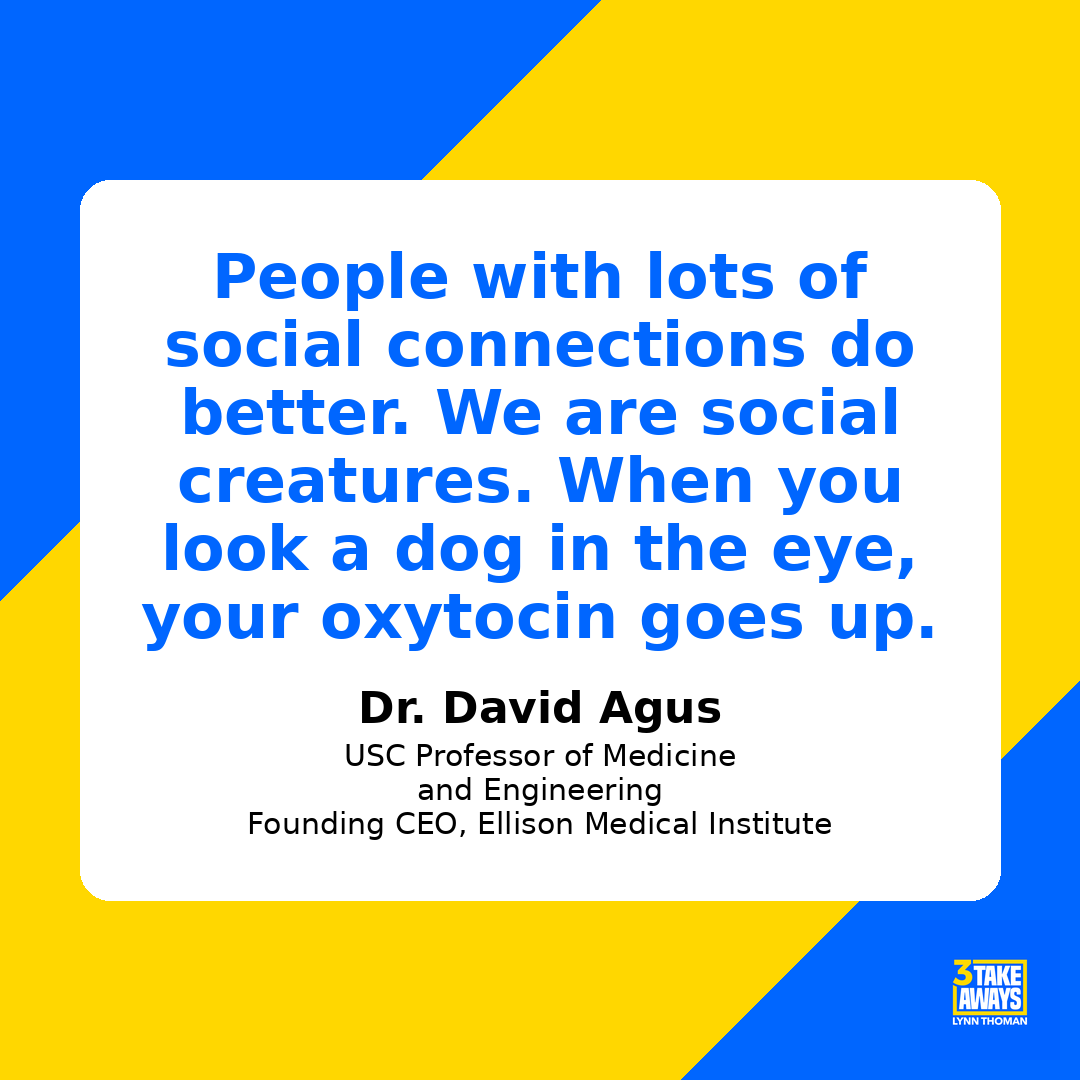
When you look a dog in the eye, your oxytocin goes up.
And that changes everything.
I'm excited to be joined on 3 Takeaways by Dr. @DavidAgus, USC Professor of Medicine and Engineering and Founding CEO of the Ellison Medical Institute @EMILosAngeles.
Dr. Agus - who has treated President Clinton and Pope John Paul II - explains how social connections affect our health at a biological level.
"People with lots of social connections do better. We are social creatures," he says.
When you look a dog in the eye, your oxytocin rises. Your blood pressure lowers. Your whole physiology changes. And the people who have these connections - whether with dogs, family, or friends - live longer and healthier lives.
This isn't soft science. It's measurable biology.
Social connections change our hormones, our cardiovascular system, our immune function. Loneliness isn't just emotional pain—it's a physical health risk.
The lesson? Invest in relationships. Pet your dog. Call a friend. Connect.
Your body will thank you.
For more,
✅📖 Read Dr Agus's wonderful book The Book of Animal Secrets https://t.co/6qVMqemKRA
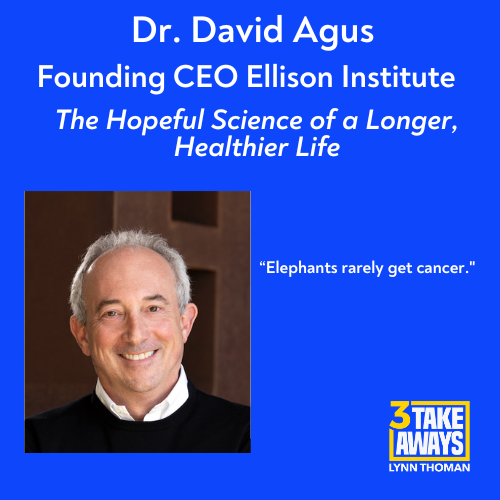
✅🎧 Listen: 3 Takeaways Podcast (top 1% globally) to Dr. David Agus on The Hopeful Science of a Longer, Healthier Life https://t.co/Z8D9PkztSf
💬 How do social connections affect your wellbeing?
#3Takeaways #DavidAgus #SocialConnections #Oxytocin #Longevity #MentalHealth #DogsOfLinkedIn #Wellness #podcast
🚀New 3 Takeaways episode!🚀
I am delighted to be joined this week by @DavidAgus, Professor of Medicine and Engineering at the University of Southern California and Founding CEO of the Ellison Medical Institute @EMILosAngeles.
He treats presidents, CEOs and cultural icons and has spent decades studying one question: What determines how long and well we live?
His answer is hopeful: Only 4% is genetic. The other 96% is under your control.
In this episode, he reveals:
- why elephants rarely get cancer
- why giraffes never get heart disease
- what inflammation does to nearly every organ in your body
- foods we think are healthy that aren't
✅He also shares the simple, proven habits that matter more than DNA, and destroys the myths quietly harming millions.
Science-backed. Actionable. Hopeful.
He is the author of multiple New York Times bestsellers, including The Book of Animal Secrets, The Lucky Years and The End of Illness.
🎧 Listen to the full conversation on 3 Takeaways, the top 1% global podcast https://t.co/Z8D9PkztSf
💬 Which health habit has made the biggest difference in your life?
#3Takeaways #DavidAgus #Longevity #Genetics #Lifestyle #PreventiveMedicine #HealthOptimization #PersonalResponsibility #podcast
From @WSJopinion: For generations, we’ve accepted the decline of the human body as inevitable. But that assumption may no longer hold true. Science fiction is becoming reality, writes @DavidAgus. https://t.co/jIn80N5eYF
Aging, once an inevitability, is becoming a frontier. And for the first time, science offers reason to hope that the future might be younger than it looks, writes @DavidAgus
https://t.co/WXEaAVqDbc
From @WSJopinion: Aging, once an inevitability, is becoming a frontier. And for the first time, science offers reason to hope that the future might be younger than it looks, writes @DavidAgus. https://t.co/IJGYEUfZXh
Researchers aren’t merely slowing aging; they’re learning how to reverse it.”
That’s from a brilliant, optimistic piece just published in the @WSJ on AI and aging by Dr. @DavidAgus, founding CEO of the @emilosangeles Medical Institute and a member of @Thrive's board.
There have been some remarkable advances in longevity recently and AI is “supercharging” that process. "AI is also revolutionizing how we understand our personal health,” he writes, helping “reveal patterns that humans might never spot.”
And as AI transforms health, we’ll also need to deal with how it’s transforming society.
"The implications of life extension are profound, and they reach far beyond medicine,” Dr. Agus writes. "Physical health can’t advance without equal attention to emotional, ethical and economic health. A world in which people live significantly longer will require a new economic model focused on multigenerational, multistage employment in which a person may pursue different careers appropriate to different stages of life rather than the traditional three-stage arc of education, work and retirement. Such a world would also require a new respect for aging.”