Brilliant paper by NVIDIA.
they found a way to make KV cache transferable between models.
the target model skips prefill entirely, and the conversion runs 2.7 to 25x faster than processing the context again.
let's understand why this is so important today.
LLM APIs are stateless, so every turn sends the entire conversation back to the model. the model reads it again before generating a new token, and all of it is billed as input.
prompt caching lets providers hold the KV cache for a stable prefix and bill cache hits at roughly 10% of the base input rate because that compute was already done.
this 90% reduction is one of the biggest levers in LLM serving.
but the cache only works on the model that produced it. since keys and values depend on that model's weights, another model cannot directly reuse them.
this becomes a problem with LLM routing.
if traffic moves to another model for cost or capability reasons, the accumulated KV cache becomes invalid.
the entire context must be processed again and billed at full rate.
NVIDIA's recent paper treats this as a representation problem.
prefill's main output is the KV cache, so transferring it means converting one model's cache into the representation another model expects.
they first checked whether this conversion had enough structure to exploit.
for Qwen3 14B → 32B, a linear regression from a single source layer reconstructed 56% of the variance in the target model's keys.
because models can have different layer counts, there is no natural one-to-one layer mapping.
so, for every target layer, they rank the source layers by predictive power and use the top eight together.
that pushes reconstruction to 79%.
the mapper has three parts:
> each target layer and head gets its own linear map, solved in closed form instead of with gradient descent.
> cross-layer selection chooses the source layers that best predict each target layer. their ablation shows this contributes the most.
> RoPE adds a position-dependent rotation to keys. they remove it, fit the mapping in position-free space, then apply the target model's rotation again at inference.
across six model pairs from Qwen3, Llama 3.1, and Ministral 3, four retain 73 to 98% of the receiving model's standalone accuracy.
conversion is also 3 to 25x faster than processing the context again.
prior cross-model KV reuse methods either train a neural adapter for every pair or require architecturally identical models.
this approach is closed-form and training-free, but there are still important limitations.
every tested pair belongs to the same model family, such as Qwen → Qwen or Llama → Llama.
cross-family transfer is still future work.
the tested pairs also share KV head count and per-head dimension. mismatched configurations remain untested.
and the work currently covers dense full-attention models only, not sliding-window or attention-recurrent hybrids.
link to the paper: https://t.co/S7PlvbCPbF
i wrote a first-principles breakdown of how KV caching works
the article is quoted below.
NEW POST
Will there be source code in the future? To wrestle with this, we have to understand what code is. Unmesh Joshi sees code as having two distinct but intertwined purposes: instructions to a machine and a conceptual model of the problem domain.
https://t.co/GsjgtYysno
La regla de oro de todo ingeniero: si tienes que hacer algo aburrido más de dos veces, automatízalo. 🛠️✨
Jules es la máxima automatización para tu flujo de trabajo.
Un agente impulsado por IA que gestiona las tareas mecánicas, las ejecuta en un entorno virtual y te entrega el código listo para integrar. ⚙️
Enfócate en crear; Jules se encarga del resto. 💜🐙
Conócelo aquí: https://t.co/2PET5JnqIx
Google acaba de hacer algo que Claude Design no esperaba.
Y lo hizo gratis, en abierto, para todo el mundo.
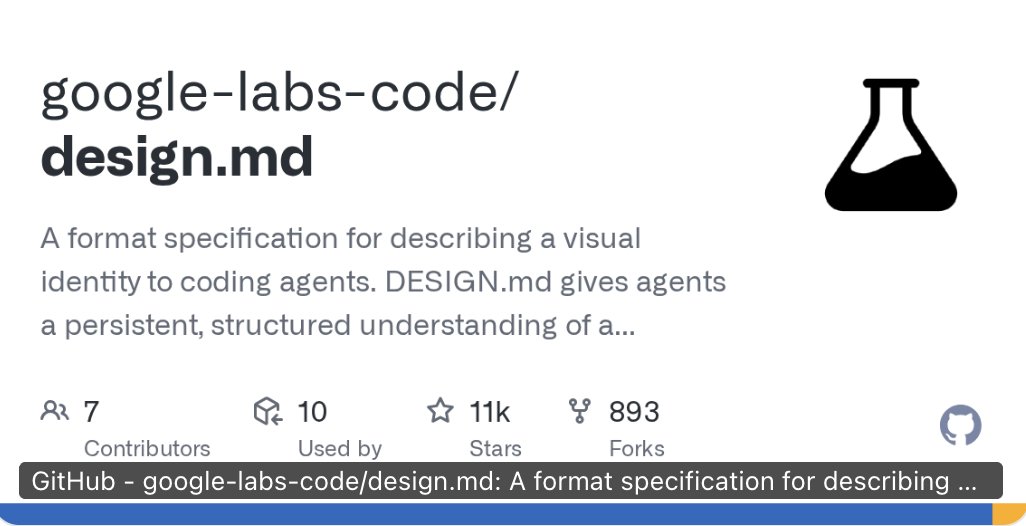
Se llama DESIGN.md.
Pero primero hay que hablar de lo que provocó esto.
Anthropic lanzó Claude Design con límites de uso ridículos.
Cerrado. Caro. Controlado.
La herramienta de diseño con IA más potente del momento, pero con la llave en su bolsillo.
Google vio la jugada.
Y respondió de la única forma que duele de verdad:
Abrió el código. Gratis. Para todo el mundo.
Se llama DESIGN.md.
Un estándar abierto que cualquier IA puede leer.
En cualquier herramienta. En cualquier plataforma.
El problema que resuelve es real:
Los agentes de IA no tienen ni idea de tu sistema de diseño.
No saben qué significa tu color primario.
No saben si ese botón es accesible.
No saben para qué sirve cada componente.
Cada vez que usabas IA para diseñar, empezabas de cero.
DESIGN.md lo resuelve con un solo archivo.
Tres cosas concretas que hace:
1️⃣ Tokens de diseño
Tus colores, tipografías y espaciados con descripciones en lenguaje natural.
La IA entiende para qué sirve cada valor, no solo cuál es.
2️⃣ Validación de accesibilidad
El agente comprueba sus decisiones contra las reglas WCAG.
Sin que tú tengas que revisar cada detalle manualmente.
3️⃣ Portabilidad total
Exportas e importas tus reglas de un proyecto a otro.
Un archivo. Cualquier herramienta. Cualquier plataforma.
Incluidas las de Anthropic.
Eso es lo que más duele en ese lado de la mesa.
Anthropic construyó muros.
Google tiró la pared entera.
El repositorio está en GitHub: https://t.co/UJ5RVJPvwJ
Esto es lo que pasa cuando los grandes se pelean.
Nosotros ganamos.
NVIDIA da acceso gratis por API a modelos de IA.
A DeepSeek V4, MiniMax M2.7, GLM 5.1, Gemma 4...
Perfecto para pruebas de desarrollo.
Puedes usarlo con OpenCode y OpenClaw
Puedes conseguir acceso aquí:
→ https://t.co/4F510HFfFi
New in Claude Code: /ultrareview (research preview) runs a fleet of bug-hunting agents in the cloud.
Findings land in the CLI or Desktop automatically. Run it before merging critical changes—auth, data migrations, etc.
Pro and Max users get 3 free reviews through 5/5.
Esto es increíble, modelos de 96GB serán reducidos al menos a 16GB. Modelos más poderosos se podrán ejecutar en máquinas de consumidor sin pérdida . Se reduce el tamaño DESDE 6 veces!
A simple Clawbot setup made me $6,700 in 3 days.
No coding.
No tech skills.
Just ChatGPT + Laptop + 2 hours daily.
This setup can generate up to $3,000/day if used right.
So I created a step-by-step guide anyone can follow.
Normally $349, But FREE for the next 24 hours.
Want exact guide?
1️⃣ Comment "Claw"
2️⃣ Like + Repost
Follow @Ejaz_bashir1 so, I'll DM you the guide. 📩
🔴 ¡OPENAI LANZA PRISM!
Un conjunto de herramientas pensadas para facilitar la vida a investigadores a la hora de redactar en LaTeX, buscar bibliografía, verificar información, etc. Todo potenciado por GPT-5.2 (y los futuros modelos que llegarán)
https://t.co/PpPQUOB3G4
¡Acaba de salir React Email 5.0!
La mejor forma de crear correos electrónicos.
✓ ¡Ahora con soporte para modo oscuro!
✓ Compatibilidad con Tailwind 4
✓ 8 nuevos componentes
Previsualización, linter y mucho más:
→ npx create-email@latest
Azure Fundamentals (AZ-900) (Quick Guide)
✍️Completed this guide (with 6 Days Learning Plan),and sharing it for FREE for just 24 hours!
✅Will share over DM to all requests, Only 179 Slots!
To get it (for FREE):
1. Follow me @TTechFusionist (So that I can DM)
2. Repost this post!
3. Reply "Azure"
Follow me so I will dm 💯