Sag-Aftra Nominated Actor Producer Director Screenwriter, NavyCombat Vet Public Safety Advisor, Stunt Coordinator Songwriter BMI Nashville Emergency Mgmt Expert
They called them flying coffins. The men who volunteered to fly them knew exactly why.
The Allied gliders of D-Day were made of fabric stretched over a frame of wood and metal tubing. They had no engine. No armor. No weapons. No parachutes for the men inside. They were towed to France at 130 mph on the end of a 300-foot nylon rope attached to a C-47, and when the rope was cut, there was one chance to land.
One. No go-arounds. No second approach. Whatever was below you was where you were going.
What was below them was Normandy at night.
The Germans had spent weeks preparing. Under orders from Field Marshal Rommel, they had driven wooden stakes into every open field in the region, angled to impale gliders on landing. The French called them Rommelspargel. Rommel's asparagus. Thousands of poles, many with mines or artillery shells wired to the tips, packed into every field large enough to land on.
What the glider pilots had not been properly told was the scale of the Norman hedgerows. The bocage. These were not English garden hedges. They were ancient earthen walls, some dating back centuries, topped with dense root systems and trees, rising 50 feet in places, bordering fields barely 200 yards long. A Horsa glider coming in at 100 mph hitting a hedgerow did not survive it. Neither did most people inside.
Some fields were flooded. Some were mined. Many were both.
517 gliders went into Normandy. 97 percent were abandoned in the field by the end of the operation. Most were destroyed.
General Don Pratt, assistant commander of the 101st Airborne, was in the first glider wave. His pilot managed to find a field near Hiesville and brought the glider down. It slid across the wet grass without slowing and hit a hedgerow at speed. The co-pilot died instantly. The pilot, Lieutenant Colonel Mike Murphy, broke both legs. General Pratt suffered a broken neck. He became the first American general to die in the Battle of Normandy. His glider had landed in one piece.
Sergeant Eric Wilson's glider did not. It hit a building at high speed. Both of Wilson's legs were broken. He was trapped inside the wreckage, unable to move, in enemy-held Normandy, for two and a half days before anyone reached him.
Lieutenant Den Brotheridge had come in earlier than anyone, in the first glider to land in France, the silent coup de main assault on Pegasus Bridge just after midnight. His glider stopped 47 yards from its target. He led his men out at a run, reached the bridge, and was shot. He died within minutes, the first Allied soldier killed by enemy fire on D-Day.
The men who survived the landing did not get to stop. Glider pilots were not assigned to combat units. Once down, they were expected to fight as infantry, dig foxholes, guard prisoners, carry ammunition, do whatever was needed. Most of them had trained to fly, not to fight on the ground behind enemy lines in the dark.
They did it anyway.
Of the 517 gliders that went in, 222 were Horsa gliders. Most were destroyed either on landing or by German fire in the hours that followed. The Waco CG-4As fared slightly better but 97 percent of all gliders from the entire operation were eventually abandoned in Norman fields, broken and empty.
The men who flew them were not pilots in the traditional sense. They were soldiers who had been given just enough training to put an unarmed, engineless box of fabric and wood into a dark foreign field at 100 mph, full of men and equipment, with one attempt and no margin for error.
Many of them got it exactly right.
Many of them did not come home.
Today is June 6th.
Remember them too.
D-DAY ANNIVERSARY: More than 30 churches in the United Kingdom, France, Belgium and Luxembourg contain stained-glass windows honoring U.S. military efforts during the First and Second World Wars.
Stars and Stripes reporter @pwwellman visited them over the course of seven months. Highlighted here are a few that remember D-Day.
See more windows here:
https://t.co/fBtpMer5u9
D-DAY • JUNE 6,1944 • As The Proud son of a WWII Veteran who Took part in the Normandy Invasion • OMAHA BEACH • GOD BLESS THEM ALL • Through their COURAGE & STRENGTH We live w/The Incredible gift that Freedom provides every American & Throughout the world • @IntrepidHeroes
The idea was brilliant. The execution was catastrophic.
Allied planners knew that the men hitting the beaches of Normandy would be cut apart without armor support in those first critical minutes. The solution was the DD tank. The Duplex Drive Sherman. A standard 33-ton Sherman tank fitted with a collapsible canvas flotation screen and two small propellers bolted to the rear. Raise the screen, drop into the water, swim to shore, lower the screen, start shooting. Tanks arriving with the first wave, ahead of the infantry, suppressing German positions before the ramps even dropped.
The concept worked perfectly in testing. The designers had one requirement: waves no higher than one foot.
On the morning of June 6th, 1944, the waves off Omaha Beach were six feet high.
Nobody stopped the launch.
At 5:40 AM, the 741st Tank Battalion began dropping their DD tanks into the English Channel, six thousand yards from shore. More than three miles of open water, in seas that were six times rougher than the tanks were designed to handle. The first tank hit the water. The canvas screen, designed to hold the weight of a Sherman afloat, was immediately overwhelmed. Waves crashed over the top. Water flooded in. The tank went down.
Then another. Then another.
The canvas screens collapsed like paper bags in the swell. Tanks that had been designed to float became 33-ton anchors the moment they hit the water. Crews inside had seconds. Some got out through the hatches. Many did not. The tanks took them straight to the bottom of the English Channel.
Some crews managed to get a radio signal out as their tank went under, warning the following units not to launch. The warnings either did not get through or came too late.
29 DD tanks were launched by the 741st Tank Battalion that morning. 27 sank before reaching the beach. The entire left flank of Omaha Beach, where the 1st Infantry Division was assaulting, had five tanks to support it. Five. Against fortified German positions housing hundreds of machine guns, 88mm guns, and mortars zeroed on every inch of that sand.
The infantry arrived first. Alone.
What happened next at Omaha Beach, the 2,400 casualties, the slaughter in the first ten minutes, the near-total destruction of Company A, is inseparable from the loss of those tanks. They were supposed to be there. They were supposed to be firing at German positions while the ramps were still closed. Instead they were on the bottom of the Channel with their crews.
The story of the 743rd Tank Battalion makes it worse.
The 743rd was assigned to the western sector of Omaha Beach. Their LCT flotilla commander looked at the sea conditions that morning, looked at the waves, and made a different decision. He refused to launch his tanks into the water. Instead he drove his LCTs directly onto the beach and dropped the ramps in the shallows. The tanks rolled off onto sand.
Nine tanks were knocked out by German fire during the assault. But they were there. They were fighting. The infantry had armor.
At Utah Beach, the sea was calmer, protected from the prevailing winds. 28 of 32 DD tanks launched there made it ashore. The infantry had support. Utah Beach cost 197 casualties. Omaha cost 2,400.
The sunken tanks of the 741st Tank Battalion still lie on the bottom of the English Channel off Omaha Beach. They have never been raised. Divers have visited them. Inside some of the wrecks, they found what they expected.
They are still there today, 82 years later, three miles off the coast of Normandy, on the bottom of the sea.
Today is June 6th.
Remember them.
We’ll start the war from right here.
—Brigadier General Theodore Roosevelt Jr., son of the former president, who landed with his troops in the wrong place on Utah Beach
https://t.co/yN0dZurNAq
Theodore “Ted” Roosevelt Jr., son of President Theodore Roosevelt, John J. Pinder, Jr. of McKees Rocks, Pennsylvania, and Jimmie Waters Monteith, Jr. of Low Moor, Virginia, were all posthumously awarded the Medal of Honor for their heroic actions on June 6, 1944, during the D-Day invasion.
Carlton William Barrett of Fulton, New York, was also awarded the Medal of Honor for his extraordinary actions on June 6, 1944.
#WeRememberThem
If that story doesn’t show the selflessness and dedication shown by Americans for Europe’s survival, nothing does. It makes one wonder what is being taught about America and American history in European schools, to lead to such ignorance and ungratefulness in the minds of young Europeans for how America saved them in both World Wars.
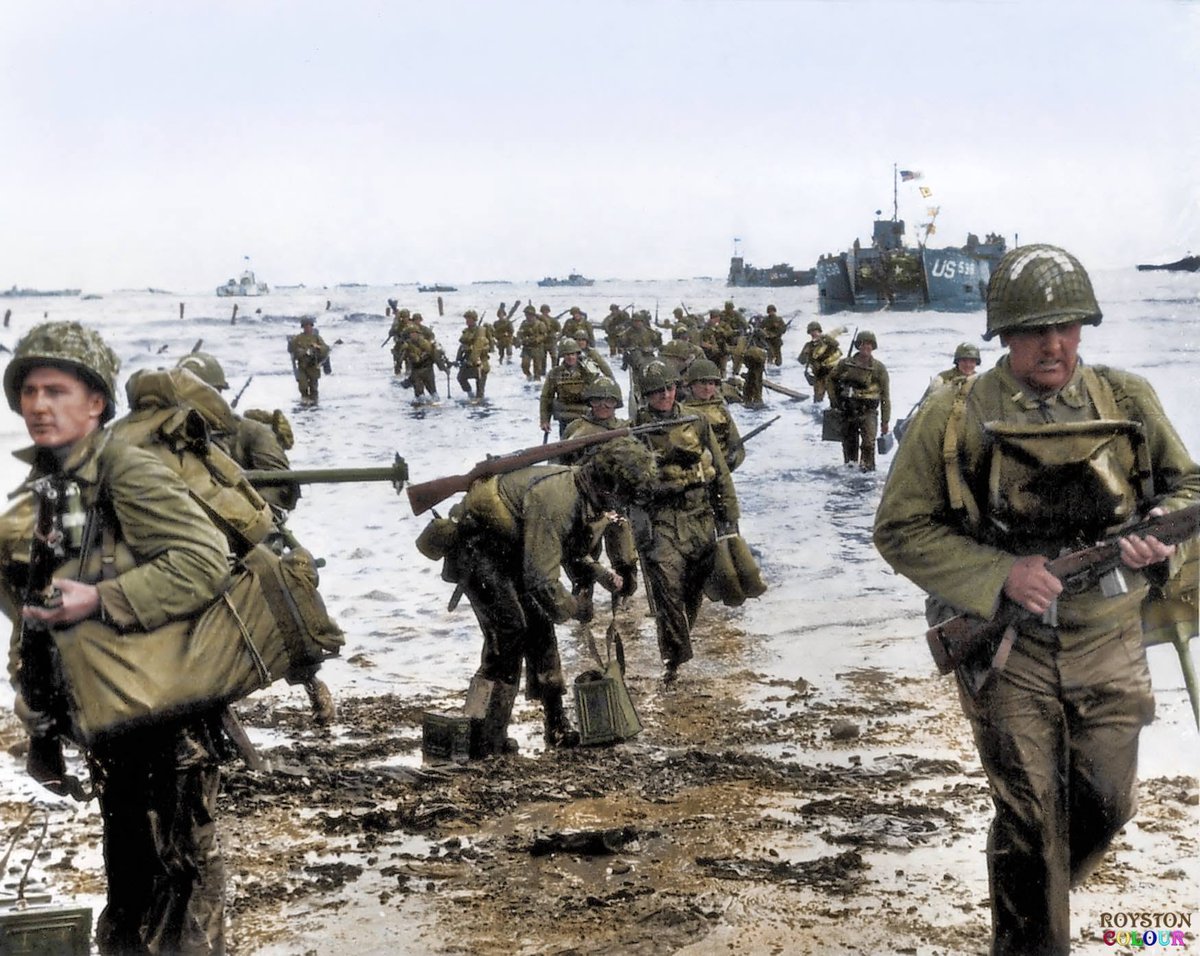
82 years ago this morning, everything went wrong at Utah Beach and it saved thousands of lives.
Utah was the westernmost of the five D-Day beaches, assigned to the American 4th Infantry Division. H-Hour was 6:30 AM. The first wave of 300 men climbed down into their landing craft in rough seas, pointed themselves at the French coastline, and headed in.
The current took them.
Strong tidal currents pushed every boat 2,000 yards south of the intended landing zone. The men hit the beach in completely the wrong place, a sector they had never trained for, in positions that appeared on no plan.
Standing on that unfamiliar sand, in the middle of an invasion, under fire, was a 56-year-old general walking with a cane.
Brigadier General Theodore Roosevelt Jr. had requested to be in the very first wave. His commanders said no. He wrote a second letter. They relented. He was the only general and the oldest man in the first wave on D-Day, and he had a heart condition and severe arthritis in addition to the cane.
When the ramps dropped, Roosevelt walked off the boat and onto the beach. He stood upright under fire, studied the terrain, and made a decision that would define the entire operation at Utah.
He was not going back. He was not redirecting to the planned sector. He looked at what was in front of him and said seven words that became one of the most famous quotes of the war.
"We'll start the war from right here."
Roosevelt personally walked the beach on foot, rallying men, pointing at the seawall, leading group after group up and over it toward the German positions. He did it repeatedly. He did it under direct fire. Every junior officer and enlisted man on that beach could see their general, cane in hand, walking calmly toward the enemy.
What Roosevelt could not have fully known in that moment was that the wrong sector was actually better. The current had deposited them near a stretch of coastline where Allied bombers had already destroyed the main German strongpoint. The planned landing zone had two strongpoints, both largely intact. By landing in the wrong place, the 4th Infantry Division had accidentally avoided the killing ground they were supposed to walk into.
197 Americans were killed or wounded at Utah Beach on D-Day.
At Omaha Beach, 13 miles to the east, the number was 2,400.
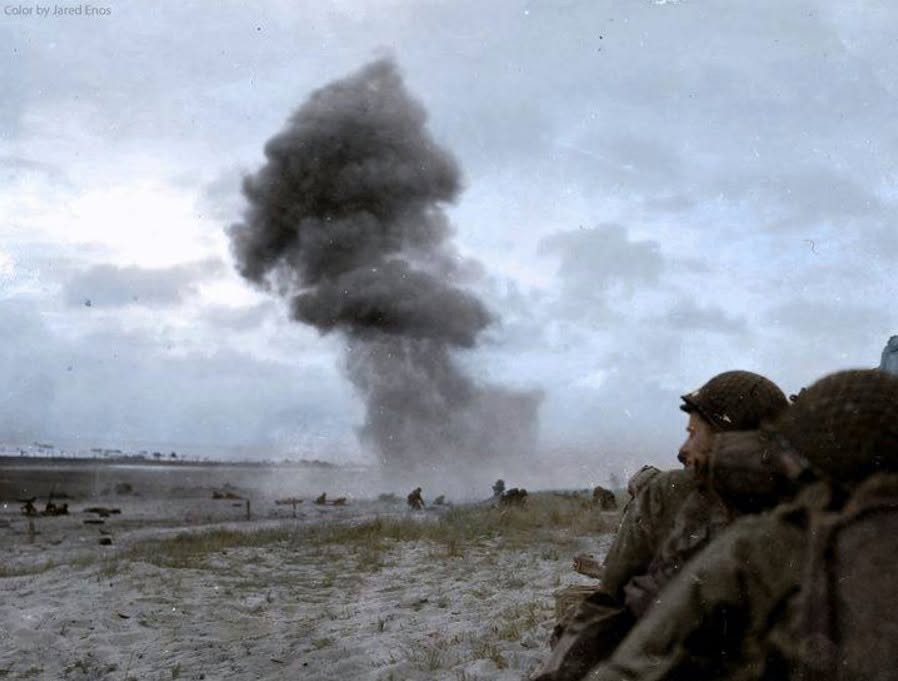
Utah was not easy. The men still crossed open sand under fire. They still lost people. But the combination of Roosevelt's calm leadership, the accidental landing position, and the 82nd and 101st Airborne troops who had been holding the inland roads since midnight meant that Utah Beach became the most successful landing of the entire invasion.
23,250 American soldiers and 1,700 vehicles were ashore by nightfall.
Theodore Roosevelt Jr. was awarded the Medal of Honor for what he did that morning. He never received it in person. He died of a heart attack on July 12th, 1944, five weeks after D-Day, still in France.
His younger brother Quentin had been shot down and killed over France in World War One, 26 years earlier. Theodore had come back to finish it.
Today is June 6th.
Remember them.
On this day in 1944, while the world watched the beaches of Normandy, another massive American operation was moving across the Pacific.
USS New Jersey, USS Iowa, and 642 ships of Admiral Spruance's Fifth Fleet sailed from Majuro bound for the Marianas — one of the most powerful naval forces ever assembled. Aboard Battleship New Jersey, Admiral Spruance commanded the fleet from her flag bridge.
One of the sailors aboard that day was Paul Robbins. He had reported aboard on her commissioning day in 1943 and was there for all of it.
Paul is 101 years old. He is believed to be the last known living Battleship New Jersey World War II sailor. On June 15th, we invite you to come aboard and honor him in person.
Downtown. 2 Market Square - Primanti Brothers. Multiple callers indicate the restaurant is on fire. PD on scene say it’s a flames showing fire and they’re trying to clear out market square for fire dept operations.
Today's 82nd anniversary of D-Day comes with the unveiling of a new national tribute to those who changed the course of World War II.
The National Memorial of Military Ascent (NMMA) is a tribute to the U.S. Army Rangers who scaled the 100-foot cliffs of Pointe du Hoc during the D-Day invasion of Normandy in World War II. Located in Grafton, Illinois, the memorial utilizes the steep limestone bluffs along the Mississippi River to visually recreate this historic 1944 climb.
#Dday
#OmahaBeach
#WW2
#LestWeForget
Thank you to all who fought and sacrificed in freedoms defense all those years ago. Incredible footage here. Blessed that both my uncles survived and will never forget the over 400,000 who did not come home.
This morning at the World War II Memorial, we pause to honor the courage and sacrifice of those who stormed the beaches of Normandy 82 years ago today. 🇺🇸
Photo by Chris Johnson
@Hot_Pepper76@JosephC13598075 The line was to be changed to “girl, we couldn’t get much better”, Jim sang it “ much higher“ his original lyrics per Ray & John.