A friend hit me with a line yesterday that completely changed how I look at prediction markets:
“The bet is easy, the nightmare is agreeing on when the bet is actually settled.”
He’s right and that nightmare is exactly where most platforms quietly fail.
🧵👇
TODAY 🚀
16:00 UTC · CA drops
16:30 UTC · the gates open
Waitlist pilots fly first, and each one can bring 20 friends in with them.
Fight, mine, trade, run the gates. Your play turns into tokens in your wallet.
See you in the frontier.
🚨 Vini Jr: “I feel like defenders can always kick me, yet I am the one who gets booked”.
“I think we need to protect players who can make a difference like me, Lamine Yamal and Julián Álvarez…”.
The prediction market pitch in Agent Tank Episode 2 made me think about a problem that goes way beyond prediction markets.
The panel asked what happens when an outcome isn't obvious. The proposed answer was token holders voting on it.
But a vote can tell you what the majority thinks happened. It doesn't necessarily tell you what happened.
That distinction gets pretty important when agents start doing business with each other.
Imagine Agent A pays Agent B to deliver a dataset.
Agent B says, “done.”
Agent A checks it and says, “you missed half the requirements.”
There isn't a customer support rep sitting in the middle. Neither agent should automatically get to be judge and jury either.
So where does the disagreement go?
That's the part of @GenLayer that makes sense to me. A random panel of validators can examine the evidence, reach a verdict, and a challenge can bring in a larger panel if someone thinks the decision is wrong.
You're not pretending every dispute is objectively obvious. You're giving the dispute somewhere credible to go.
Because agents being able to transact without humans is one thing.
Agents being able to deal with each other when something goes wrong is the harder part.
The Agent Tank hackathon is a good place to build around that problem:
https://t.co/QTJkW31yjj
If two agents disagree about whether a job was actually completed, should the system trust one side, trust a vote, or make both sides prove their case?
@SlimeSyntax The 95% example is one I wouldn't want to leave to a simple vote. If the missing 5% is the part that makes the whole deliverable usable, “95% complete” can be completely meaningless.
DCF is usually where these models start exposing themselves.
Ling went through the full chain and landed at $291.62 against Python’s $291.622975, with 12/12 checks passing.
What stands out to me is that the math stayed intact all the way through terminal value and equity value. How many financial models would you actually trust an AI to build or audit today?
So happy to be among the winners, thanks to @predict_365 I get to understand prediction market it was a wonderful experience
Can wait for official launch
So happy to be among the winners, thanks to @predict_365 I get to understand prediction market it was a wonderful experience
Can wait for official launch
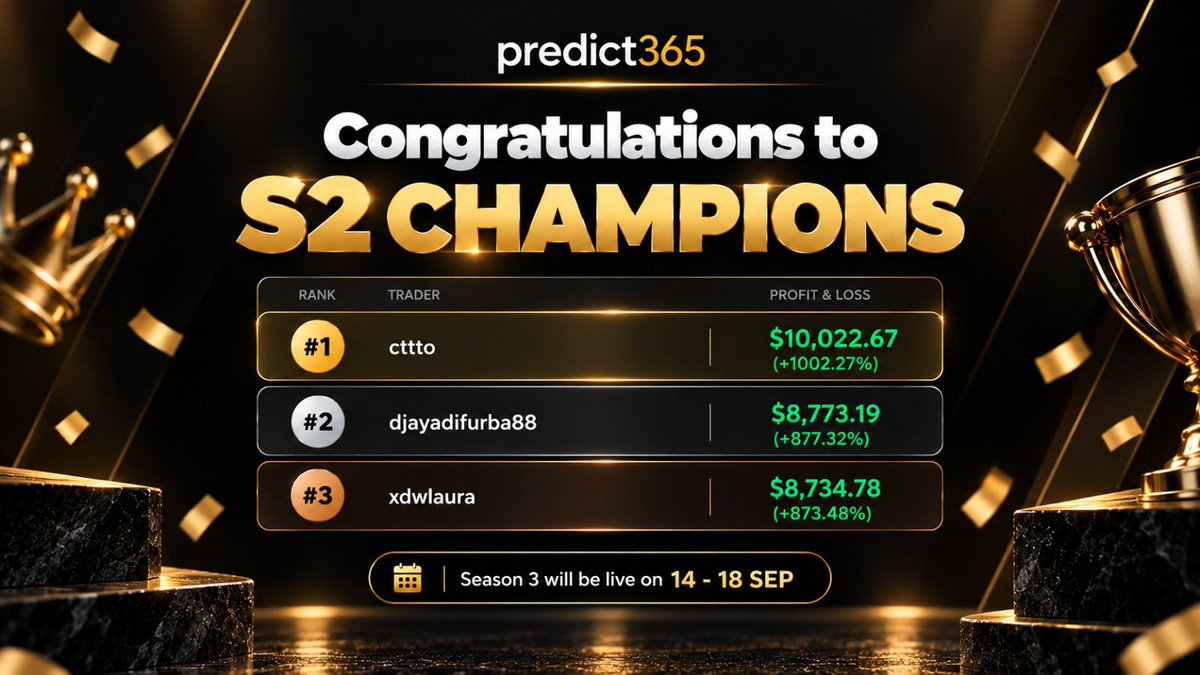
Winner’s Circle Season 2 is closed.
1st - cttto
2nd - djayadifurba88
3rd - xdwlaura
86 played
Leaderboard was public full week.
Season 3: 14–18 Sep
Join Now: https://t.co/Whj9PRISip