You will not see a better sports video today:
Kolby Branch hits a HR for Georgia in his last ever college AB. His brother, on the other team, gets to celebrate with him as he rounds the bases with parents in attendance
What a moment for this family
My husband is deployed.
I have a newborn and a toddler.
The grass in my yard was knee-high;
I just couldn’t get to it,
and I was exhausted.
I heard a mower outside at 7 a.m. on a Saturday and was annoyed.
When I looked out, I saw three teenage boys from the neighborhood.
They were mowing my lawn, weeding the flower beds, and trimming the hedges.
I ran out and asked, “How much do you charge?”
The leader, a kid named Mike, wiped his forehead and said,
“Nothing, ma’am. We saw the flag on your porch.
We know your husband’s away.
My dad was in the Marines, so we know how hard it is.”
They finished the job and even swept the driveway.
When I tried to give them money, they refused, saying,
“Just tell him thanks when he calls.”
I took a picture and sent it to my husband.
He cried and said, “These are heroes in training.” 🫡🇺🇸
🇺🇸🙏🇺🇸
In April 1972, Thomas Norris sailed straight into enemy rivers wearing a fisherman's disguise.
Command said the pilots were irretrievable.
Norris was 24, a Navy SEAL operating inside North Vietnam. Two U.S. pilots had been shot down. Patrol boats everywhere. Checkpoints on every river bend. Enemy soldiers hunting them day and night. Rescue planners called it impossible.
Norris volunteered.
He moved at night through swamps and jungle with South Vietnamese commandos. Lt. Col. Iceal Hambleton had survived 11 days alone behind enemy lines. Norris found him, hid him, and guided him through darkness to the Cua Viet River. A U.S. ship pulled them out alive.
Then Norris went back.
Deeper. Harder. More patrols.
With Nguyen Van Kiet, he located Lt. Mark Clark and brought him out under increasing enemy pressure. Two men saved from certain capture.
For that, Norris received the Medal of Honor.
Six months later, October 31, 1972, his recon team was ambushed by 50 to 100 North Vietnamese soldiers. Norris was shot in the head. His skull fractured. His left eye destroyed. He collapsed and was presumed dead.
One man refused to accept that.
Mike Thornton ran back through gunfire, lifted Norris onto his shoulders, fought to the ocean, and swam 2 hours under fire until a U.S. ship reached them.
Norris survived. Metal plate in his skull. Lost eye.
Years of recovery.
The only time 1 Medal of Honor recipient saved another.
Most people still have no idea who Thomas Norris is.
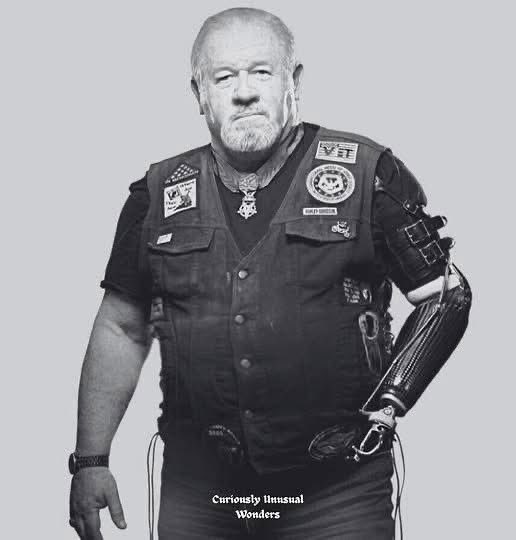
He tucked his severed arm into his waistband and kept firing—then what happened next will break you.
January 8, 1968. A rice paddy in Vietnam.
Twenty-year-old Gary Wetzel looked down at his body and saw the impossible.
His left arm was hanging by threads of flesh. His right arm was shredded. His chest was torn open. His leg was bleeding into the muddy water.
Two enemy rockets had just exploded inches from where he stood as a door gunner. The blast had hurled him out of his helicopter and into the paddy below.
Most men would have died from shock alone.
Gary Wetzel stood up.
His helicopter crew was part of the 173rd Assault Helicopter Company, inserting troops into what had become a kill zone. The moment they touched down, enemy fire erupted from every direction. Then the rockets came.
Now, bleeding out in a rice paddy, Gary realized something through the haze of agony: his machine gun was the only weapon still hitting the enemy position. American troops were pinned down. Men were dying. That automatic weapons emplacement had to be silenced.
And he was the only one who could do it.
Gary climbed back into his gun well.
He took his left arm—useless, nearly severed, hanging by skin and muscle—and tucked it into his waistband to get it out of the way.
Then, using his mangled right arm, he grabbed his machine gun.
And he opened fire.
The pain should have killed him. The blood loss should have knocked him unconscious. The shock should have shut his body down.
But Gary Wetzel kept firing.
He stayed at that gun until he eliminated the enemy emplacement that was slaughtering his brothers. Only then—only then—did he try to tend to his wounds.
He attempted to reach his aircraft commander, who was also badly hit. But his body had finally reached its limit. He collapsed, unconscious.
When he woke up—minutes or hours later, he couldn't tell—his first thought wasn't about survival.
It was about his crew.
Gary began dragging himself, inch by agonizing inch, across that rice paddy toward where his crew chief was trying to pull the wounded commander to safety.
He passed out from the effort.
He woke up.
He kept crawling.
When he finally reached them, Gary helped move the commander behind a dike. Then darkness took him again.
The next morning, rescue forces found Gary Wetzel barely alive. He'd been on the critical list for a week.
Doctors amputated his left arm in a field hospital. Infection set in. He needed another surgery in Tokyo, where physicians removed over 400 stitches and fought to keep him breathing.
But here's the part Gary remembers most.
While recovering in that Tokyo hospital, some of the men he'd saved—the soldiers whose lives he'd bought with his blood and his arm—found out he was there.
They walked up to his bed, one by one.
"Are you Gary Wetzel?"
"Yeah."
And they pulled out photographs. Wives. Children. Girlfriends waiting back home.
"Hey, man," they'd say, tears streaming. "Because of you, this is what I've got to go back to."
That's when Gary understood.
Not just in military terms—enemy eliminated, mission successful, lives saved.
But in human terms.
Families that would stay whole. Children who would grow up with fathers. Love stories that would continue. Futures that would happen.
November 19, 1968: President Lyndon B. Johnson pinned the Medal of Honor on Gary Wetzel's chest at the White House. He also received the Purple Heart and Air Medal. He was promoted to Specialist Four—a rank earned in the most brutal way imaginable.
After five months in hospitals learning to live with a prosthetic arm, Gary returned to South Milwaukee, Wisconsin. He went to work as a heavy equipment operator—a job that requires two hands.
Except Gary figured out how to do it with one and sheer determination.
He married Kathy. He raised a family. He lived quietly, never seeking attention.
But Gary Wetzel has never stopped serving.
On May 2, 1968, near the Cambodia-Vietnam border, a 12-man reconnaissance team was pinned down in the jungle, surrounded and cut apart by enemy fire.
Their radio calls to base were frantic: "Get us out. We're dying."
Three helicopters had tried to rescue them but were driven back by intense gunfire. Command braced for the worst.
Staff Sergeant Roy Benavidez, a Special Forces soldier, overheard the pleas. Unassigned to the mission, he grabbed a medical bag and knife, then jumped onto the last helicopter heading out.
The crew chief yelled, asking about his rifle and gear. Roy pointed to the jungle.They reached the chaotic clearing—a killing field of muzzle flashes. The pilot couldn't land safely.Roy leaped out anyway, running 75 yards through bullets. One hit his leg; another shattered his jaw. Blood filled his eyes.
He kept going.
Reaching the team, he found dead and wounded scattered, ammo low, perimeter collapsing.
Roy took charge: he dragged wounded to cover, redistributed ammo, and called in dangerously close air support. Shrapnel tore into his back and limbs, but he rose each time.When the helicopter returned for extraction, Roy carried men through thick fire—one by one. More bullets and a grenade blast struck him. He staggered on.
An enemy soldier bayoneted him at close range. Roy wrested the blade free and fought hand-to-hand.Then he continued loading the wounded.
Only after all survivors were aboard did he board himself.
He'd fought for hours, shot multiple times, cut and torn open. On landing, medics thought him dead amid the blood and dirt.
They zipped him into a body bag.
But Roy was conscious. Gathering his last strength, he spat blood.The doctor recoiled: "He's alive!"
Roy was rushed to surgery. Recovery was grueling; doctors doubted he'd walk normally. He defied them, pushing through rehab step by step.
He'd sustained 37 wounds from bullets, shrapnel, and blade. Every man he saved survived.
Years later, President Ronald Reagan awarded him the Medal of Honor. The citation took minutes to read.
Roy said he wasn't seeking glory—just helping men who needed it.
The body has limits: it breaks, bleeds, shuts down.
But the will can defy them.
In that body bag's darkness, Roy found one final act of defiance.
It was enough.
A Japanese Manager Once Told Me: “We Fire Employees Who Arrive on Time.”
I laughed.
Then he explained why—and it completely changed how I see success.
I first heard this in Tokyo during a business dinner.
I asked why being late is such a serious offense in Japan.
He replied calmly:
“We don’t fire the late ones. We fire the ones who arrive exactly at the start.”
The table went silent.
In my culture, arriving right on time means:
• responsible
• disciplined
• professional
In his culture? It means passive.
He explained:
“If you arrive at 9:00 sharp, you’ve waited until the last possible second.”
That tells us something important.
It tells us you didn’t plan for:
• traffic
• delays
• uncertainty
• responsibility beyond yourself
And if you don’t plan for uncertainty… you can’t be trusted with systems.
He said something I’ll never forget:
“Only the weak arrive in the last minute.”
Not because they’re lazy—but because they think in limits, not margins.
Japanese companies don’t value accuracy.
They value anticipation.
A professional arrives early to:
• settle the mind
• read the room
• prepare mentally
• show readiness
Not to rush in out of breath.
That idea stayed with me.
And once I noticed it… I couldn’t unsee it.
The most successful people everywhere, no matter within which country:
• arrive early
• stay calm
• observe first
• speak last
They’re already present before others even enter.
They build trust before the meeting begins.
They notice details others miss.
They create opportunity before others react.
That edge compounds.
Showing up early isn’t about time.
It’s about mindset.
Exactly on time says: “I did the minimum.”
Early says: “I came prepared for reality.”
Business, and life, require margin.
When someone says, “But I came on time,”
I no longer hear discipline.
I hear the limit of their thinking.
Japan understood this long ago:
Success begins before the clock starts.
Will Americans and Germans and many others relearn these self-explanatory principles?
The question going forward is:
Will YOU continue with the behavior of the Have-Nots, or choose the behavior and success of the Have-Yachts?
Bitcoin. 🟠
In case you missed it, Chevrolet released a Christmas ad this season that will give you chills from start to finish.
An absolute must-watch.
Every second reminds you why family is everything…
Master Gunnery Sergeant Peter Wilson—You haven’t truly felt the Star-Spangled Banner until you’ve heard it played by him on his violin. 🎻 🇺🇸
Trust me, nothing else even comes close. Goosebumps guaranteed. 🫡
Greg Maddux Intentionally hitting Benito Santiago in 1987...
And getting sent to the Minor Leagues after the game.
"That was way more valuable than any win I could've ever gotten."
@HartsvilleSBC Thank you, I was humbled and honored, but honestly I was just one of a bunch of people who loved their kids and loved baseball back then and we all worked hard to make the Northern league the best! These days I just do what I can to help when they need me ❤️